

What’s a local dollar really worth? Made in KC launches study to find hard value behind ‘shop local’ mantra
April 3, 2020 | Austin Barnes

“Shop local” used to be a throwaway term for the owners of Made in KC.
“We didn’t really know the true value of shopping locally. Spoiler alert: We still don’t know,” said Tyler Enders, co-founder of the local retailer and meca for makers looking to establish a distribution footprint.
What’s it worth? Take the survey
Business owner or founder? Click here to complete the Made in KC survey and help the company reach its goal of engaging with 50 local businesses.
Now, Made in KC is cracking down on the term, committing to understanding the true value of shopping small and the impact each dollar spent in Kansas City has on the local economy, Enders explained.
“We didn’t know how much better it was to buy a candle from us versus a candle at Yankee Candle, a card from us versus a card at Target, a coffee from us versus a coffee at Starbucks,” he said of the company’s lack of understanding and growing curiosity for what they could do to elevate small business support in the City of Fountains.
“What if it was only slightly better? Or what if this unquestioned notion that, ‘Shopping locally is good,’ was actually a misconception?” Enders pondered.
A newly launched survey which asks business owners to give insight into sales, costs, and payroll information is already answering the question for the Made in KC team, which has partnered with Civic Economics — the go-to source for civic research, Enders noted — to finance a study that could identify the impact of Kansas City-made retailers versus big box stores and chains.
Business owner or founder? Click here to complete the Made in KC survey and help the company reach its goal of engaging with 50 local businesses.
“What I’m really excited about is conducting our own research. This will be a long process — multiple years — but I intend to kickstart a new generation of shop local research,” Enders said, noting Made in KC is also working to overhaul Civic Economics outdated methodology.
“Right now, the existing data and studies can’t tell us the value of having a local landlord versus a non-local one. The existing research can’t differentiate between giving a high-net worth person a check for $2,000 a month versus giving a low-income worker a check for $2,000 a month,” he said, offering examples of the gap in data. “We don’t know whether a barbershop that does $1 million in annual revenue is more impactful than a restaurant that does the same revenue or a bookstore.”

Kansas City, March 2020
An emphasis on investigating such numbers could ultimately produce results for Kansas City business owners in the form of civic support, Enders noted.
All data collected — which will remain private, with identifiers shared only with Civic Economics and not Made in KC directly — is expected to be distributed to such groups as the Economic Development Council of Kansas City, Missouri (EDCKC), Port KC, and the office of Mayor Quinton Lucas and the KCMO city council, he added.
Already in the know For every $100 spent at a local store, $58 is recirculated into the local economy, existing Made in KC research revealed. $31 is injected from non-locally owned companies.
“We predict that Kansas City metrics will follow those of other cities in which local businesses recirculate roughly twice as much per dollar of revenue in the local economy in comparison to national counterparts,” Enders said.
While data pours in, Made in KC research has already identified that national chains are pulling money from the local economy, creating a net loss of wealth, the company outlined in a statement on its website.
“Locally-owned businesses generate economic value for the community. That’s a staggering reality that bears repeating: national chains have a negative effect on our local economy while local, independently-owned shops generate value for the local economy,” the statement read.
For every $100 spent at a local store, $58 is recirculated into the local economy, existing Made in KC research revealed. $31 is injected from non-locally owned companies.
“Made in KC recirculates over $93 back into the local economy for every $100 spent at our stores. That’s because we not only employ locals, but we buy all our products from local companies, and choose local partners whenever possible — from banking to legal to accounting to printing,” the company said.
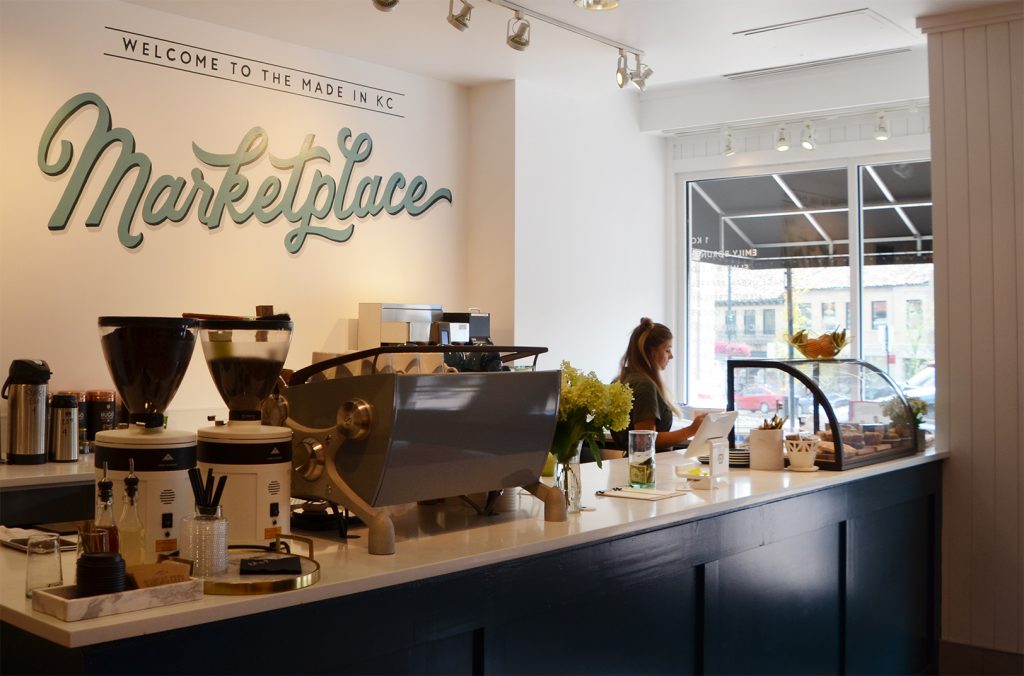
Made in KC Marketplace
And as the city braces for a potential downturn in the days of the Coronavirus (COVID-19) pandemic, research on the impact of shopping locally could be more important than ever, Enders said.

Made in KC Cafe
“We’ll try to uncover it as quickly as we can and produce some sort of digestible report as quickly as possible,” he said, noting an outpouring of support on social media could ultimately prove its own impact in long term support for small businesses.
As a result of the health crisis, Made in KC closed its six Kansas City retail shops in line with local government Stay At Home orders.
“It does hit us disproportionately hard, in that if you think about a sales cycle for a retail business versus a larger company, your sales cycle is multiple times a day or daily,” he explained.
“Three of our locations have a coffee shop and bar. … So it’s that cup of coffee or someone coming in and buying a gift versus someone who’s working on a large construction project or who has longer term commitments,” Enders explained. “We have a really short cycle and I think that’s why we’re seeing so many small retail businesses really in a tough spot.”
Click here to find out how you can support local restaurants affected by the COVID-19 pandemic.

This story is possible thanks to support from the Ewing Marion Kauffman Foundation, a private, nonpartisan foundation that works together with communities in education and entrepreneurship to create uncommon solutions and empower people to shape their futures and be successful.
For more information, visit www.kauffman.org and connect at www.twitter.com/kauffmanfdn and www.facebook.com/kauffmanfdn

Featured Business

2020 Startups to Watch
stats here
Related Posts on Startland News

Rack Performance beefs up with seed investment from former Perceptive Software execs
Lenexa-based Rack Performance has raised a seed investment round that will fuel the exercise tech startup’s sales and development. Rack Performance has raised $300,000 from perceptiveEQUITY, a new early-stage investment firm that’s managed by three former executives at Lenexa-based Perceptive Software, which was purchased by Lexmark International for $280 million in 2010. Lexmark recently sold…

Six takeaways from the digital transformation at Hallmark
It’s not just tech startups that innovate and disrupt. One of the Kansas City area’s largest firms, Hallmark Cards, recently launched a digital transformation. In 2015, the greeting card giant funneled thousands of products that were popular on the shelves to online sales. The firm also updated its social media practices to attract younger customers.…

Report: Kansas City’s tech workforce is growing faster than most big cities
Techies around the nation have flocked to Kansas City at a rate faster than many major cities, including New York City, Chicago, San Diego and others according to a recent report. CBRE’s annual Tech Talent Report found that between 2011 and 2016 Kansas City’s tech workforce grew 39 percent, adding about 15,000 new tech staffers…

How the Kansas City Chiefs became the No. 1 NFL team in social engagement
Most Kansas City Chiefs fans are likely aware that they hold the Guinness World Record for the “loudest crowd roar at a sports stadium.” But what fans may not know is how that same enthusiasm and energy translates to the Kansas City Chiefs’ social media engagement. Using a variety of platforms, the team’s social media…