

Now is not the time to be timid: Adapting KC’s spirit to confront COVID-19
April 9, 2020 | Dennis Ridenour
Editor’s note: The opinions expressed in this commentary are the authors’ alone. Dennis Ridenour is president and CEO of BioNexus KC.
Kansas City is a unique and extraordinary city. There is no doubt. We celebrate a successful corporate landscape highlighted by world class companies including Hallmark, H&R Block, Garmin, Sprint, Cerner and many others. The success of these companies over the years has created incredibly generous homegrown philanthropists, who have sought to reinforce Kansas City’s position as a leading metropolitan area.
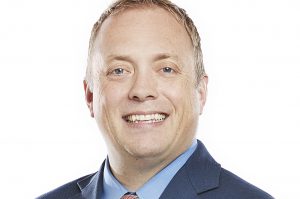
Dennis Ridenour, BioNexus KC
The KC region is a leader in research relevant to both animal and human health. We’re home to the Animal Health Corridor, the largest concentration of animal health companies in the world, and also to a vibrant human health industry segment — including major research universities and hospitals, the headquarters of companies like Cerner, Netsmart and Garmin and the presence of significant companies like Quest Diagnostics, Catalent Pharma Solutions, and PRA Health Sciences.
The COVID-19 crisis highlights the need for our civic passion and generosity to align with our region’s research strengths and experience to positively impact and inform the way we respond and potentially prevent the next pandemic.
Never have we experienced disruption like what has unfolded as COVID-19 has spread worldwide. Despite ample warning for the U.S., we have largely failed in adequately protecting our citizens and controlling the spread of COVID-19. We have seen metropolitan areas march through the same progression of increasingly tightened restrictions: starting with social distancing and ultimately ending in stay-at-home orders. While most major cities went through some iteration of this procedure, COVID-19 has defied their best efforts and altered our way of life.
Much of the current focus is on the response of our healthcare system and providing relief for those businesses impacted by this pandemic. These considerations are critical, and our region is benefitting from well-coordinated and publicized efforts on both fronts, though there is much still to do.
What we’re not hearing about is how our city could better embrace innovation and use it to flatten the curve, improve our response for regional patients, and prevent Kansas City from becoming the next Seattle or New York. We’ve already seen incredible examples of unique and innovative approaches taken by corporate and civic leaders in Kansas City, including the launch of the COVID-19 Response Accelerator by Black & Veatch and the Economic Development Corporate of Kansas City and the work of a local group of business leaders to purchase 50,000 test kits and two machines to process the tests.
But much more can be done. The KC region has the opportunity to construct the most innovative civic response to COVID-19. If we are going to be the “Most Entrepreneurial City in America,” then now is not the time to be timid. Now is the time to double down on our region’s collaborative and innovative nature to accelerate the translation of research into impactful treatments and technologies. We need our region to build out the infrastructure to rapidly and effectively identify the most promising regional technologies, introduce them to the most valuable connections, and streamline the process of generating preliminary data.
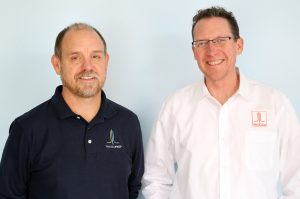
Andy Page and David Alburty, InnovaPrep
And Kansas City is ripe with companies, big and small, whose technologies could make a difference in the battle against COVID-19:
- InnovaPrep – A company in Drexel, Missouri, that has developed a coronavirus airborne detection system
- TripleBlind – A Kansas City company that has developed a privacy-first app that allows for contact tracing to help track exposure to COVID-19.
- Clara Biotech – A Lawrence biotech startup that has an exosome technology that could reduce the severity of COVID-19 lung infections
- Numerous other examples, including Viracor Eurofins, Redivus Health, MAWD Pathology, SickWeather, MRIGlobal, iShare Medical and others.
On Friday, April 10, BioNexus KC will host Convene KC, a virtual event series designed to spotlight those working on the frontlines and to describe initiatives, resources and technologies in the KC region that could positively impact both our response to COVID-19 and for life after COVID-19. This is an important step in growing community-wide awareness of the challenges we face, and in identifying the opportunities to use our regional strengths to develop unique and innovative solutions. With our rich history of fostering successful collaborations and our regional network of both researchers and clinicians, BioNexus KC is the right organization to host this community discussion.
We already know what some of these opportunities look like. For example, BioNexus KC has supported the Kansas City Quality & Value Innovation Consortium (QVIC), an existing collaboration that is committed to improving the value of healthcare in the KC region and that hopes to serve as a vehicle for more rapidly testing the effectiveness of new innovations for healthcare delivery. Currently, hospitals are overwhelmed by COVID-19; they simply don’t have the bandwidth to properly assess the outcomes associated with various treatments or to share best practices and lessons learned with other regional hospitals. With funding, the QVIC could step in to play the role of researcher for hospitals and quickly identify the most effective treatments and workflows.
But this effort is bigger than BioNexus KC and the QVIC, and it requires more than just funding. It requires a network of experts that can identify a variety of the most promising technologies. It needs a group of highly connected and politically savvy professionals that can accelerate the path of these technologies by providing community-wide connectivity and access to providers, patients, data and support organizations. And it requires a community that embraces a unique but potentially game-changing effort.
If we can successfully use the KC region as a proving ground for innovative technologies and approaches for battling COVID-19, we could build a healthcare innovation infrastructure that could benefit our region for decades, while simultaneously benefitting its citizens. What an amazing story it would be — a region convening its most innovative and entrepreneurial minds to combat COVID-19 in a way that isn’t being done in any other city in the world.
It’s time to roll up our sleeves.
Dennis Ridenour is president and CEO of BioNexus KC, a global leader at the nexus of human and animal health with a focus on human and economic impact.

Featured Business

2020 Startups to Watch
stats here
Related Posts on Startland News
Kauffman CEO: Foundation’s reset aligns Mr. K’s intent with KC’s needs of the moment
A recently announced strategy refresh for the Ewing Marion Kauffman Foundation will drive the organization’s collective impact in the community — honoring the vision of its namesake while recognizing the challenges Kansas City faces today, said Dr. DeAngela Burns-Wallace. “Mr. K had very distinct philosophies and ideas around how he wanted this work done,” explained…
Block by block: Prototype builds startup’s housing vision where everyone can afford their own castle
A mock home facade project on the grounds of Kansas City’s historic Workhouse Castle serves as a proof point for Godfrey Riddle’s rebooted Civic Saint — a social venture built on compressed earth blocks as its key to affordable, sustainable housing. “CEBs (compressed earth blocks) are great for Kansas City, because non-expansive sandy clay soil…

Resource revival: Digital Inclusion Fund relaunches with initial grants focused on devices
Kansas Citians can’t upgrade skills or devices they don’t already have, said organizers of a newly relaunched Digital Inclusion Fund — emphasizing a need to attack the metro’s digital divide at the infrastructure level. The fund is set to award up to $250,000 to 501(c)(3) public charities (including schools and churches) or governmental entities across…
New deal with lightwell keeps WeWork in Kansas City after closing Corrigan Station space
A freshly negotiated lease agreement with the developer behind the lightwell building in downtown Kansas City means WeWork will continue its two-floor coworking and flexible office space operation in the heart of the city’s central business district. WeWork has officially completed its lease rationalization with the assumption of its lightwell location contract, the company said…