

Facebook-bound software engineer: Senior year at MIT ‘ripped away’ by COVID-19
March 27, 2020 | Austin Barnes
Editor’s note: The following is part of Startland News’ ongoing coverage of the impact of Coronavirus (COVID-19) on Kansas City’s entrepreneur community, as well as how innovation is helping to drive a new normal in the ecosystem. Click here to follow related stories as they develop.
A global pandemic and social distancing weren’t part of the plan when Nic Rodriguez envisioned his senior spring at the Massachusetts Institute of Technology (MIT).
“I think everyone kind of went into shock,” Rodriguez, an Olathe native who has interned for area startups TripleBlind and EyeVerify, said of the day he and his classmates learned they’d be forced out of the university’s Boston campus because of spreading Coronavirus (COVID-19) concerns.
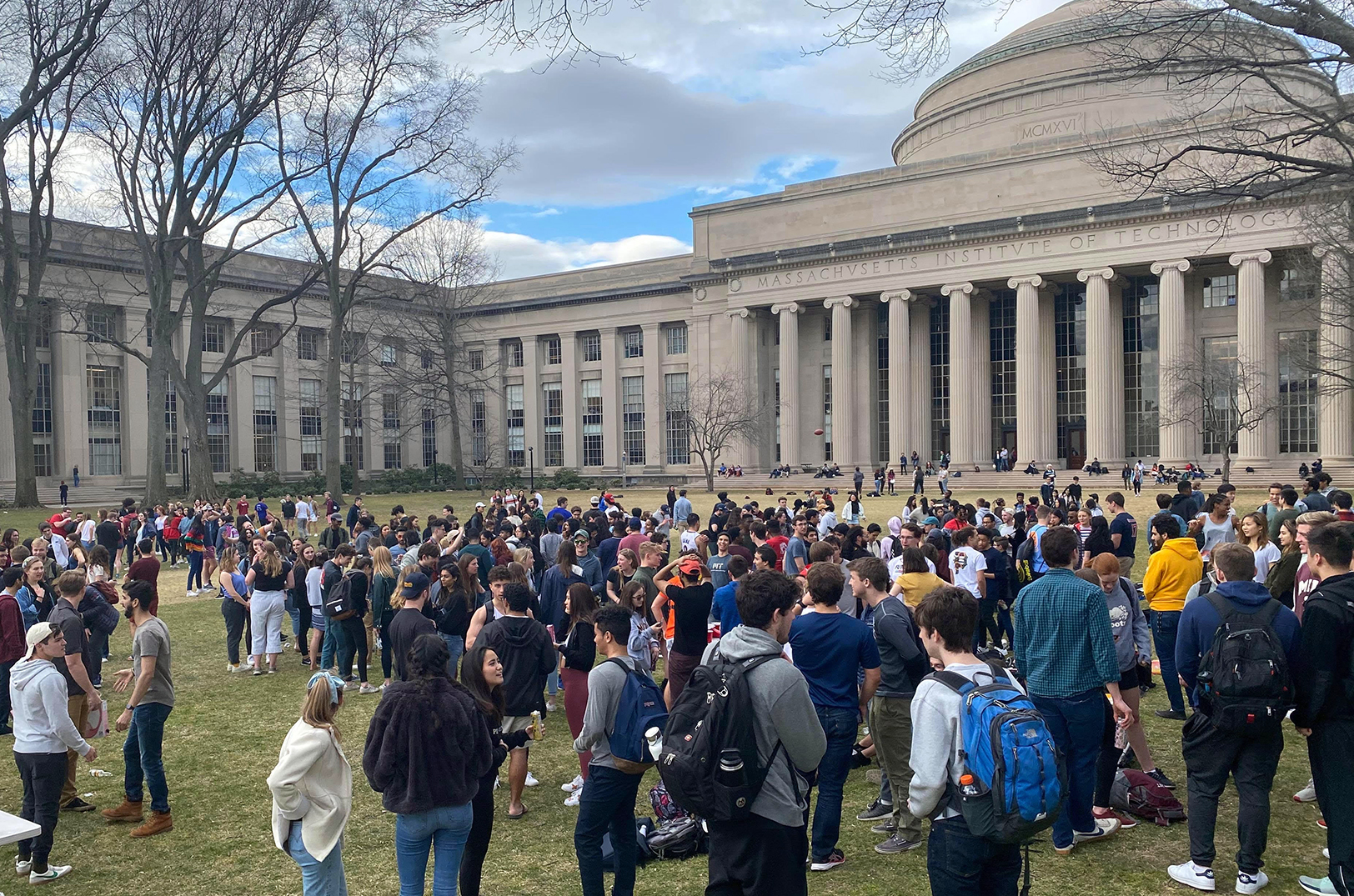
MIT students gather on campus before being sent home because of COVID-19 concerns
It was a scene that played out across the country this spring as news of the outbreak’s severity began to intensify.
“There had been some rumors flying around among the senior class that MIT was going to shut down … but nothing was confirmed. We were all kind of thinking, ‘That’s ridiculous, but wouldn’t that be so fun,’ not really understanding the gravity of the situation,” he said of the health crisis which unfolded rapidly and ultimately saw him on a plane back home to Kansas City.
“It was a really strange feeling because you have this expectation that you’re going to have another three months of spending time with your friends and you’re finally cooling down after three-and-a-half years of hard school work,” Rodriguez said.
“To have it all ripped away with just one email was shocking to say the least.”
Quick parties and rushed goodbyes, Rodriguez can’t help but feel like he was robbed of key rites of passage in his college experience, he said.
“MIT wasn’t even a place that I thought I could get into in the first place,” he said recalling his on-campus experience, which will culminate online beginning next week.
“I think in terms of mentally, emotionally growing and figuring out how to do the whole adult thing … having that chance to stand up on the stage and walk across and kind of close out that chapter in my life was going to be a big moment for me. … I wish it didn’t end up like this.”
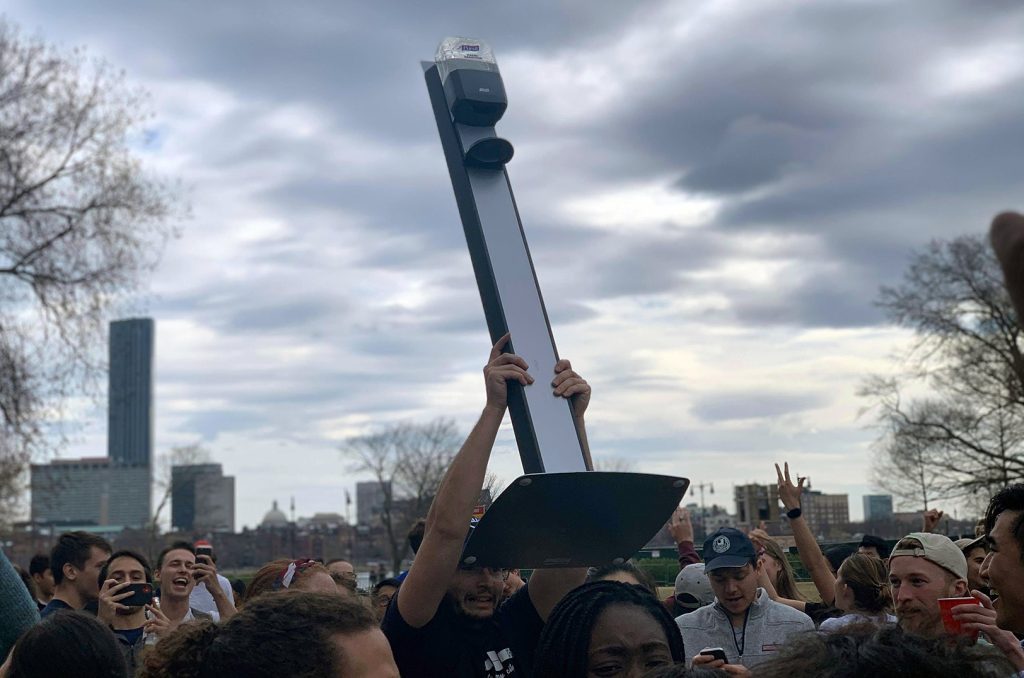
MIT students gather on campus before being sent home because of COVID-19 concerns
With newfound free-time — the result of an extended spring break — Rodriguez is spending his days reconnecting with TripleBlind and EyeVerify colleagues who recently deployed a COVID-19 tracking app (built alongside a team at MIT and Harvard) that could soon receive the endorsement of the White House.
“I got a text from [the TripleBlind team] and they proposed this idea to me and it seemed perfect,” he said of his experience helping with the Coronavirus exposure tracker, Private Kit: Safe Paths. “I have been able to work on it a little bit when I’ve had the time and been fun. It is a good distraction. But also, it feels like you’re helping the cause in some way, even though it may or may just be in terms of writing some code.”
Click here to read more about the TripleBlind response to COVID-19.
The experience will serve as a resume booster for Rodriguez who’s already secured a job at Facebook once he finishes classes.
“[I’ll be] in New York at the end of August and I recently received an email that I don’t have to worry about that changing. So that’s one bright side,” he said, eager for the world to return to normal and optimistic that his generation would take the threat of COVID-19 seriously.
“I wouldn’t even know how to communicate to those people [who are ignoring warnings] how serious it is. I mean, all you have to do is look at Italy as the best example of what the United States could be soon if we’re not taking it seriously,” he said in response to news reports of college students partying for spring break and laughing off social distancing measures on social media.
“No matter how unfortunate the situation is and how disappointed I am with the outcome [of classes being canceled], in a sense, I understand we have to do this,” Rodriguez said. “I’m missing out on a big, important part of my life. But at the end of the day, [a few months] in the long run isn’t too bad if we can save some lives.”

This story is possible thanks to support from the Ewing Marion Kauffman Foundation, a private, nonpartisan foundation that works together with communities in education and entrepreneurship to create uncommon solutions and empower people to shape their futures and be successful.
For more information, visit www.kauffman.org and connect at www.twitter.com/kauffmanfdn and www.facebook.com/kauffmanfdn

Featured Business

2020 Startups to Watch
stats here
Related Posts on Startland News

Addressing a market gap, $25M seed fund arrives in Kansas City
Nearly a year after identifying an early-stage funding need in the area, a $25 million seed fund will open a Kansas City office that aims to boost local startups. With a Wednesday night intro at Polsinelli, the Royal Street Investment & Innovation Center will soon move into the Kansas City metro for its second fund. Founded…

Mid-America Angels’ injects $2.8M into nine startups during 2015
The Mid-America Angels, a Kansas City area-based angel investor network, closed 2015 on a high note with more than $2.8 million invested in nine ventures. The 2015 investment total is a near-20 percent increase in capital from 2014’s roughly $2.3 million invested. Rick Vaughn, the MAA’s managing director, said last year also was the most…

An insider’s guide to the 2016 Pipeline IOTY
One of the region’s most highly-esteemed and exclusive events — Pipeline’s Innovator of the Year — is set for this Thursday in Kansas City. Attracting some of the most powerful businesspeople in the Midwest, IOTY is one part pitch competition, two parts black-tie gala and four parts party. It’s a cocktail of entrepreneurial energy, and…

Digital Sandbox KC funding three UMKC student-led startups
Kansas City business incubator Digital Sandbox KC selected three student-led companies for proof-of-concept funding support Tuesday. The enterprises were selected from the University of Missouri-Kansas City’s E-Scholar program and will join three other E-Scholar companies selected in June as part of Digital Sandbox’s partnership with UMKC. Each student startup will receive $10,000 in project development…