

White House expected to endorse Kansas City-built COVID-19 exposure tracking app
March 19, 2020 | Austin Barnes
Editor’s note: The following is part of Startland News’ ongoing coverage of the impact of Coronavirus (COVID-19) on Kansas City’s entrepreneur community, as well as how innovation is helping to drive a new normal in the ecosystem. Click here to follow related stories as they develop.
The White House is expected to announce its support for a new Coronavirus (COVID-19) tracking app in the coming days, curated — in large part — by Kansas City tech minds, revealed Greg Storm.
But is privacy
at risk?
“The risk of [users] losing privacy over their data is so small as to be insignificant as compared to the potential good collecting this data can do. If we collect enough data on where the virus is and where it is not, we’ll all be smarter on how to stay safe. If we all choose to be private and not share anything, we’re going to continue to fly blind.”
— Greg Storm, COO, TripleBlind
How it works: The backend of Private Kit: Safe Pathways uses Triple Blind to encrypt location data that is shared between phones and bypasses central authority.
Click here to read more about the data science behind the app.
“They told us, ‘As soon as you’re ready, let us know,’” Storm, COO and co-founder of Kansas City-based TripleBlind, said of the nation’s support for Private Kit: Safe Paths — a free app designed to track its users locations, keeping logs of where they’ve been in recent days, should they test positive for Coronavirus.
The City of Kansas City, Missouri, is in discussions to join a pilot for the app, along with Boston and Washington D.C., TripleBlind told Startland News.
Storm and his colleagues at TripleBlind — a newly launched startup designed to provide data privacy in various data markets — had been working closely with Ramesh Raskar, professor and renowned data scientist at the Massachusetts Institute of Technology (MIT) Media Lab, to develop various features and functions for the company.
Focused on growing their KC startup, Storm and Riddhiman Das, CEO and co-founder, were caught by surprise when they learned the philosophy behind TripleBlind had been pitched by Raskar as an idea in a brainstorming session on Coronavirus combat, initiated by Vice President Mike Pence in late February.
“He was at a [healthcare providers] conference in Florida and it happened to be the day that Mike Pence was announced as the U.S. lead in fighting Coronavirus,” Storm recalled.
“One of [the vice president’s] guys’ was in the room and he stopped the conference and said, ‘Hey, my boss just got this responsibility … What can you guys in this room do to help?’” he explained, noting the ask ultimately set a whirlwind of events into motion.
“[Raskar called us and said,] ‘Hey this is the first time in the history of pandemics that everybody’s carrying around a phone and a key to fighting this thing will be to know where it is and who has it, and we can use phone location to track the virus,’” he said.
Backed by MIT with assistance from Harvard, the team quickly began to develop Private Kit, but noted a need for as many experienced developers as possible to deploy on the project.
Global team with distinct KC identity
Both founding teammates who exited Kansas City’s famed EyeVerify, Storm and Das called on expertise from former colleague David Biga, most recently founder of Particle Space, who was uniquely positioned to tackle the short runway needed to develop the app.
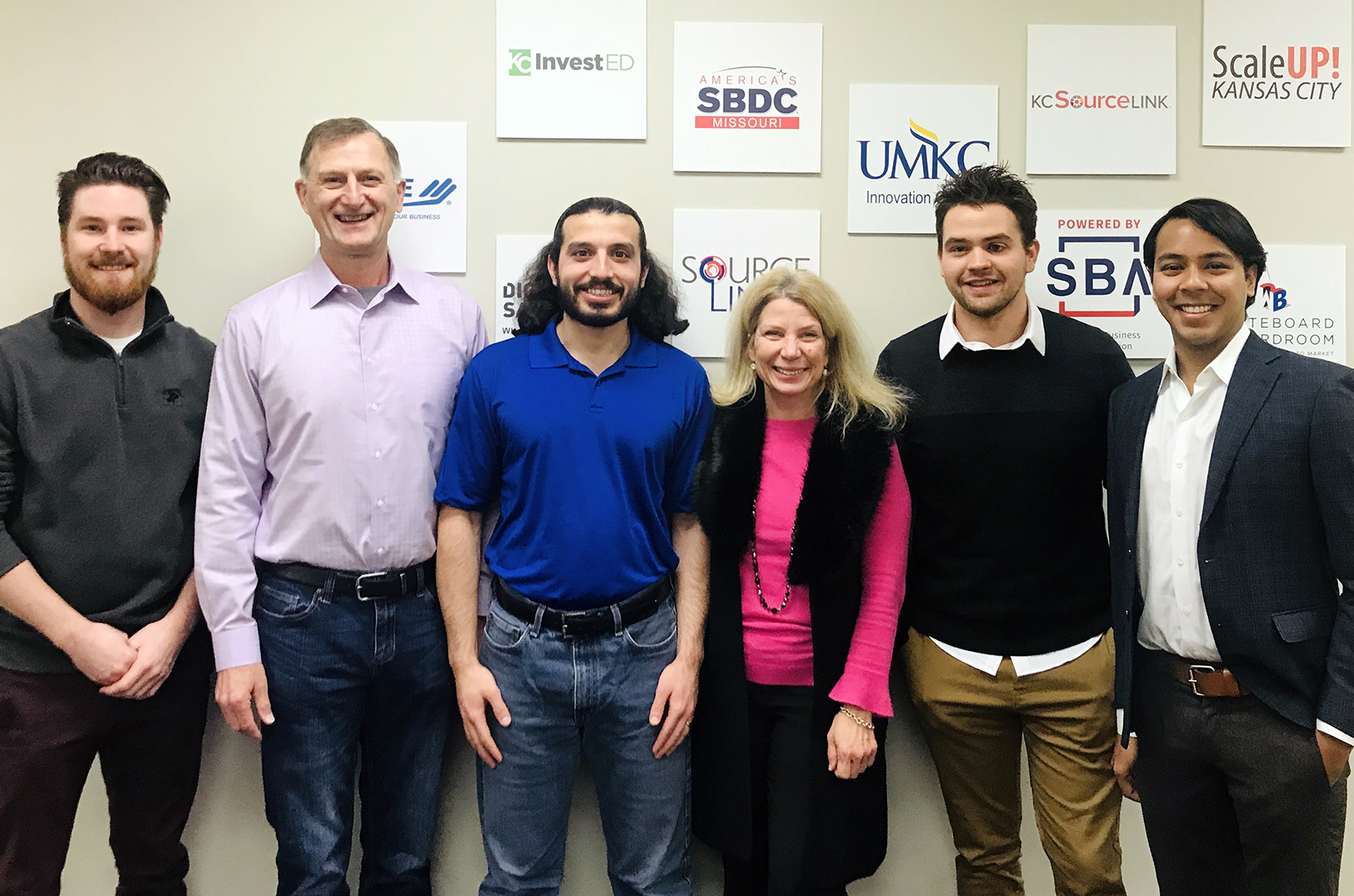
Digital Sandbox KC, Q4, 2019: Jerry Workman, Destiny; Greg Storm, TripleBlind; Hasan Ali, B!TLab Innovations; Jill Meyer, Technology Ventures UMKC Innovation Center; David Biga, Particle Space; and Riddhiman Das, TripleBlind
“I loved the idea of being able to use my skills in programming and contributing to a needed cause to help make a difference,” Biga said of the role he’s played in the development of Private Kit within the last two weeks.
“… I want to do whatever I can to help us get over this pandemic quickly so we can get back to normal operations of growing our companies and communities [in Kansas City],” Biga said.
Click here to find out how Biga and Particle Space are responding to COVID-19.
Private Kit has also leaned on support from volunteer developers around the globe, Storm noted.
In recent days, Private Kit has gained support from the World Health Organization, the Department of Health and Human Services, the Centers for Disease Control, and the foreign governments of Spain, Italy, Chile, and India.
Not blind to distraction
As the development team prepares for its latest government endorsement of the app — this time on U.S. soil — Storm is reflective; eager to watch Private Kit save lives, while riding a line of uncertainty for the future.
“Look for opportunity, but know why you’re pursuing the opportunity,” he said, offering advice to other founders who might also find themselves in a position to pivot their companies in light of trying times.
“We’re still not entirely sure that jumping in on this opportunity is going to be good for our business. It’s a heck of an opportunity to get our name out there, a heck of an opportunity to get some worldwide exposure … all those things are good,” he said candidly.
“Since we were not planning on building an app, it is a big distraction to us. We are continuing to try to keep our eye on the ball,” Storm continued, noting ways founders across the country are faced with a dilemma in the uncharted era of pandemic, asked to use their tools and skill sets in ways they hadn’t intended.
“We’re good guys and we want to contribute and we want to do our part to fight … but if it doesn’t turn into some sort of a business opportunity for TripleBlind, it will have just turned into a big distraction,” he said, quick to reiterate his gratitude for the opportunity which could save the lives of U.S. citizens.
“If you show up as an infected person, this app is going to make your life a boatload easier. If you show up at the hospital infected and you don’t have this app — you’re going to sit through an hours-long manual interview while you try to remember where you’ve been the last 28 days,” he said, urging consumers and volunteer developers to support the project.
“If you have this app it’ll show you exactly where you’ve been in the last 28 days. You don’t have to remember anything and it will make that process much shorter and much more efficient.”

Featured Business

2020 Startups to Watch
stats here
Related Posts on Startland News

Here’s how ULAH’s new boutique model aims to rack success for local brands, not inventory debt
The new KC Collective consignment-based program for local brands at ULAH is a win for both the Westwood boutique and Kansas City creatives, said Joey Mendez and Buck Wimberly, announcing a fresh model to help the struggling store stay open and financially stable. “We’ve always had local brands,” said Mendez, co-founder of ULAH, explaining the…
Tiki Taco ticks up giving alongside expansion; CEO owns up to taco shop’s neighborhood impact model
A month-long campaign in the popular Kansas City-based chain offers easy add-on: joining KC GIFT’s network of donors Restaurant executive Eric Knott wants Tiki Taco’s operators to own the neighborhoods into which the popular taco shop expands, he said, but that doesn’t just mean dominating the fast-casual market in each pocket of Kansas City. “Our…
Kauffman Foundation announces first-ever semifinalists for Uncommon Leader Impact Award
A new leadership prize aimed at celebrating changemakers at organizations aligned with the priorities of the Ewing Marion Kauffman Foundation is closer to naming its first winner, the influential nonprofit announced Wednesday, revealing 12 semifinalists culled from more than 300 nominations. “The response from community members across the Kansas City metro area was tremendous,” said…
Main Street is already harnessing AI to build wealth; adoption now key to region’s growth, heartland leaders say
WICHITA, Kan. — Artificial intelligence is likely to be one of the most transformative technologies of the digital era, said Taylor Eubanks, noting that AI’s thoughtful deployment can be a tool for growth, not displacement. “By engaging directly with entrepreneurs, small businesses, nonprofit leaders and local innovators, we can better support responsible AI adoption that…