

Blockchain Basics: It’s more than a tech buzzword, but how does it actually work?
March 16, 2020 | Kenyon Briggs

Editor’s note: The opinions expressed in this commentary are the author’s alone. Kenyon Briggs is an attorney at Husch Blackwell in Kansas City. This op-ed is part of a limited series on blockchain sponsored by Husch Blackwell.
What is blockchain technology?
Technically precise definitions found on Google define it as “a distributed, decentralized, public ledger.” But, what does that mean?
In its most basic and general form, simply think of blockchain technology as a new method of securely storing and processing data. At its core, blockchain technology is simply a new ledger technology that can store information.

Kenyon Briggs, Husch Blackwell
Ledgers have been used throughout history to track and organize information. Think back to the years when hotels used guest ledgers to track overnight stays. Accountants used to track all of a company’s bookkeeping entries in physical books.
Speed forward a few years and ledger software like Microsoft Excel, Google Sheets, and QuickBooks, allows companies across the globe to easily organize and share vast amounts of information. Blockchain is simply a new ledger technology that can organize and store information, but in a much more secure way.
Blockchain’s ability to organize and store vast quantities of information has the potential to solve real world problems. For example, prescription drug recalls are often imprecise, and it is difficult to spot exactly where in the manufacturing and distribution chain something went wrong.
In response to this problem, IBM, the Food and Drug Administration, KPMG, Merck, and Walmart announced a collaboration to use blockchain technology to better track each drug along the manufacturing and distribution chain. The collaboration hopes to save lives and reduce waste by being able to more accurately recall defective prescription drugs.
With that understanding in mind, it is important to explain how blockchain technology works at a high level (interested readers can dive deeper here). Blockchain technology gets its name from the “chain” of information stored in “blocks” all strung together.
Let’s say you want to add and store new information on a blockchain. Before new information can be added to the chain of information (i.e., the blockchain), that information is often validated by members of the blockchain, which is also referred to as obtaining a “consensus.”
These members are referred to as “nodes,” wherein a node is a distinct computer that stores a copy of the blockchain. For most public blockchains, nodes are extremely powerful computers. In addition, larger blockchain networks may comprise tens-of-thousands of nodes spread out across the globe.
After the information to be added to the blockchain is validated, that information is packaged into an encrypted “block,” timestamped, and published onto the end of the blockchain with its own unique, encrypted serial number (called a “hash function”). Every time a new block is added to the end of the blockchain, all of the previous blocks’ serial numbers are embedded into the code of the new block. This is referred to as “chaining” blocks together.
The superior security that blockchain enthusiasts tout comes from the combination of chaining blocks together in a time-stamped manner and the “decentralized” nature of the system as the data is stored on multiple nodes across the network. “Decentralized” just means that a copy of the blockchain is stored in multiple locations and not on one centralized computer server.
The architecture of a blockchain ledger system would require a potential hacker to hack each node and change each node’s individual copy of the blockchain rather than simply hack into one server and modify the centralized copy.
In summary, blockchain technology is a new type of ledger for electronically storing data that bears resemblance to other ledger software and organizes similar types of information.
Without diving much deeper into the technical side, the key difference between blockchain technology and other types of ledger software lies in the method by which information is added to the ledger and how entries of the ledger are chained together in a time-fixed relationship. A majority of nodes/computers on the blockchain network must validate, encrypt, and chain all of the information together, which results in an incredibly secure set of information that all parties with access can trust to be accurate.
Trust can then be put in the method and authenticity of the data in the ledger due to the inherent architecture and validation mechanisms of a blockchain, rather than placing trust in individuals to enter the information correctly.
Kenyon Briggs is an attorney in Husch Blackwell LLP’s Kansas City office.

Featured Business

2020 Startups to Watch
stats here
Related Posts on Startland News
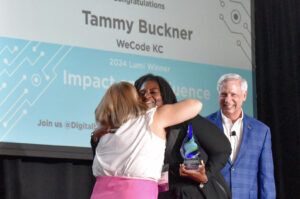
Digital Health KC debuts Lumi Awards with star-powered roster of tech honorees
Healthcare is a team sport and Kansas City has all the players, said Dick Flanigan, heaping praise on the region’s innovators at the intersection of healthcare and technology. “We have key entries in every sector, allowing us to tap into these companies and individuals to truly form a winning team,” said Flanigan, president of Digital…

World Cup will be KC’s biggest-ever event, top founder says (and local businesses can still get in the game)
When Neal Sharma co-founded DEG at the turn of the millennium, Kansas City felt like it had an inferiority complex, he said. Fast forward to 2024, and the city is teeming with extrinsic validation, he added. The exited founder-turned-civic leader hopes being a World Cup host city in 2026 pushes Kansas City to take a…

ProX names equity-centered leader as first executive director of its popular student intern program
The new leader of ProX — one of the largest paid internship programs in the country — is expected to be instrumental in taking the Ewing Marion Kauffman Foundation affiliate to the next level, said Dr. Bill Nicely. ProX and the Kauffman Foundation on Thursday announced the appointment of Solissa Franco-McKay — a longtime supporter…

How an animal health leader’s $130M investment in KC will boost its fight against canine parovirus
ELWOOD, Kansas — A $130 million investment from global animal health leader Elanco is a testament to Kansas’ pro-business economy, said Laura Kelly, lauding this week’s expansion announcement and its plans to bring 70 new jobs to the region’s animal health corridor over the next two years. “Elanco’s expansion not only is creating new job…