

How many fans packed parade route for Chiefs? Crowd counting a touchdown for KC’s EB Systems
February 15, 2020 | Austin Barnes

While a sea of red greeted Chiefs players Feb. 5 outside Union Station, many fans skipped the official victory rally honoring the world champion football team — opting instead to fight for their right to party nearby, according to crowd data from an emerging Kansas City startup.
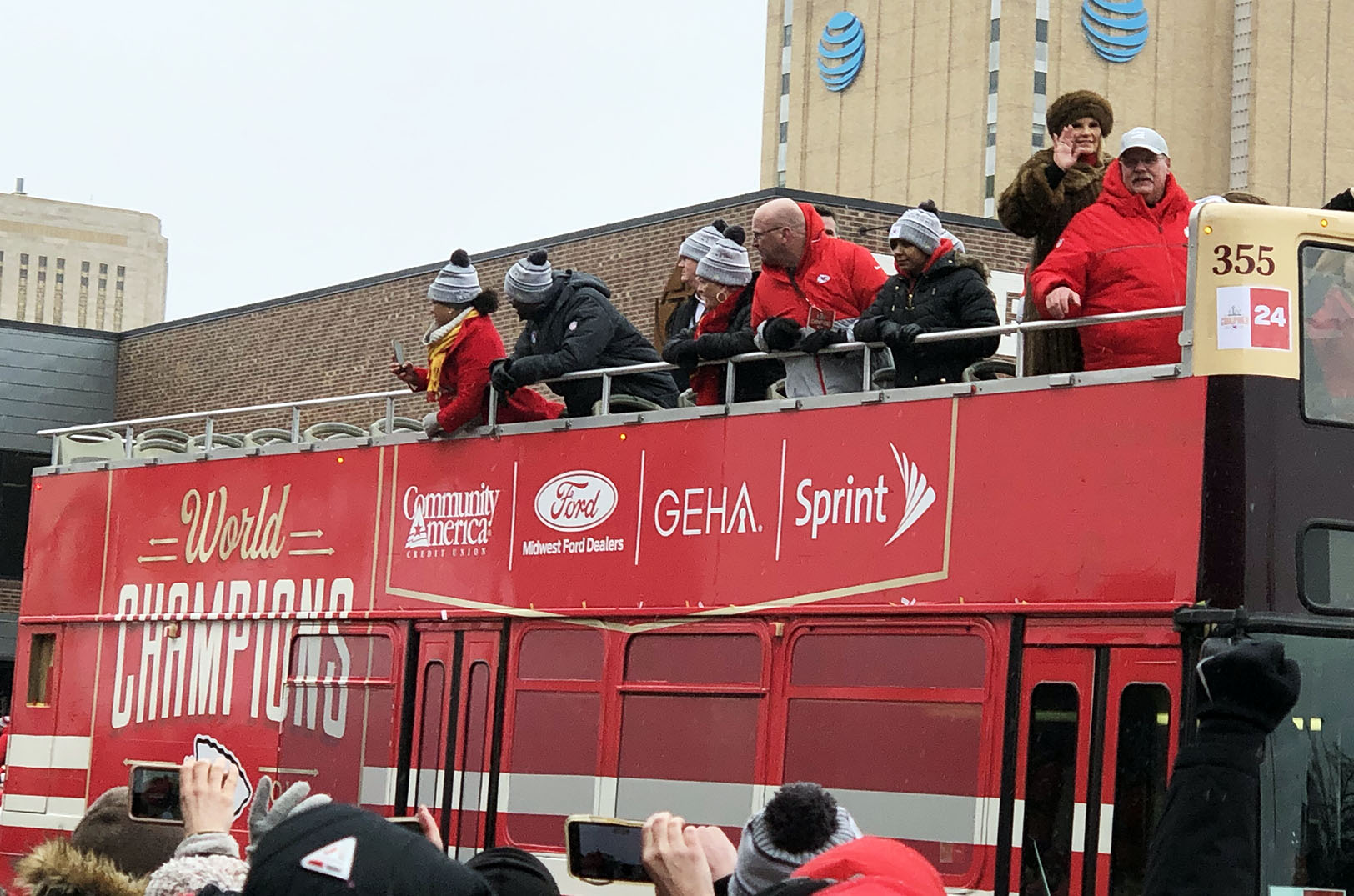
Kansas City Chiefs Super Bowl victory parade
“Harsh weather and a drunk driving incident on the parade route may have been contributing factors to this trend,” EB Systems told Startland News, detailing data points it had collected during the historic parade and rally — which media reports said drew nearly 1 million people to city streets throughout the day.
The startup’s electronic beacons — small devices that use proximity Bluetooth technology to detect the presence of people — tracked the size and scope of the crowd that grew despite bitter temperatures and a dusting of snow. Their observations revealed some fans spent a total of 13 hours on Union Station grounds.
Thanks to beacons affixed in such spots as the rooftop at Messenger Coffee and to an AT&T cell signal booster at Union Station, EB Systems data showed the parade drew the most fans during a peak between noon and 1 p.m., with 77,000 gathered at Union Station and 22,046 in the Power & Light district — with tens of thousands more gathered in spots downtown and around the Crossroads Arts District.
“Now when the Chiefs — knock on wood — have their Super Bowl parade next year, or the year after that, they can use this data to basically say, ‘OK, we see some spikes and dips in this area at this time,’” Jon Ruiz, co-founder and CEO of EB Systems, explained of benefits the tech company’s platform offers customers.
“[Organizers can ask,] ‘Do we need more porta potties? Do we need to put more officers on duty? Do we need to alter our busing routes and shuttles that we were running?’” he added.
Dips in crowd size in the Power & Light and 18th and Grand areas seemed to follow the progression of the parade, the company noted, indicating many fans still braved the cold to get a glimpse of Chiefs quarterback Patrick Mahomes and the Lombardi Trophy, then left the route rather than attend the Union Station rally.
How does EB Systems’ technology work? Check out a video at the bottom of this story.
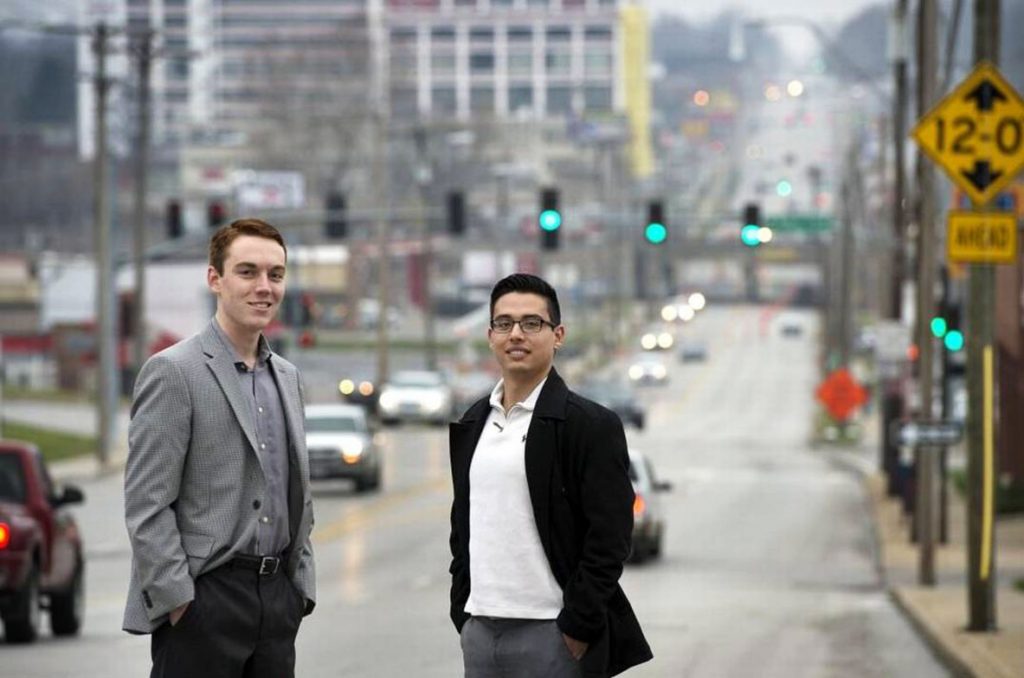
Brendan Waters and Jon Ruiz, EB Systems
Crowding into the smart tech market
Accurately detecting and analyzing crowd numbers can greatly impact revenue for large events and festivals, Ruiz said. The Feb. 5 parade provided a unique opportunity to prove EB Systems’ ability to track such data as the nearly six-year-old company aims to scale.

“We looked at 2020 as our big scale-up year. And what could be a bigger event or scenario than the Chiefs winning the Super Bowl [and having a] parade?” he laughed, highlighting ways in which timing is everything for growing startups.
“We looked at it and said, ‘We might get this opportunity again next year … but we also might never get another opportunity to test our technology on such a massive scale.’”
EB Systems also deployed two electronic beacons at Power & Light for Super Bowl Sunday — a test run days before the parade. The data revealed fans spent an average of 11 hours celebrating the Chiefs and more than 24,000 fans gathered around the big screen at game time — 5,000 of which showed up between 1 p.m. and 2 p.m. Feb. 2.
With a pre-existing working relationship with the city’s downtown council and experience with such local events as Boulevardia, getting electronic beacons installed in time for the parade was as smooth for EB Systems as scoring a touchdown appears to be for Mahomes, Ruiz noted.
“We’re at the point now where the technology is strengthened. We have a good analytics and big data team working with us and we’re getting some good insights out of the data. … It’s been pretty fun for us,” he said.
EB Systems technology stands to dramatically alter data collection in the smart home and IoT space, Ruiz detailed, citing a nearly three-year project with the City of Dallas that’s greatly contributed to the company’s growth.
“Dallas is starting to use it and say things like, ‘We just invested $100 million renovating this building for the new Holocaust museum; how’s this going to drive up not only traffic around us — but for more investment around this area?’” he said in example of ways EB Systems technology can help shape the smart city landscape.
“Now they have data to say, ‘We saw an uptick of 20 percent more traffic in this area after the museum opened. Let’s open some condos around here to see if we can drive that up or try to get people to move here.’”
Proven on the road, programmed at home
While working with a major U.S. city like Dallas has been exciting for the startup, Kansas City will always be home, Ruiz said.

Jon Ruiz and Brendan Waters, EB Systems
“I’m a [University of Missouri-Kansas City] Entrepreneurship Scholar grad, [my co-founder] Brendan [Waters] is a [University of Kansas] grad. We grew up here in Kansas City. We started the company when we had a year left in college and we’ve pretty much bootstrapped it,” he said of the startup’s history.
E-Scholars, 1 Million Cups, and the Ewing Marion Kauffman Foundation are but a few of the building blocks that led to the growing success of EB Systems, Ruiz added.
“[1 Million Cups] was one of the first ways that we were able to network and connect with folks and actually meet our first client,” he said. “I took free programming classes at the Kauffman Foundation and actually learned how to program and help build the first version of our mobile app that way.”
Waters also participates with Growth Mentoring Services through the Enterprise Center in Johnson County.
The co-founders wrote their own patents for EB Systems and have prioritized maintaining ownership of the company and developing themselves as thought leaders in the computer software and IoT space, they said.
“I think that shows that we know what we’re talking about and we know how to innovate in this space and are hopefully creating a product that will scale up and become pretty huge,” Ruiz said.
Click here to learn more about EB Systems.

This story is possible thanks to support from the Ewing Marion Kauffman Foundation, a private, nonpartisan foundation that works together with communities in education and entrepreneurship to create uncommon solutions and empower people to shape their futures and be successful.
For more information, visit www.kauffman.org and connect at www.twitter.com/kauffmanfdn and www.facebook.com/kauffmanfdn

Featured Business

2020 Startups to Watch
stats here
Related Posts on Startland News

MTC’s spring $1.4M investment cycle loops Facility Ally, DevStride into equity deals
Two Kansas City startups are among a handful of Missouri companies receiving a collective $1.4 million in investment allocations through a state-sponsored venture capital program. Facility Ally, led by serial entrepreneur Luke Wade; and DevStride, co-founded by Phil Reynolds, Chastin Reynolds, Aaron Saloff and Kujtim Hoxha; must now complete the Missouri Technology Corporation’s due diligence process…
Kauffman CEO: Foundation’s reset aligns Mr. K’s intent with KC’s needs of the moment
A recently announced strategy refresh for the Ewing Marion Kauffman Foundation will drive the organization’s collective impact in the community — honoring the vision of its namesake while recognizing the challenges Kansas City faces today, said Dr. DeAngela Burns-Wallace. “Mr. K had very distinct philosophies and ideas around how he wanted this work done,” explained…
Block by block: Prototype builds startup’s housing vision where everyone can afford their own castle
A mock home facade project on the grounds of Kansas City’s historic Workhouse Castle serves as a proof point for Godfrey Riddle’s rebooted Civic Saint — a social venture built on compressed earth blocks as its key to affordable, sustainable housing. “CEBs (compressed earth blocks) are great for Kansas City, because non-expansive sandy clay soil…

Resource revival: Digital Inclusion Fund relaunches with initial grants focused on devices
Kansas Citians can’t upgrade skills or devices they don’t already have, said organizers of a newly relaunched Digital Inclusion Fund — emphasizing a need to attack the metro’s digital divide at the infrastructure level. The fund is set to award up to $250,000 to 501(c)(3) public charities (including schools and churches) or governmental entities across…