

TechMap Kansas reveals open tech jobs, potential for startups to reshape employment trends
January 15, 2020 | Austin Barnes

Startland News’ Startup Road Trip series explores innovative and uncommon ideas finding success in rural America and Midwestern startup hubs outside the Kansas City metro. This series is possible thanks to the Ewing Marion Kauffman Foundation, which leads a collaborative, nationwide effort to identify and remove large and small barriers to new business creation.
LAWRENCE — Tech talent relocating to the Kansas City area shouldn’t worry about their future — opportunities for growth are everywhere, said Brian McClendon. TechMap Kansas exists to prove it, the mapping veteran behind Google’s and Uber’s popular tech added.
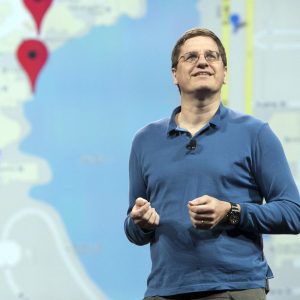
Brian McClendon, Free State Forge
“One of the challenges is recruiting and keeping new graduates and also bringing outside employees into the region,” said McClendon, serial entrepreneur and half of the husband-wife duo behind Free State Forge — an angel investment arm that’s backed a wide range of Kansas City startups from working capital titan, C2FO to such early-stage ventures as Griffin Technologies.
Click here to learn more about Brian McClendon, Beth Ellyn McClendon and the portfolio at Free State Forge.
Officially launched Wednesday by Free State Forge, TechMap Kansas is an ever-evolving resource that pinpoints tech jobs across Kansas and Missouri, bringing visibility to area tech opportunities for prospective workers, investors and the communities at large — a weakness of the region’s tech ecosystem, McClendon noted.
“If there isn’t enough opportunity outside of the company in question, it looks risky,” he noted, highlighting ways TechMap Kansas shows potential employees ways they can survive in the region should the job they relocate for fails them.
Click here to explore TechMap Kansas.
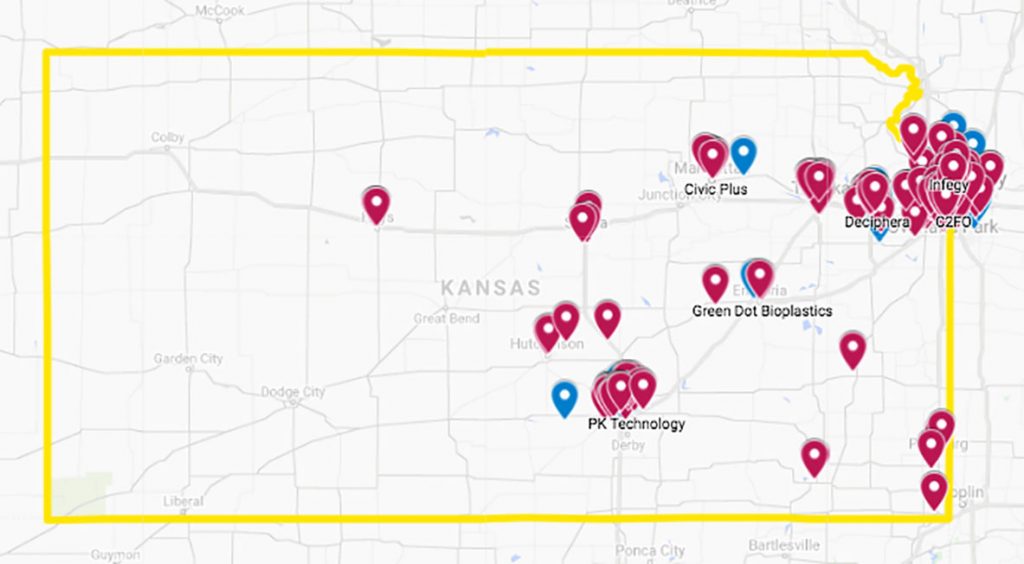
TechMap Kansas
“If you come to the region or stay in the region, you’ll have many choices over your career — while still being able to live a great quality of life in an area with good schools, housing that’s affordable and commutes that don’t give you huge headaches,” he said.
Rich with statistics, the first version of TechMap Kansas shows that startups account for little hiring activity in the region, holding less than 32 percent of open positions. A fact that surprised but didn’t shock McClendon, he noted.
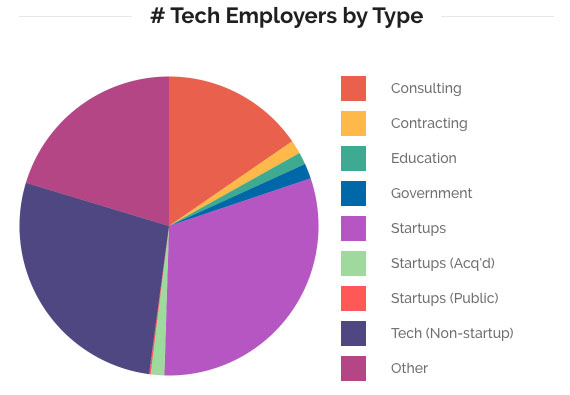
“We only have a few [startups] that are seeing big investment and big growth. And there’s many that are sort of in process, but I would like to see a bigger community of bigger startups,” McClendon explained.
“What’s going to be the growth of employment in Kansas and the region are these startups and they need to grow for that to happen,” he added.
And nothing fuels growth like capital, he added, detailing ways TechMap Kansas could further serve as a tool for companies looking to land cash injections.
“Our goal is that all the investors in the region and even investors outside the region can use this as a discovery mechanism and a [sense of] comfort that they’re not investing in an island. We’re actually a pretty dense archipelago out here,” McClendon said.
Such a realization took McClendon and his wife, Beth Ellyn McClendon, by surprise when they returned to the Kansas City area in 2017, he noted, adding that more tech employers exist in the region than most people recognize.
TechMap Kansas reveals there are 610 employers supporting a collective 34,000 tech jobs in the metro. Thirty-eight percent of those positions are based on the Kansas side and 29 percent are held in Missouri.
“In Kansas City, the well-known names are Cerner, Garmin, Burns & McDonnell, and Black & Veatch,” McClendon noted of high profile employers who might not necessarily drive tech employment. “Less well-known, Honeywell FMT employs over 3,000 engineers keeping our country safe and the Kansas City Federal Reserve has over 600 software developers.”
Though startups hold less of a presence, their power shouldn’t be dismissed, McClendon added. The 193 companies on the map as of its release employee up to 125 engineers, developers, and/or data scientists.
“These young companies are doing cool things like sequencing the genome better, faster and cheaper than ever before or attacking the inefficiencies in a $200 trillion marketplace,” he said, noting the impact startups have on the region — despite lower volume.
This story is possible thanks to support from the Ewing Marion Kauffman Foundation, a private, nonpartisan foundation that works together with communities in education and entrepreneurship to create uncommon solutions and empower people to shape their futures and be successful.
For more information, visit www.kauffman.org and connect at www.twitter.com/kauffmanfdn and www.facebook.com/kauffmanfdn

Featured Business

2020 Startups to Watch
stats here
Related Posts on Startland News
How wearables could change America’s pastime and Amazon’s big oops
In this week’s roundup of watercooler talk from the region’s startup hubs, we have the dish on Major League Baseball wearables, Amazon’s flub with expanding the digital divide and Chicago’s STEM workforce issues. Check out more in this series here. Mobile Commerce Press: Major League Baseball gives the nod to wearable technology No, this doesn’t…

The red carpet, garageband and laboratory of funding models
Editor’s note: The opinions expressed in this commentary are the author’s alone. “Funding! Funding! Funding!” It’s the warrior’s cry of the startup community. In the world of entrepreneurship, there’s an incredible amount of pressure to run a startup that can be described as “disruptive,” “innovative” and “scalable.” Those descriptions come with a hefty price tag,…

Kauffman Foundation CEO serves up 5 policies for entrepreneurial growth
Adaptation, experimentation and research. No, those aren’t tips to run a startup. Rather, they’re a few of the recommendations for lawmakers to consider if they’d like to spur nationwide entrepreneurial growth, according to Wendy Guillies, CEO of the Ewing Marion Kauffman Foundation. Now nearly a year into her tenure as CEO, Guillies recently presented five…
Google opens applications for Digital Inclusion Fellowship
Just two months after it unveiled free access to gigabit internet for low-income households in Kansas City, Google Fiber is again ramping up efforts to close the digital divide. In partnership with the Nonprofit Technology Network, Google Fiber has again opened applications for its Digital Inclusion Fellowship, this time looking for 22 bright minds to…