

Lawrence-based Sweet Jane magazine offers safe space for women to get candid about cannabis
October 29, 2019 | Austin Barnes

Satisfying her own curiosity, Katy Ibsen penned an article on cannabis opportunities for publishers.
“There were niche magazines being published, there were B2B magazines being published, there was ‘High Times’ and ‘Dope,’” Ibsen, now founder, editor and publisher of Sweet Jane magazine, said of her research for the piece.

A 10-year publishing vet with a heavy portfolio of freelance work, Ibsen wrote the article to fill time during a sabbatical, she explained.
“I kind of got this really great background on what that industry was and what some of these publishers had been doing … simultaneously, I had friends who were also mothers who were kind of curious [about cannabis],” Ibsen said coyly, recalling the moment she discovered a new target market for the emerging industry of cannabis focused media.
“What if there was a print magazine for women and mothers who wanted to learn more about cannabis and wanted something that was slightly higher quality than what they were finding in dispensaries — but also not so over the top cannabis that they were embarrassed or insecure about reading it?” Ibsen said of the idea for Sweet Jane, which slowly emerged throughout her research.
Click here to read about more businesses getting into the cannabis space.
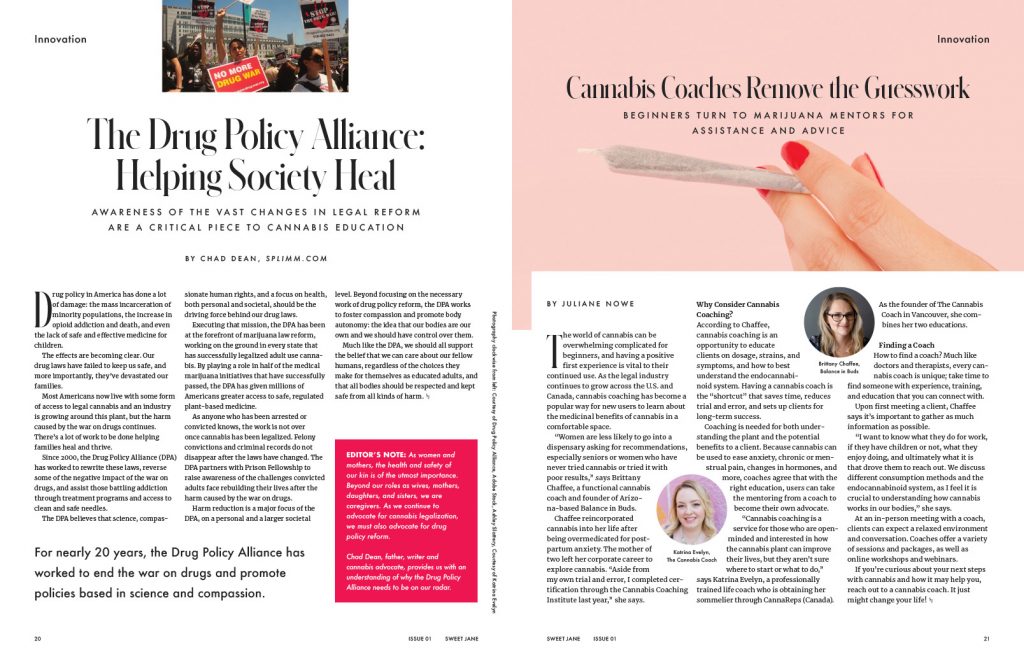
Elegant but modern with matte pages and black and white photos, Lawrence-based Sweet Jane — which formally exists to empower women, those who identify as women, mothers, and grandmothers who support legal cannabis use for health and wellness — first went to print in June, backed by a nationwide reach, Ibsen said.
Click here to flip the pages of Sweet Jane before the release of its second issue in November.
“Through my channels in publishing, I ended up getting connected with a Newsstand consultant. … Our consultant happened to have a really great connection over at Barnes & Noble and he pitched them on our publication and they really liked it,” she said of the way the deal came together and the importance of making and keeping connections — especially in media.
“People sometimes compare it to the mafia,” she joked. “It’s really just a ‘who you know, how you know them, what connections do they have” [kind of thing.]”
But connections don’t make things totally painless, Ibsen was quick to note. Every company has struggles. Such a distribution path wasn’t the initial strain of Sweet Jane.
[pullquote]
Sweet Jane’s Name
Sweet Jane shares its name with a song by the Velvet Underground, Katy Ibsen said.
“The Velvet Underground covered Lou Reed’s version of Sweet Jane and it actually was just a song in rotation. I was actually driving one day and that song came on and it felt like the right fit. We went through the right channels to make sure there was no trademark or copyright and fortunately there wasn’t, so we ran with it. The concept for the magazine came before the name.”
[/pullquote]
“Our original business plan had us producing a complimentary publication — so, free — that would go to high-end dispensaries across the U.S.,” she explained.
“We wanted to be able to give women access to this publication where they might be going to experience cannabis and learn about cannabis … we had learned through our market research that soccer moms were this leading demographic,” she said. “Then we really crunched the numbers on the cost of shipping, and the number was astronomical.”
Partnering with Newsstand gave Sweet Jane the same high-end feel for a manageable fee, Ibsen said.
“I’m learning in the world of startup, you must be nimble and you must be flexible,” she laughed, stressing the importance of founder flexibility.
“Barnes & Noble is known for being a really great jumping off point for new publications,” she said. “They really want their newsstand to be a leading newsstand and they take — probably — more chances on smaller niche publications than other newsstands do.”
While Barnes & Noble hasn’t shied away from material like Sweet Jane, retail hubs such as Apple have — a turn that can cripple small and independent publishers, Ibsen noted.
“I see the reasoning as pretty vague and it’s frustrating, of course, especially when you see here in the Midwest, a ‘Gun Monthly’ or [something similar].”
Though mainstream retailers are hesitant to spark distribution deals with publications like Sweet Jane, a publication’s success won’t burn in prohibition states, Ibsen suggested.
“We’re seeing women be more private about their cannabis views — and in many cases for good reasons, especially if they’re in a state or a region where they don’t have safe, legal access,” she explained.
“They may not feel comfortable even walking into a Target or a Hy-Vee or a Walmart and buying a cannabis-related publication while they’re with their kids and doing all their grocery shopping,” she said. “We’re OK with that. We want to meet them where they want to be.”

Katy Ibsen, Sweet Jane, Startland’s October Innovation Exchange
For now, that means giving readers access to online content — updated consistently between issues — and letting them purchase copies through the Sweet Jane website and its affiliate partners.
“Corporate America is slowly coming around to an acceptance that cannabis may be mainstream and that their consumers may want access to information about cannabis. Its just now really getting that point,” Ibsen added, making note of the rise of CBD in retail.
“We’re still in the Midwest. Kudos to Missouri for passing medical and Oklahoma for passing medical and Illinois for passing adult use. But that doesn’t mean everybody’s ready to talk about cannabis,” she said.
Beyond impacts on publishing, hesitation often impacts the ability of founders in cannabis to obtain adequate funding. Such a battle is no less prevalent in the world of publishing, Ibsen noted.
“I think a lot of people are making savvy investments because they see the potential, but that doesn’t necessarily mean that they want to be a soundboard for the industry just yet,” she said. “A lot of people are waiting to see what changes on a national level and for maybe mainstream to reach a certain benchmark before they feel more candid about talking about it.”
An entrepreneurial endeavor still budding, Sweet Jane remains entirely bootstrapped, Ibsen said.
Click here to read more about the funding struggle for local cannabis founders.
A frequent conversation among the magazine’s editorial board, Sweet Jane’s mission to make people feel comfortable transcends the role of reader and partner, Ibsen said.
“Until people can have those conversations about either their personal use or medicinal use or maybe their investment, they have to feel like they’re in a safe place to do it. I don’t necessarily know that those safe places exist yet,” she said, adding that Sweet Jane could be a catalyst for change as cannabis becomes to come online in the heart of America.
“I make the comment that California is so cosmopolitan about cannabis and Colorado is still very earthy — but many Midwest states have recently legalized and there’s very little quality content for them to reference,” she added. “As a Midwest-born brand, we absolutely see the midwest region as an area for us to grow to hopefully help those conversations advance.”
“For us, we get to be a part of this growing industry — but even more so, we get to be a part of an emerging media market in an emerging industry and that’s really exciting.”
[divide]
This story is possible thanks to support from the Ewing Marion Kauffman Foundation, a private, nonpartisan foundation that works together with communities in education and entrepreneurship to create uncommon solutions and empower people to shape their futures and be successful.
For more information, visit www.kauffman.org and connect at www.twitter.com/kauffmanfdn and www.facebook.com/kauffmanfdn


2019 Startups to Watch
stats here
Related Posts on Startland News

Claimkit snags ‘aspirational entrepreneur’ award
Overland Park-based tech startup ClaimKit recently was dubbed 2015’s most “aspirational entrepreneur” by the Greater Kansas City Chamber of Commerce. Founded in 2011, Claimkit created a contract management platform for insurance companies, law firms and consulting groups to help them more efficiently collect and analyze documents. Now with five full time staff, the company in…

C2FO CEO Sandy Kemper talks failure, VCs, maximizing time
From a Kansas City arena to the founders of one of the nation’s largest financial institutions, the Kemper name is well known in Kansas City. But it’s more than just Sandy Kemper’s name that drew a sold out crowd at Kansas City’s May Startup Grind event. Kemper leads one of Kansas City’s fastest growing companies…
Tech startup, KCSV among finalists for small biz awards
The Kansas City Kansas Chamber of Commerce announced Thursday its small business award finalists. The awards celebrate businesses that are financially successful, have a dynamic idea and are making an impact on the community. This year’s finalists include two members of the startup community. RFP365, which created software that eases the request for proposal process,…