

Custom retro arcade gaming consoles take Hammerspace workshop down memory lane
September 10, 2019 | Paul Cannon
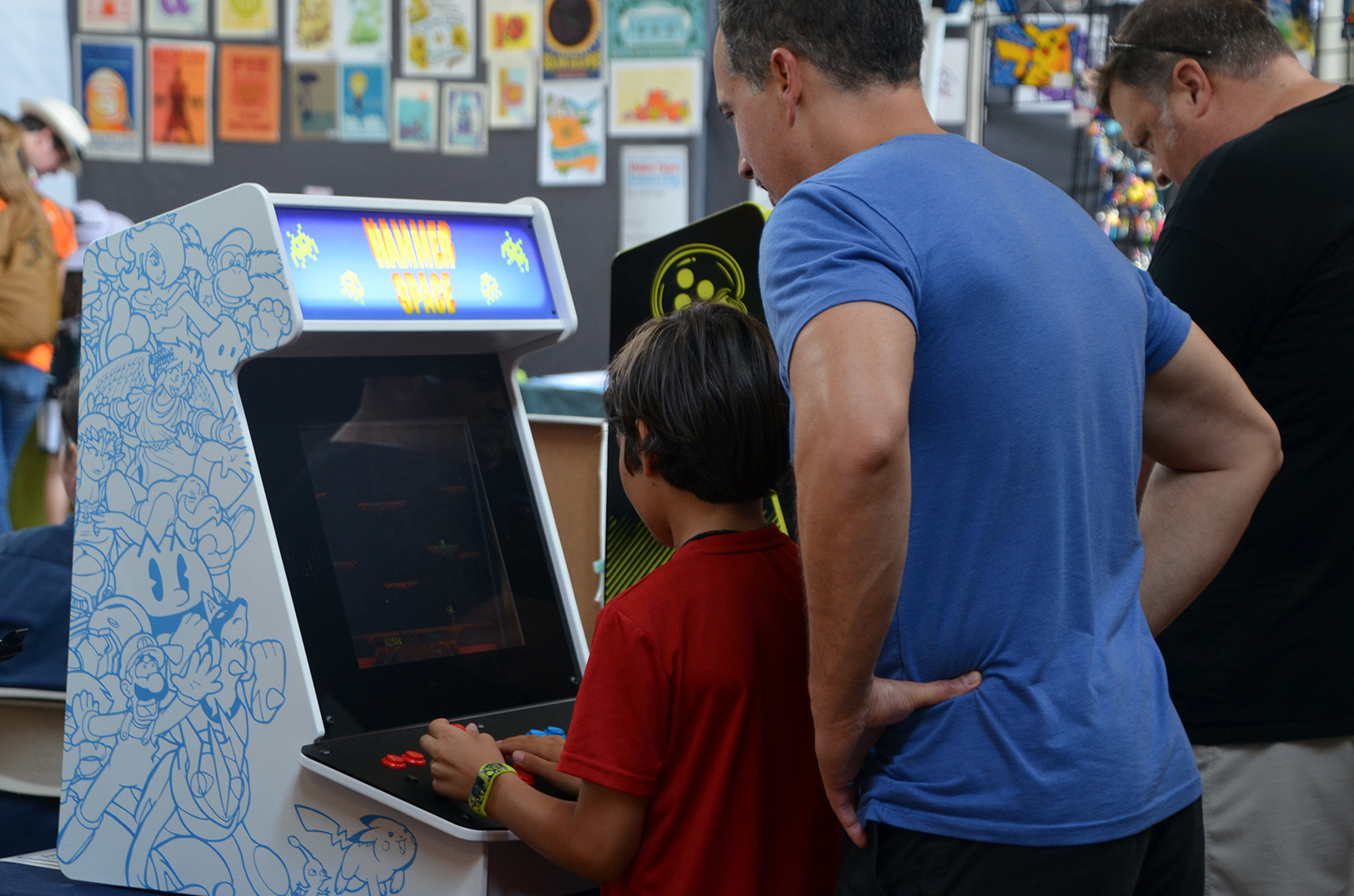
When Hammerspace Community Workshop moved into its space off Emanuel Cleaver Boulevard in 2017, a small gaming console served as a showpiece for a room designed for creative and crafty children.
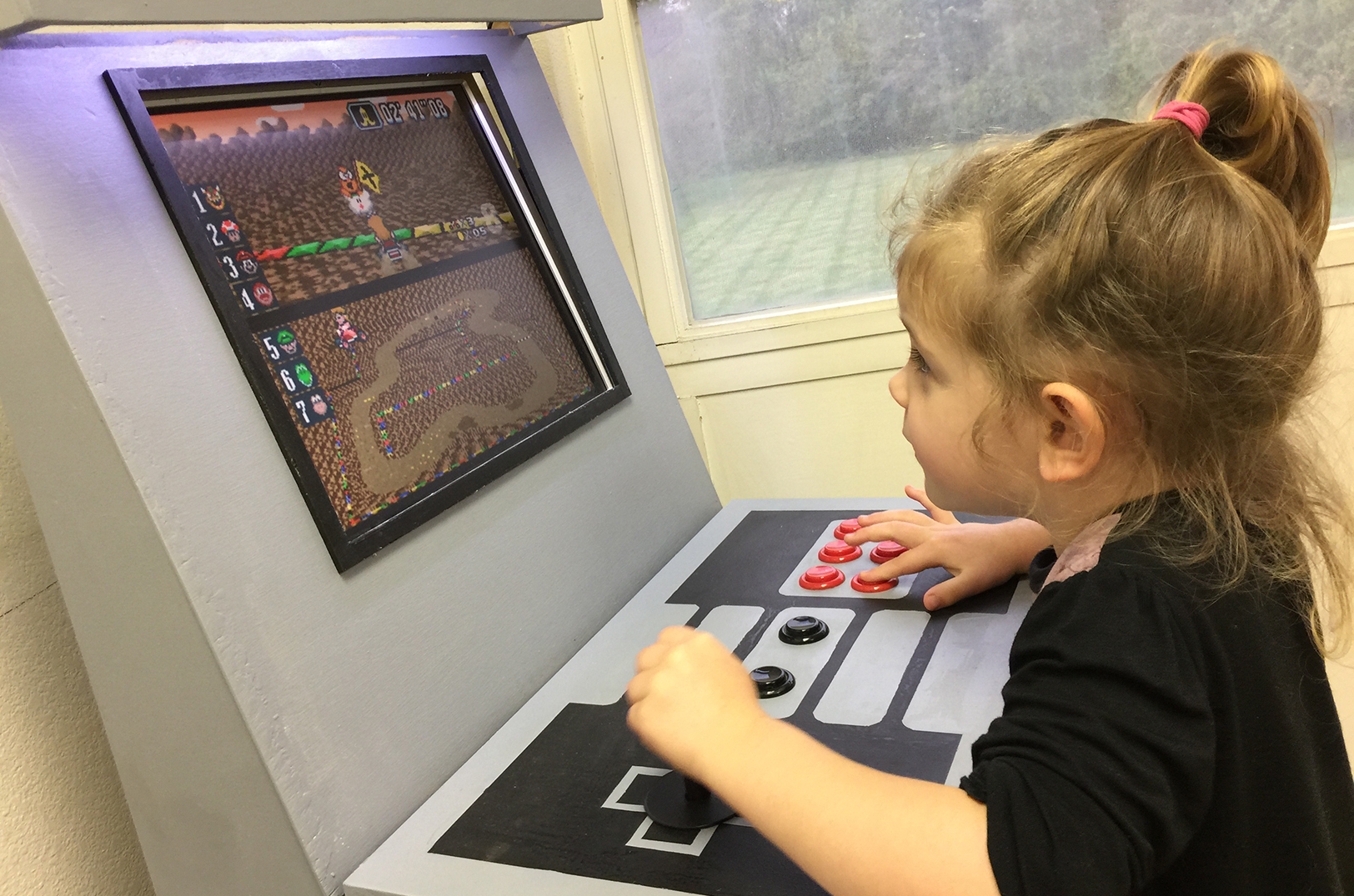
Hammerspace Community Workshop
Mimicking the look of a classic Nintendo GameBoy-turned-arcade game, the apparatus allowed kids — and adults alike — to play retro titles in an environment designed to foster collaboration. Today, it serves as an inspiration of sorts for a wildly popular class at Hammerspace where families build their own game consoles with the same vintage feel.
“We are making custom retro arcade cabinets using Raspberry Pi board computers to power about a dozen different consoles and cabinet game emulator programs,” said Dave Dalton, owner and creative mind behind Hammerspace. “That will let you simulate an original Dreamcast or PlayStation as well as classic arcade games.”
Hammerspace-crafted retro arcade consoles publicly debuted in June during Maker Faire Kansas City at Union Station. Multi-day “Retro Bar Top Arcade Machine Build” classes followed with participants learning the ins and outs of assembling the gaming platform.
“It’s kinda nice because it’s a fabricated cabinet that you got through all the assembly, learn how to wire and program,” said Dalton. “On Day 2, we paint and apply decals to the cabinet to finish a very quality looking piece — one that will be less expensive than buying a similar kit from the store.”
The next sessions are expected in November. While the hobby shop is membership-based, its gaming console classes don’t require a membership.
‘We had several young helpers there to assist their parents this time,” Hammerspace said in an Instagram post after a workshop in August. “We hope that they will enjoy going down memory lane with their parents as they battle each other in all of the retro games on the arcade machines they built together.”
Click here to learn more about Hammerspace’s offerings.
Exercise creativity
On a crisp late summer day, fair weather allowed Dalton to open the windows at Hammerspace, mixing the smells of the tree-lined neighborhood around 5200 E. 45th St. with freshly-cut wood in the shop.
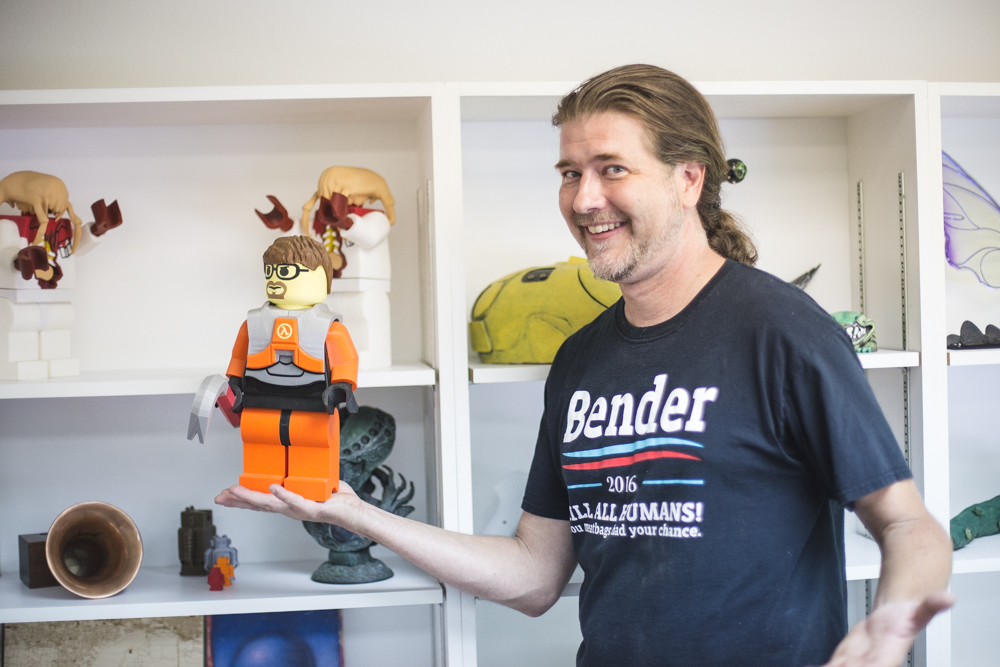
Dave Dalton, Hammerspace Community Workshop
“Hammerspace is like a gym for people who want to build stuff,” he said, describing the 17,000-square-foot workshop, which Dalton frequently calls a “third space” — a place that is neither home nor work.
Click here to learn more about Hammerspace.
“The maker space is a machine that removes ‘linchpin’ obstacles for creative people and their path,” he added.
Crafters, inventors and production-minded artists are attracted to the humble maker mecca, said Craig Berscheidt, an associate at Hammerspace.
“It’s where you go to exercise your creativity,” he said.
Armed with a bevy of tools — from welding equipment to sewing needles — even the inexperienced can come learn and take up a new hobby from scratch, the two said. Hammerspace even provides tool training and an open house 6 p.m. to 9 p.m. every Thursday.
The location also has the space necessary to provide work on large projects, Dalton added, emphasizing room to fuel the imagination.
“Productivity happens when you ask ‘Why not?’” he said. “The obstacles for people are generally three different things: they don’t know how to do the thing they want to do; they know they want to do it, but they know they don’t have the skill or technique; or they don’t know how to even begin.”
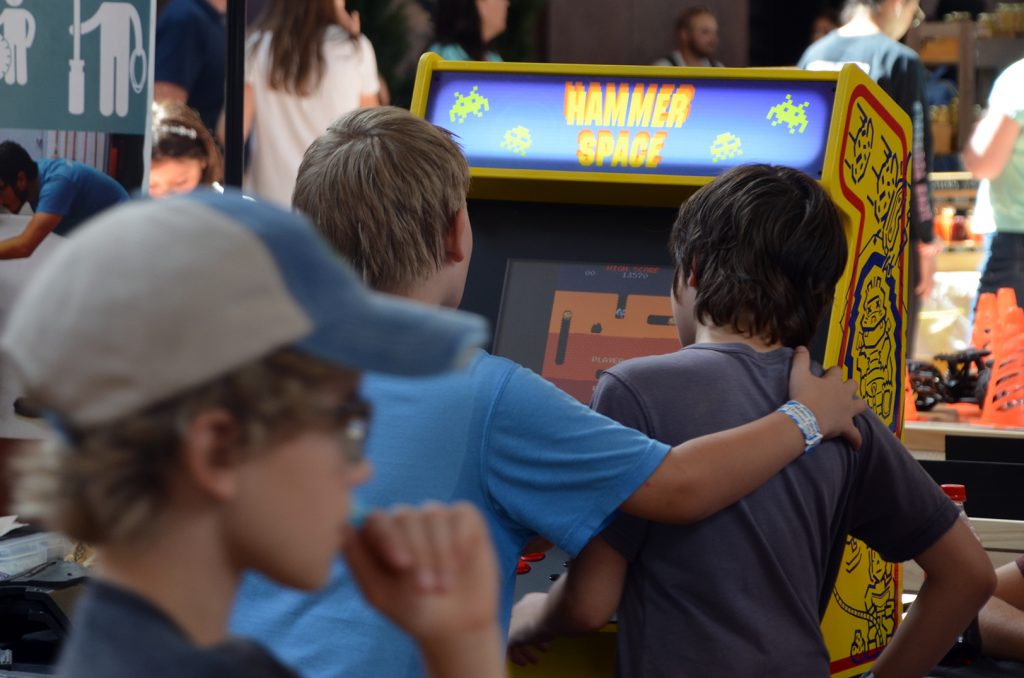
Hammerspace at Maker Faire Kansas City 2019
Tools of the trade
Most hobbyists can’t afford to buy — or perhaps even rent — an expensive piece of equipment needed for a single or limited project, Dalton said. Hammerspace offers an alternative by pooling resources at the space.
“Of course, now we can invest in the community. The shop is for people to come down and use things ike table saws, plasma cutters, and welders,” he said, noting an in-house 3D printing studio and a drafting program that designs machine cuts for artists and designers that don’t require a human hand.
“We can take images and use them as instructions for a robot to design your project rather than relying on a human,” he added.
Dalton’s collection of tools is immediately evident upon walking into Hammerspace, but new visitors shouldn’t be overwhelmed, he said.
“We have a constantly growing volume of tools,” said Dalton, emphasizing that mentoring helps make the space less intimidating. “This is your community workshop.”

Featured Business

2019 Startups to Watch
stats here
Related Posts on Startland News
Brood of Bird electric scooters land in Kansas City
Birds of a feather scoot together. Joining more than 20 cities across the U.S., Kansas City became the most recent community to welcome a flock of Bird electric scooters. The Los Angeles-based firm dropped off dozens of black, lithium-ion-powered scooters throughout Kansas City, allowing users to rent the vehicles and zip across town with a…
Photos: Kauffman’s ESHIP Summit sees strength in numbers, diversity
Despite a living legacy of ongoing entrepreneurial support, even the Ewing Marion Kauffman Foundation doesn’t have all the answers, Wendy Guillies told a 600-strong crowd at Wednesday’s ESHIP Summit kickoff in Kansas City. “We approach our work with a great deal of humility,” said Guillies, Kauffman Foundation president and CEO. “We need to listen and…
Rewriting the playbook: ESHIP Summit eyes new model of economic development
Whether it be in art, technology or science, fledgling fields of study often face challenges of legitimacy when they enter the mainstream. Such is the case for the domain of ecosystem building, which struggles to find validity for and unity among those working to create vibrant communities in which entrepreneurs thrive, said Victor Hwang, vice…
Manual entrepreneurship, refuge: ‘Farming is just the vehicle,’ says BoysGrow founder
“What’s the word?” “Respect!” shouted the teenage farmhands at BoysGrow, a two-year program dedicated to teaching entrepreneurship to urban youth through agriculture and farming. The 10-acre BoysGrow farm outside Grandview plays host to 30 to 40 boys, ranging in age from 15 to 17. They work, eat and learn on the nonprofit farm three days…