

Report: Kansas, Missouri economies hinge on homegrown startups, not border war wins
August 29, 2019 | Rashi Shrivastava
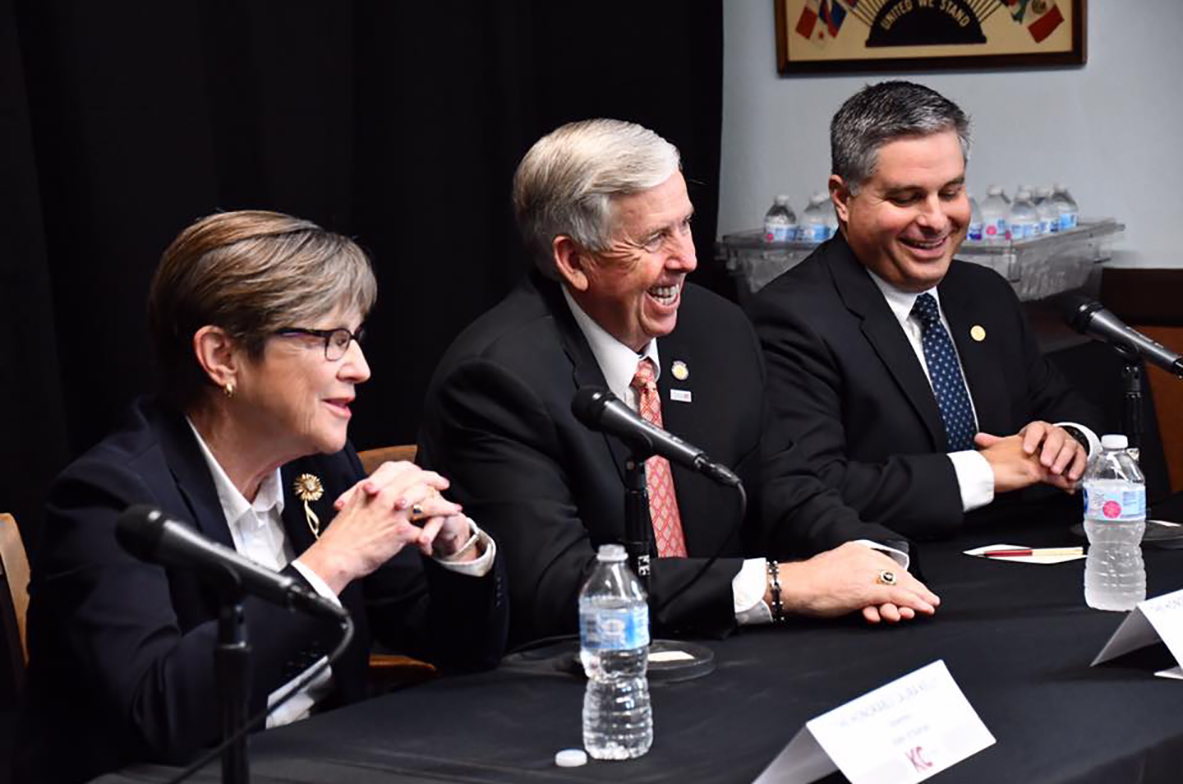
Kansas and Missouri must “grow from within” if the neighboring states aim to successfully confront structural challenges that face their economies, said Amy Liu, a contributor at national think tank the Brookings Institution.
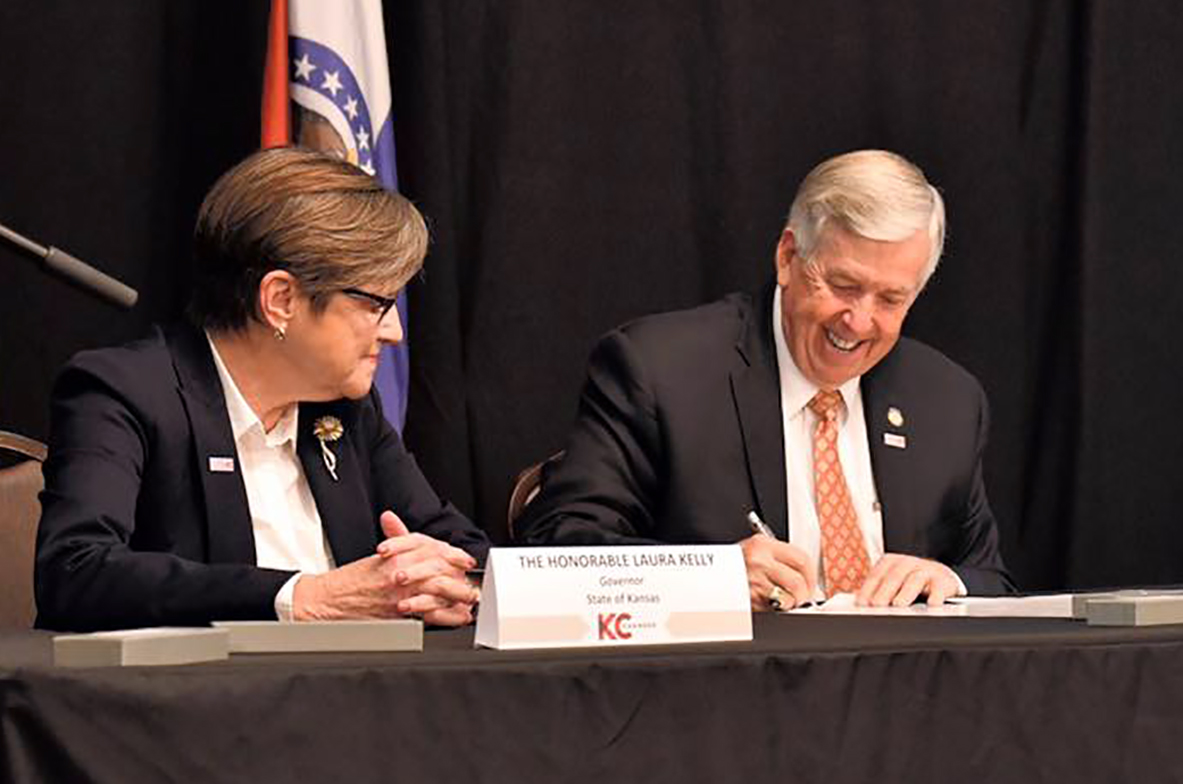
Govs. Laura Kelly, D-Kansas, and Mike Parson, R-Missouri
The “historic handshake” between Govs. Laura Kelly, D-Kansas, and Mike Parson, R-Missouri, earlier this month marked the symbolic end to an ongoing economic border war that produced headline-making wins for the states in a decades-long game of tit for tat — but little actual economic development or job creation in either state, according to previous reporting.
A new era of collaboration for Kansas and Missouri should focus on job growth linked to the expansion of existing businesses and startups — not from business relocations and tax incentive-based lures, said Liu.
“The opportunity is now there for both states to put the unbalanced tax abatements and hollow business relocations in the past,” she said. “They need to move forward vigorously by focusing on building homegrown talent, enriching education opportunities, and ensuring that each state’s workforce can access quality transportation and housing.”
The two Midwest states are among those geographic economies that lack the “critical mass of knowledge assets” like applied research and development capability and specialty skilled workers, Liu said. And while efforts like innovation districts in communities like Kansas City and St. Louis seek to address such challenges, statewide and even multi-state initiatives are needed to secure long-term wins in the world of rapidly-advancing innovation.
Click here to read about how communities and developers are working to craft the right formula for innovation hubs in Kansas City.
“We are in the midst of a winner-take-most economy where superstar cities like San Francisco, San Jose, Austin, and Boston are capturing an ever-growing share of the nation’s innovation jobs and talent,” Liu said.
Another trend putting Kansas and Missouri at risk: automation of jobs, she said, noting a quarter of jobs in the two bordering states are at “high-risk” of automation, according to a report published by Brookings.
“Leaders must embrace a vision of regional economic development that is comprehensive in scope, collaborative in spirit, and inclusive, improving incomes and employment for everyone, no matter their race or zip code,” Liu said.
This story was produced through a collaboration between Missouri Business Alert and Startland News.


2019 Startups to Watch
stats here
Related Posts on Startland News

This Kansas gardener sued to sell fruit and honey; Now her town will allow urban farming
Editor’s note: The following story was published by KCUR, Kansas City’s NPR member station, and a fellow member of the KC Media Collective. Click here to read the original story or here to sign up for KCUR’s email newsletter. Ottawa city officials are trying to strike a balance between people who want to produce food and the interests of their…

Godfrey Riddle wants to build you a home; How Civic Saint’s eco-friendly bricks could reshape the foundation of affordable housing
Winning $55,000 in a recent national LGBT pitch competition provides Godfrey Riddle the building blocks for a hard pivot — shifting the focus of his lifestyle company Civic Saint from handmade retail goods to earthen bricks used to sustainably create artful, affordable homes. “Affordable housing is a problem I’ve been pondering since my family lost…

KC Cattle Company steaks its reputation on wagyu hot dogs; Why this rural MO business enlists veterans on its new mission
WESTON, Missouri — Patrick Montgomery struggled to find his way after his service in the U.S. Army, he said. Now on a new mission — his venture KC Cattle Company — Montgomery is helping other veterans at a similar crossroads. “The military does some things really well and they do some things really poorly,” he…

KC-area startup earns spot in first-ever AWS accelerator for emerging GovTech companies
A Lee’s Summit-based startup focused on developing tech for the criminal justice industry has been selected for Amazon Web Services’ (AWS) inaugural GovTech Accelerator cohort. eHawk — led by co-founders Bart Cooper and Ted Green, a former bail bondsman and trial attorney — is one of 13 companies tapped for the program. The Kansas City-built…