

Report: Kansas, Missouri economies hinge on homegrown startups, not border war wins
August 29, 2019 | Rashi Shrivastava
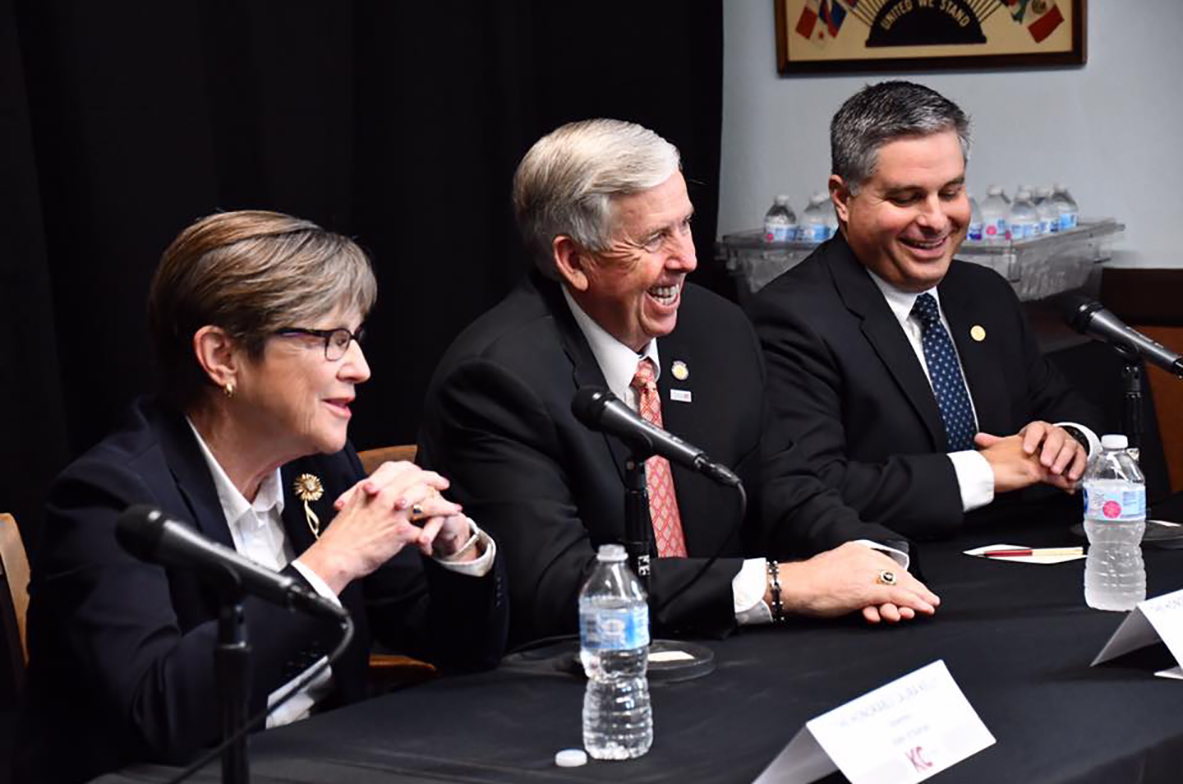
Kansas and Missouri must “grow from within” if the neighboring states aim to successfully confront structural challenges that face their economies, said Amy Liu, a contributor at national think tank the Brookings Institution.
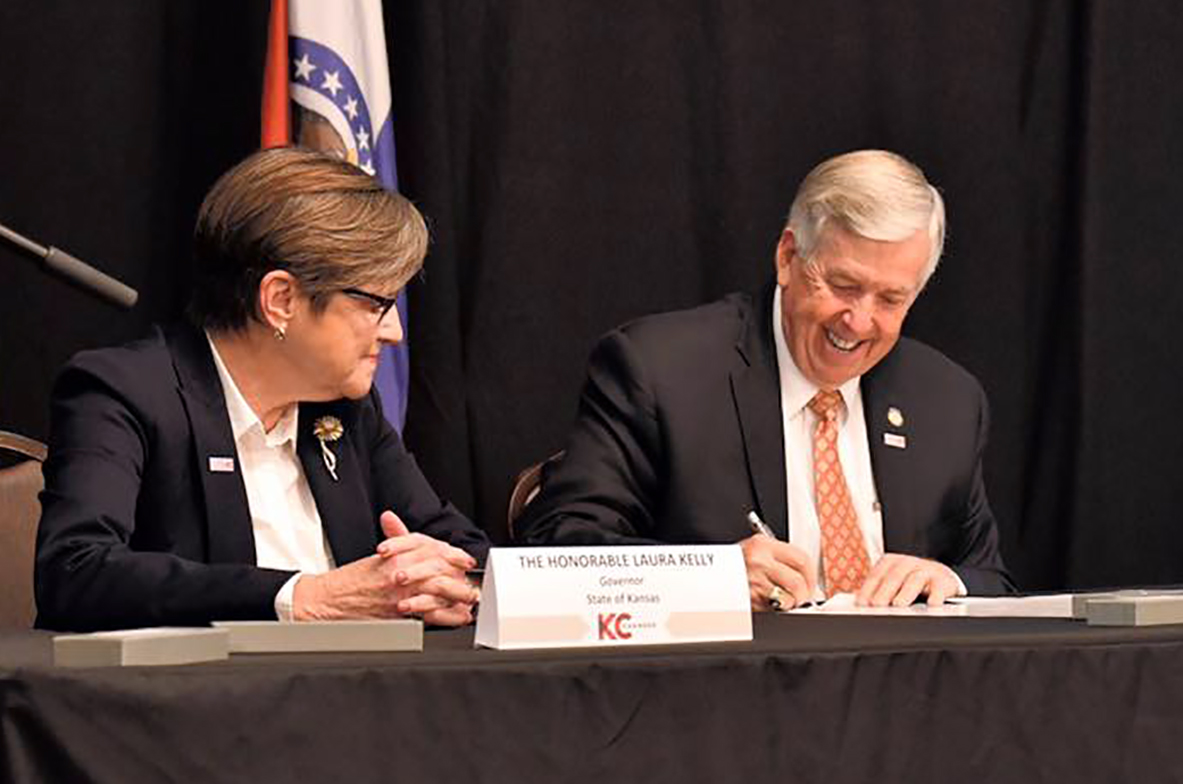
Govs. Laura Kelly, D-Kansas, and Mike Parson, R-Missouri
The “historic handshake” between Govs. Laura Kelly, D-Kansas, and Mike Parson, R-Missouri, earlier this month marked the symbolic end to an ongoing economic border war that produced headline-making wins for the states in a decades-long game of tit for tat — but little actual economic development or job creation in either state, according to previous reporting.
A new era of collaboration for Kansas and Missouri should focus on job growth linked to the expansion of existing businesses and startups — not from business relocations and tax incentive-based lures, said Liu.
“The opportunity is now there for both states to put the unbalanced tax abatements and hollow business relocations in the past,” she said. “They need to move forward vigorously by focusing on building homegrown talent, enriching education opportunities, and ensuring that each state’s workforce can access quality transportation and housing.”
The two Midwest states are among those geographic economies that lack the “critical mass of knowledge assets” like applied research and development capability and specialty skilled workers, Liu said. And while efforts like innovation districts in communities like Kansas City and St. Louis seek to address such challenges, statewide and even multi-state initiatives are needed to secure long-term wins in the world of rapidly-advancing innovation.
Click here to read about how communities and developers are working to craft the right formula for innovation hubs in Kansas City.
“We are in the midst of a winner-take-most economy where superstar cities like San Francisco, San Jose, Austin, and Boston are capturing an ever-growing share of the nation’s innovation jobs and talent,” Liu said.
Another trend putting Kansas and Missouri at risk: automation of jobs, she said, noting a quarter of jobs in the two bordering states are at “high-risk” of automation, according to a report published by Brookings.
“Leaders must embrace a vision of regional economic development that is comprehensive in scope, collaborative in spirit, and inclusive, improving incomes and employment for everyone, no matter their race or zip code,” Liu said.
This story was produced through a collaboration between Missouri Business Alert and Startland News.


2019 Startups to Watch
stats here
Related Posts on Startland News

American buying habits push Swappa to $70M in 2017 hand-me-down tech sales
Grown from a one-person, side-hustle project to a team of more than 30 people, Kansas City-based Swappa is swelling. The user-to-user marketplace for buying and selling used technology enjoyed its best year to date in 2017. The platform sold more than $70 million in hand-me-down electronics in 2017 — up about 17 percent from 2016, said…
BKS Artisan Ales takes measured approach with nano-brewery concept
It takes only about an hour for BKS Artisan Ales to sell out of its packaged bottles and cans each Saturday afternoon, Brian Rooney said. “We thought it would be great if maybe 40 people came in and maybe each of those 40 took a beer home,” said Rooney, a craft brewer who owns and…

KC named a top ‘dark horse’ to land Amazon HQ2
National media is lending credence to Kansas City’s prospects of attracting Amazon’s second headquarters. Inc. Magazine on Wednesday published a list of “5 Dark Horse Cities” to land Amazon HQ2, a prospective project that promises to create upward of 50,000 new jobs in whatever locale that nabs the online retailer’s massive new hub. While speculative,…

Couple with tech, startup background embraces risk-taking as new Pitch owners
Local ownership of The Pitch will preserve the Kansas City alternative news publication’s voice, as well as expanding digital content for readers, and promotions and services for advertisers, Stephanie Carey said. “I love the independent voice. I love the fact that we can push those boundaries, push the envelope on stories, dig a little deeper,”…