

Sickweather spent 8 years and $100K+ to obtain a patent; Is IP protection worth the cost?
July 16, 2019 | Rashi Shrivastava

Graham Dodge wanted to check a box for investors seeking security for his crowdsourced sickness forecasting startup Sickweather, he said. Obtaining a patent for the technology, however, proved a tougher task to chart.
“We just wanted to protect ourselves to build value in the company,” said Dodge, CEO of Sickweather, as well as Garnish Health, a reciprocating donation platform for health care funds. “We had a lot of investors early on who asked us if we had any intellectual property protection. And a patent is a great way to have that IP protection.”
Click here to read more about Sickweather, a member of the inaugural Sprint Accelerator class in Kansas City.
After filing for a provisional patent, the application was rejected time and again by Sickweather’s patent examiner, Dodge said.
“At one point, we resigned from thinking that we’d ever get the patent, and adopted the now-popular notion that patents aren’t actually worth much these days — or they aren’t defensible for a startup,” he said, noting the Baltimore-born startup spent more than $100,000 through the patent application process.
“It was the office actions and the back and forth with our legal counsel [that] rapidly increased the fees over time,” Dodge explained of the costs.
After eight years defending the originality of Sickweather’s business idea to its examiner, the company finally received its patent, said Dodge.
“If you’ve ever seen the movie social network, where Mark Zuckerberg says, ‘Well, if Facebook was their idea, they would have invented Facebook.’ It was very similar for us to be able to point to these other inventions and say if they had intended to build something like Sickweather they would have invented Sickweather,” he said, describing how the company overcame comparisons to other, similar tech startups.
Ultimately, Dodge said, Sickweather found value in the end result patent protection, though that exact value remains to be fully seen as the startup continues its upward trajectory.
Code in the open
Given the complicated process, Dodge said, it seems natural that some investors actually discourage startups from getting patents based on the notion that they aren’t relevant in today’s open-sourced IP terrain.
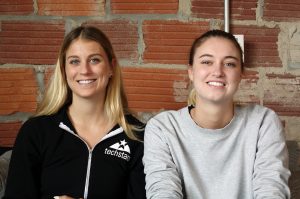
Claudia and Carolina Recchi, EdSights
Claudia Recchi and Carolina Recchi, co-founders of EdSights, tend to agree.
The sisters launched their startup two years ago using artificial intelligence to increase student retention. Procuring a patent for software-based products like theirs doesn’t make sense, said Claudia Rechhi.
“You are basically showing the code to the public and saying that you can’t copy this, which makes it easier to copy. Nothing stops people from changing something very small and coming up with a product that’s almost the same,” she said.
Click here to read more about Techstars Kansas City graduate EdSights.
Filing for a patent is like gambling with no immediate return on investment, but it’s the only way to save a company’s product from being plagiarized, said Jennifer Bailey, a software patent attorney at Erise IP.
“I think the tech community is a different breed in the sense that they want to share information. There’s this idea that intellectual property should not be owned by one person,” she said. “But the problem is we have a patent system, and the big companies will take it and use it against you.”
Finding support
Patenting a product is like protecting the recipe for a secret sauce, said Max Younger, co-founder and CIO of Mobility Designed.
Younger, an industrial designer, redesigned the crutch in 2008, changing the anchor of support from armpit to elbow. Acquiring a patent for the product would dictate the future success of his product, said Younger.
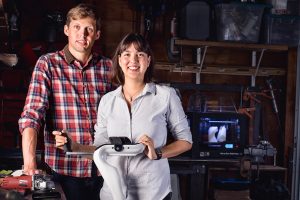
Max and Lilianna Younger, Mobility Designed, photo courtesy of Travis Young, Austin Walsh Studio
“One of the barriers for us to enter the market was being able to patent our remodified crutch. There’s a lot of upfront investment that goes into developing a product and in order to have a chance at recouping costs you need to protect your product,” said Younger.
Click here to read more about Mobility Designed.
The treacherous task of obtaining a patent began with a knock on the doors of University of Missouri- Kansas City to help fund the patent application costs through the Entrepreneurship Scholars program.
Patent applications can cost anywhere between $10,000 to $20,000, said Bailey. The reason for the intimidating cost: drafting a comprehensive patent for a tech startup requires at least 40 hours of a highly educated patent attorney, she said.
“A patent attorney is the only field of law that requires us to have a science or engineering degree,” explained Bailey. “So for example, one of my associates has a PhD in computer science from a top five school. We’re in a field that requires really smart people, and there aren’t that many of them. And so it’s expensive.”
Though costly and intimidating, procuring a patent is worth the effort, said Younger.
“If you’re not looking at investment or going to sell your company, a patent is not completely necessary, but if you want to be in the global market and attract investments, a patent is the ticket to market power,” he said.
This story was produced through a collaboration between Missouri Business Alert and Startland News.

Featured Business

2019 Startups to Watch
stats here
Related Posts on Startland News
Looping back? Missouri partners with Hyperloop to study 23-minute KC-St Louis route
Missouri’s prospects for landing a Hyperloop route apparently aren’t off the rails after all. Despite the company revealing four U.S. finalist routes in September — which did not include a proposed route through the Show Me State – Hyperloop One announced Tuesday it has entered into a public-private partnership with the State of Missouri to conduct…

Techstars Spotlight: GRIT Virtual builds 3-D tech into 2-D construction mindset
3-D should stay 3-D, said Chris Callen, CEO of GRIT Virtual. And with the rise of virtual reality and augmented reality technology, that philosophy can be applied to the construction of 3-D buildings, Callen said. Wichita-based GRIT Virtual is a software-as-a-service platform for large contractors. It uses VR software to streamline the workflow for construction…
Cherry Pit Collective offers community-first workspace for female artists, makers
For artists and makers, coworking is often more than just a preference for a non-traditional space – it can be a necessity. When Kelsey Pike graduated from the Kansas City Art Institute in 2011, she came to the realization that she wouldn’t be able to continue her craft — papermaking — without the tools and…
Under-the-radar innovators exchange challenges, answer ‘Why KC?’ (photo gallery)
It all comes back to time and money, Jennifer Rosenblatt said. “With a startup, things always take longer, and they always cost a lot more,” said Rosenblatt, co-founder of MusicSpoke. “Where we are now is not where I wanted to be.” Though selected as one of Startland News’ 2017 under-the-radar Kansas City startups, as well…