

Two Missouri biology students just wanted an ‘A’ — ultimately they devised a treatment for Crohn’s Disease
July 31, 2019 | Elyssa Bezner
Launching a biotech company based on a class project took the quest for an ‘A’ to a whole new level for two Missouri University of Science and Technology students — founders of Bionic Bowell.
Prompted by professors to find a use for a special ion-interacting glass compound, Vanessa Mahan and Catherine Pollman devised an ingestible version in pill form that could treat Crohn’s Disease and ulcers by altering the pH balance in the stomach, they said.
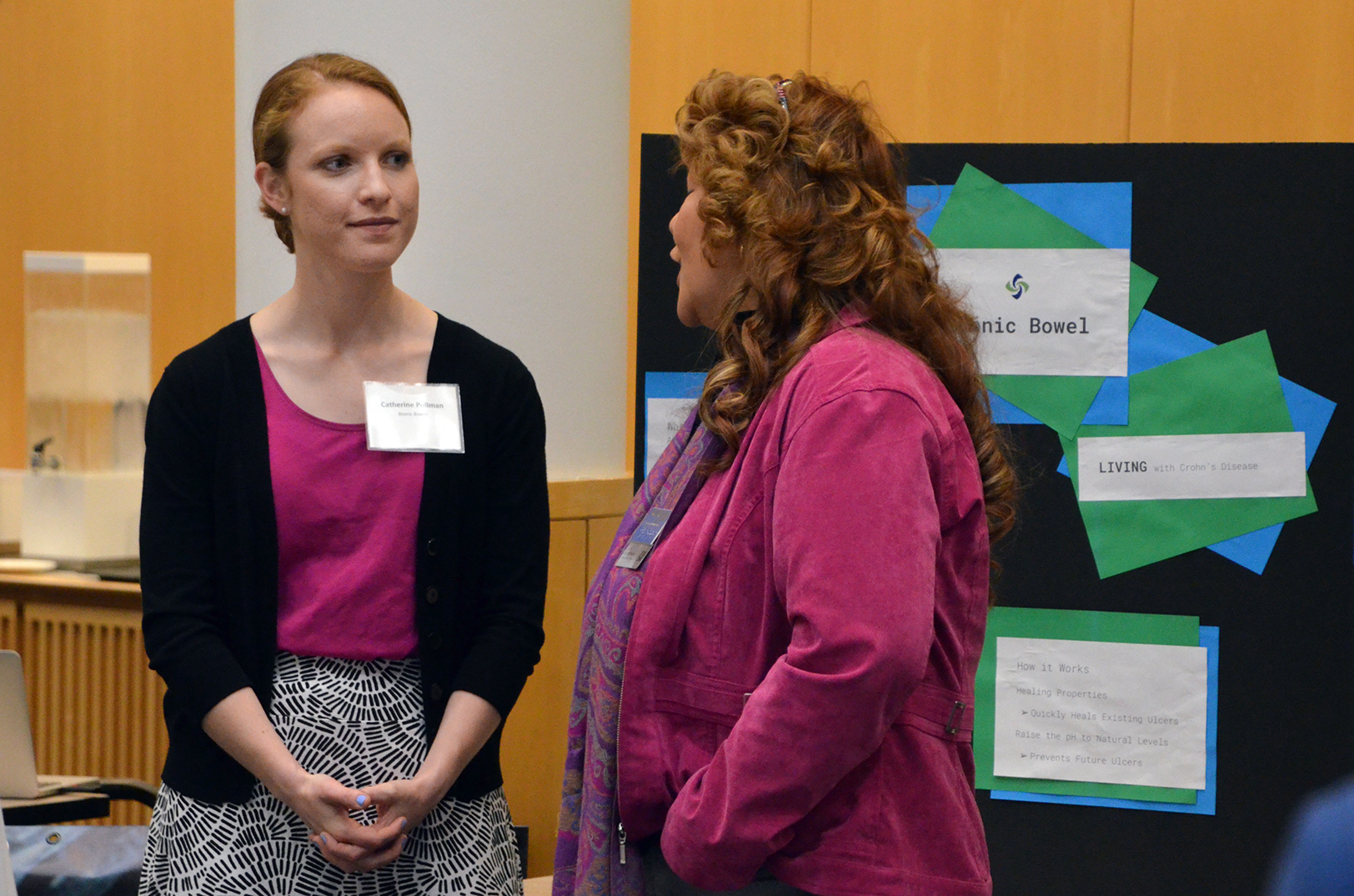
Catherine Pollman, Bionic Bowel, UMKC Regnier Venture Creation Challenge
“From that class, one of the things that they said at the beginning was if you enter and win a competition, you would get an automatic ‘A.’ Vanessa and I liked that,” laughed Pollman.
With one of Mahan’s relatives living with Crohn’s, the Bionic Bowell’s origins were also spurred by personal experience, said Mahan, noting current medications for the autoimmune disorder only target general inflammation in the body and do not focus on healing the stomach itself.
“Medicines like Humira even will just manage their pain and inflammation,” she added. “So there’s this really large market of people who have never found a way to manage their daily lives. We just thought that we could really bring a large impact to that side of the medical community. We hope to just give somebody another option to help them feel better.”
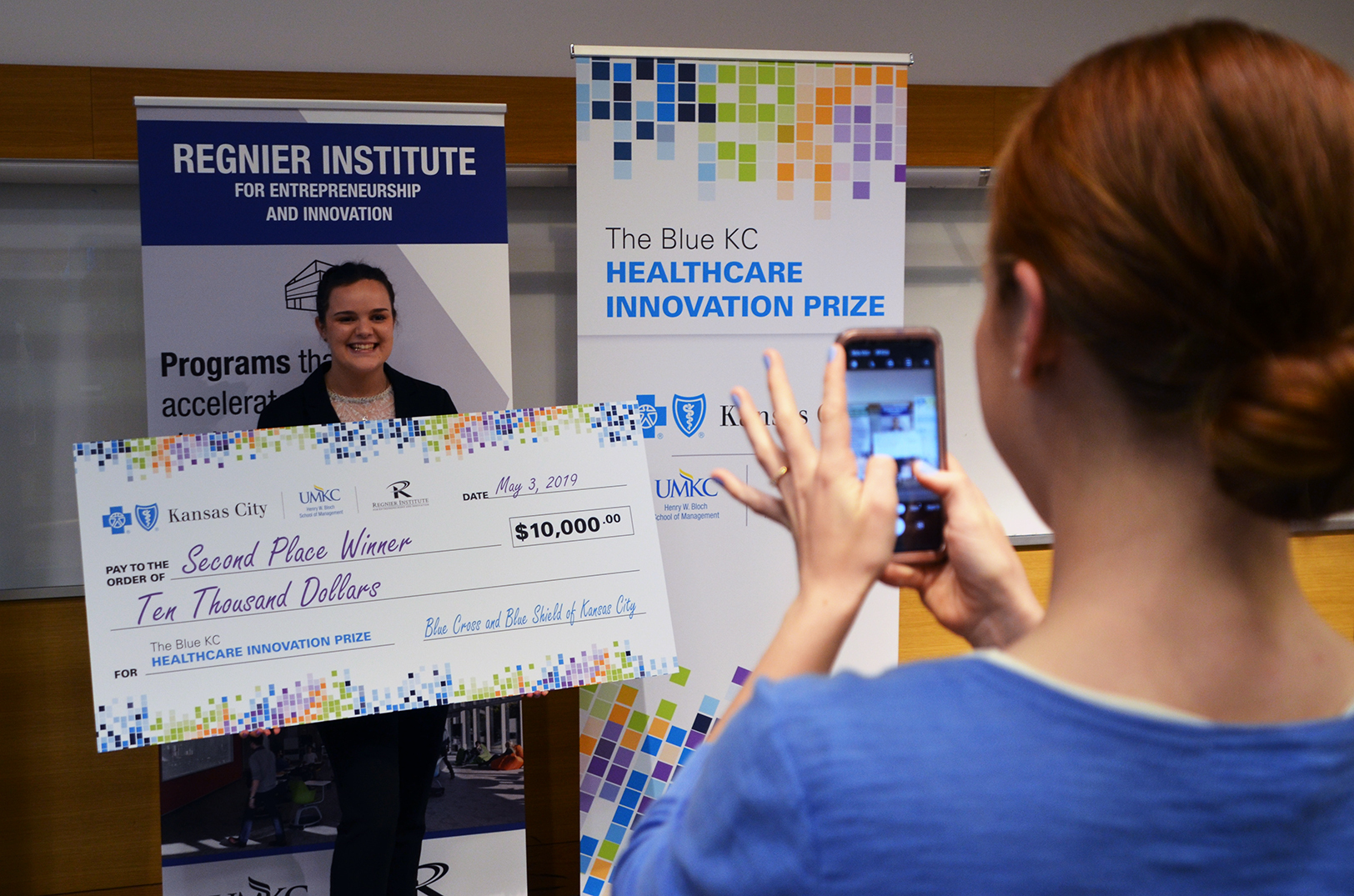
Taking their idea to the University of Missouri-Kansas City’s Entrepreneurship Quest competition, the pair earned third place, later earning the $10,000 second-place prize from the UMKC Regnier Venture Creation Challenge in May, they said.
“It really kind of fell into our lap,” said Mahan. “We met the right people at the right time with all the information to help us in our cause.”
The compound critical to Bionic Bowel is expected to be supplied from Missouri University of Science and Technology, a member of the University of Missouri system in Rolla. Meanwhile, Mahan and Pollman plan to enter the animal-testing stage and actual application of the product before the pair can begin to make strides on the business, they said.
“One of the professors at [Missouri S&T] who invented [the glass compound] really supports our project a lot because he hadn’t really found anything to do with it,” Mahan said. “We pretty much get it for free right now, but that may change as we might start needing a lot more of it.”
The compound itself is owned by the inventor, though patents of its application are free-range for two founders, she added.
“We’ve been very lucky with having mentors who are willing to work with us and give us advice,” said Pollman. “We’re navigating this whole world of business and patents and Big Pharma versus what we’re trying to do, so it’s been a process to find the people that we trust, but luckily we’ve got a couple people that are awesome.”
Funds gained from previously won competitions and more slotted for the future are expected to aid the product-building efforts as the founders try to gain exposure — all while Mahan finishes the last year of schooling and Pollman begins post-graduate life, they said.
“Right now, we’re playing the game of step-by-step,” said Pollman, smiling. “Step 1: do the product testing. Step 2: file for FDA approval and that process alone takes time.”
“But like [Mahan] said, it’s all kind of been an accident so far,” she added. “So, rather than get ahead of ourselves and plan super far ahead, I think we’re just taking it step by step to see what happens.”
Entrepreneurism was a foreign concept to the two biology students before Bionic Bowell became a viable idea, said Mahan.
“Honestly, it never even crossed my mind,” she laughed. “Even while we were doing this whole project for about seven or eight months, we kept hearing that word, ‘entrepreneur’ and we were like, ‘What is that?’”
After being introduced to the Kansas City community however, people went out of their way to help the two founders find their path in the startup arena, she said.
“Some of them provided lab space if we needed it or other resources because when we were first going through the programs, not a lot of people knew anything about medical products,” Mahan said. “All of the [competitors] were like coffee shops and clothing lines. No one else had a pharmaceutical product. So, Kansas City really helped us out. There’s a lot of people from the medical community here to get us resources and people who know the industry to help us further our products.”
“I never set out to be my own boss,” she added, smiling. “But, we have an LLC and everything. It’s weird to talk about.”

Featured Business

2019 Startups to Watch
stats here
Related Posts on Startland News

Firebrand Ventures closes $40M seed fund for ‘authentic’ founders in emerging communities; adds Leo Morton as advisor
A year after two prominent venture capital firms announced their merger, the consolidated Firebrand Ventures II is officially closed — reaching its $40 million target and having already invested in startups from Detroit, Seattle and Toronto. “Several years ago we raised our first funds — Boulder-based Blue Note Ventures and Kansas City-based Firebrand Ventures I —…

KC council members set to rappel from Canary bar atop 10-story building for Fringe festival fundraiser
Nothing screams KC Fringe Festival quite like rappelling down a 10-story building in the heart of Midtown, said organizers of a weekend fundraiser to help bring professional arts advocates — laid off because of the pandemic — back to the payroll. “To me, this fundraiser really speaks to what the Fringe does — which is…

Three Dog Bakery’s newest location brings doggie cookies, birthday cakes to Bar K
A partnership between a Kansas City-bred, all-natural dog treat brand and one of the metro’s hottest spots for four-legged meetups is a natural pairing, said David Hensley, noting both businesses are centered around the goal of bringing joy to people and their pets. “We’ve been working with Three Dog Bakery for a while now to…
Grandview-based battery innovator — Evergy Ventures’ first investment — exiting to global power player
A Kansas City-area startup developing next-generation scalable lithium-ion battery storage systems for land, sea and air is being acquired by a global power management leader, the companies announced Monday. Financial terms of the transaction — through which Grandview-based Spear Power Systems will add its power and talent to Sensata Technologies — were not disclosed. The…