

Two Missouri biology students just wanted an ‘A’ — ultimately they devised a treatment for Crohn’s Disease
July 31, 2019 | Elyssa Bezner
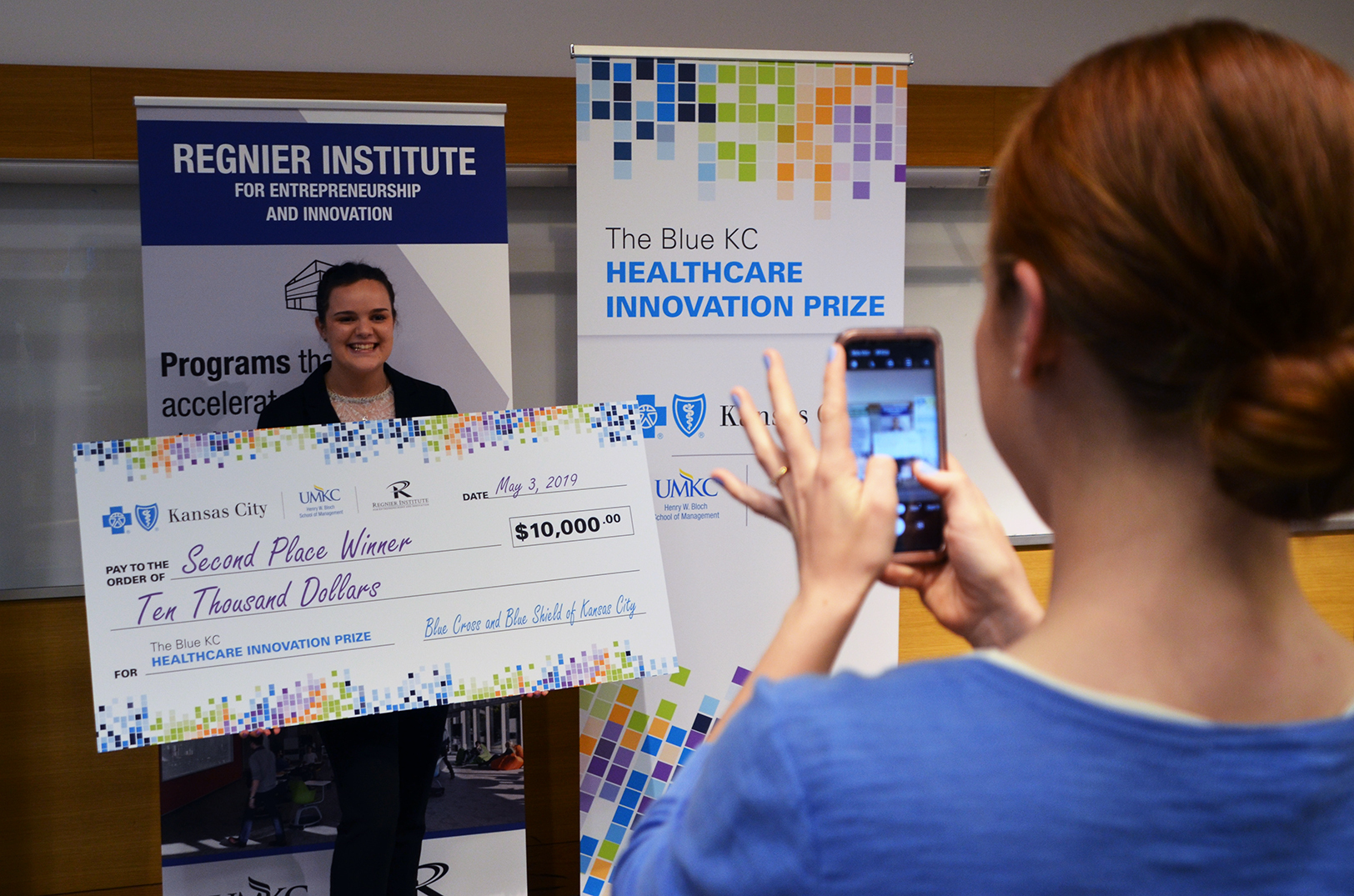
Launching a biotech company based on a class project took the quest for an ‘A’ to a whole new level for two Missouri University of Science and Technology students — founders of Bionic Bowell.
Prompted by professors to find a use for a special ion-interacting glass compound, Vanessa Mahan and Catherine Pollman devised an ingestible version in pill form that could treat Crohn’s Disease and ulcers by altering the pH balance in the stomach, they said.
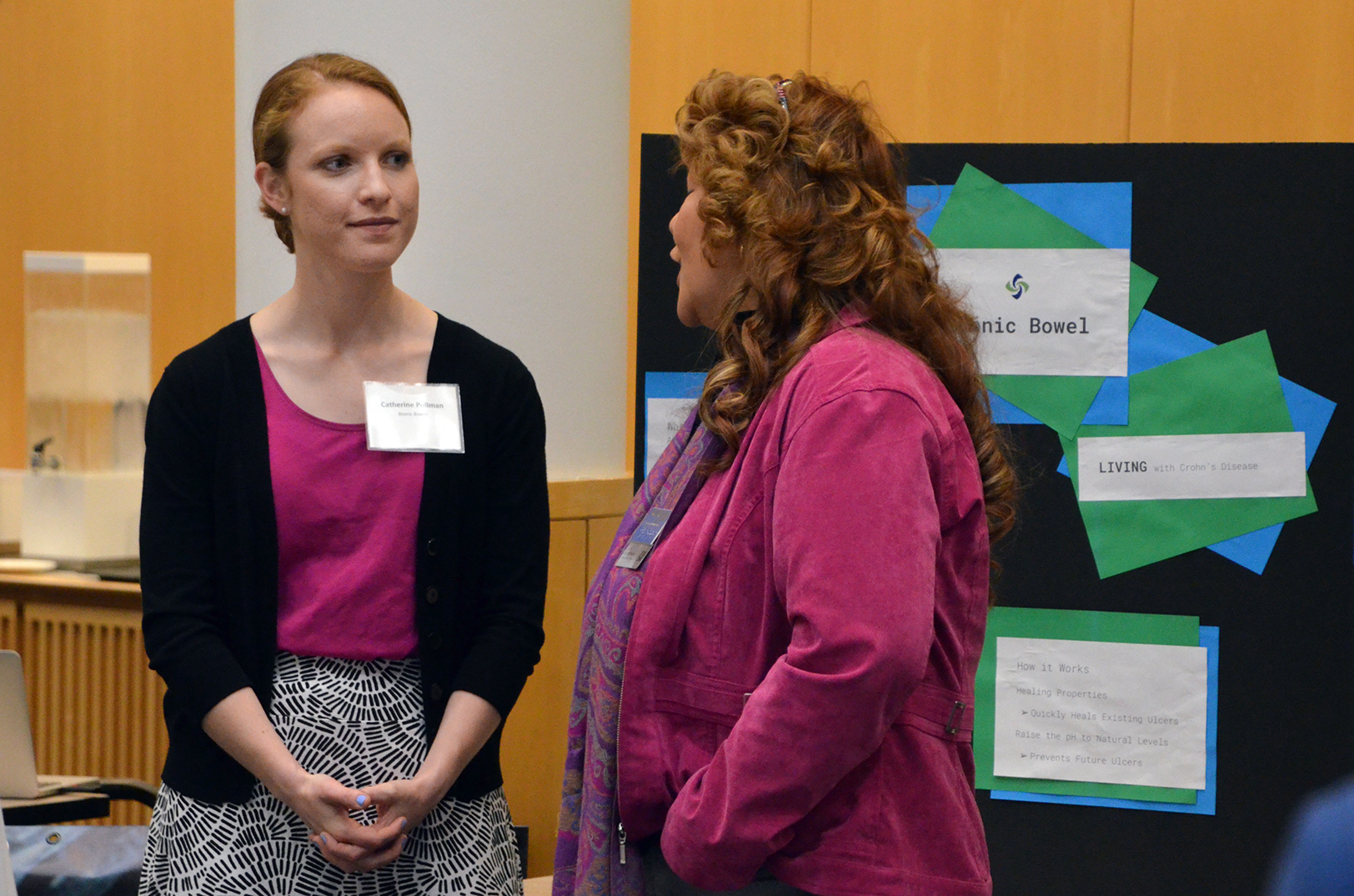
Catherine Pollman, Bionic Bowel, UMKC Regnier Venture Creation Challenge
“From that class, one of the things that they said at the beginning was if you enter and win a competition, you would get an automatic ‘A.’ Vanessa and I liked that,” laughed Pollman.
With one of Mahan’s relatives living with Crohn’s, the Bionic Bowell’s origins were also spurred by personal experience, said Mahan, noting current medications for the autoimmune disorder only target general inflammation in the body and do not focus on healing the stomach itself.
“Medicines like Humira even will just manage their pain and inflammation,” she added. “So there’s this really large market of people who have never found a way to manage their daily lives. We just thought that we could really bring a large impact to that side of the medical community. We hope to just give somebody another option to help them feel better.”
Taking their idea to the University of Missouri-Kansas City’s Entrepreneurship Quest competition, the pair earned third place, later earning the $10,000 second-place prize from the UMKC Regnier Venture Creation Challenge in May, they said.
“It really kind of fell into our lap,” said Mahan. “We met the right people at the right time with all the information to help us in our cause.”
The compound critical to Bionic Bowel is expected to be supplied from Missouri University of Science and Technology, a member of the University of Missouri system in Rolla. Meanwhile, Mahan and Pollman plan to enter the animal-testing stage and actual application of the product before the pair can begin to make strides on the business, they said.
“One of the professors at [Missouri S&T] who invented [the glass compound] really supports our project a lot because he hadn’t really found anything to do with it,” Mahan said. “We pretty much get it for free right now, but that may change as we might start needing a lot more of it.”
The compound itself is owned by the inventor, though patents of its application are free-range for two founders, she added.
“We’ve been very lucky with having mentors who are willing to work with us and give us advice,” said Pollman. “We’re navigating this whole world of business and patents and Big Pharma versus what we’re trying to do, so it’s been a process to find the people that we trust, but luckily we’ve got a couple people that are awesome.”
Funds gained from previously won competitions and more slotted for the future are expected to aid the product-building efforts as the founders try to gain exposure — all while Mahan finishes the last year of schooling and Pollman begins post-graduate life, they said.
“Right now, we’re playing the game of step-by-step,” said Pollman, smiling. “Step 1: do the product testing. Step 2: file for FDA approval and that process alone takes time.”
“But like [Mahan] said, it’s all kind of been an accident so far,” she added. “So, rather than get ahead of ourselves and plan super far ahead, I think we’re just taking it step by step to see what happens.”
Entrepreneurism was a foreign concept to the two biology students before Bionic Bowell became a viable idea, said Mahan.
“Honestly, it never even crossed my mind,” she laughed. “Even while we were doing this whole project for about seven or eight months, we kept hearing that word, ‘entrepreneur’ and we were like, ‘What is that?’”
After being introduced to the Kansas City community however, people went out of their way to help the two founders find their path in the startup arena, she said.
“Some of them provided lab space if we needed it or other resources because when we were first going through the programs, not a lot of people knew anything about medical products,” Mahan said. “All of the [competitors] were like coffee shops and clothing lines. No one else had a pharmaceutical product. So, Kansas City really helped us out. There’s a lot of people from the medical community here to get us resources and people who know the industry to help us further our products.”
“I never set out to be my own boss,” she added, smiling. “But, we have an LLC and everything. It’s weird to talk about.”

Featured Business

2019 Startups to Watch
stats here
Related Posts on Startland News

NXTUS expands enterprise-focused program beyond Kansas; four KC-area startups selected
WICHITA, Kan. — An ongoing initiative to demystify the relationship-building process between emerging entrepreneurs and potential enterprise partners just expanded deeper into the Midwest, welcoming 20 growth-minded innovators from Wichita to St. Louis. “For entrepreneurs whose success depends on forging relationships with ‘the big guys,’ this unique program is so valuable,” said Mary Beth Jarvis, president…

Here’s how Bungii delivered spot No. 981 in its Inc. 5000 fastest-growing companies debut
Nailing Bungii’s geographic expansion model has unlocked significant growth, said Ben Jackson, detailing a years-long evolution that earned his Kansas City-built final-mile delivery carrier a coveted spot on the latest Inc. 5000 fastest-growing companies list. “Bungii’s network is becoming one of the largest sharing economy footprints across the U.S.,” explained Jackson, who co-founded the company…

Caterpillar subsidiary expands into KC, turning dirt to create 85 jobs in revitalized industrial corridor near riverfront
A multi-million dollar expansion project is expected to put an aging manufacturing site back on track in Kansas City, officials at Progress Rail announced Monday, noting the converted operation will focus on re-manufacturing railcar wheelsets and bearings. Progress Rail — a wholly owned subsidiary of Caterpillar Inc. — expects to bring 85 new full-time jobs…
Emerging KC space tech startup relocating to Colorado to build autonomous factory
A space tech startup that shot into orbit from its West Bottoms headquarters in Kansas City has announced plans to build its first smart factory in Colorado — relocating operations to Broomfield to join the Centennial State’s “robust aerospace and defense ecosystem.” “Colorado is home to some of the best aerospace, defense, and manufacturing talent…