

MoCannaHub lights up information prohibition; launches cannabis resource-finding app
June 28, 2019 | Austin Barnes
Rolled in entrepreneurial opportunity, tech companies shouldn’t be afraid to take a hit of the growing marketplace that is cannabis, said Andrew Ellis, explaining the methodology behind MoCannaHub — the app that connects curious consumers with experts and information of various strains.
“Some of the platforms out there are banning cannabis-related content,” explained Ellis, president and founder of Gaudete Development — the creative agency behind MoCannaHub.
“Without naming names, I would say the largest, most recognizable names in social media … [are] blocking cannabis pages and information,” he said.
(Under pressure from the U.S. Federal Trade Commission, social media sites like Facebook, Instagram and Twitter have restricted content related to cannabis, according to Forbes.)
While such behavior can’t be blamed on a single company, Ellis and co-founder Matt Blake noted censorship issues have become increasingly baked into the strategy of platforms where users are encouraged to embrace their First Amendment rights, he said.
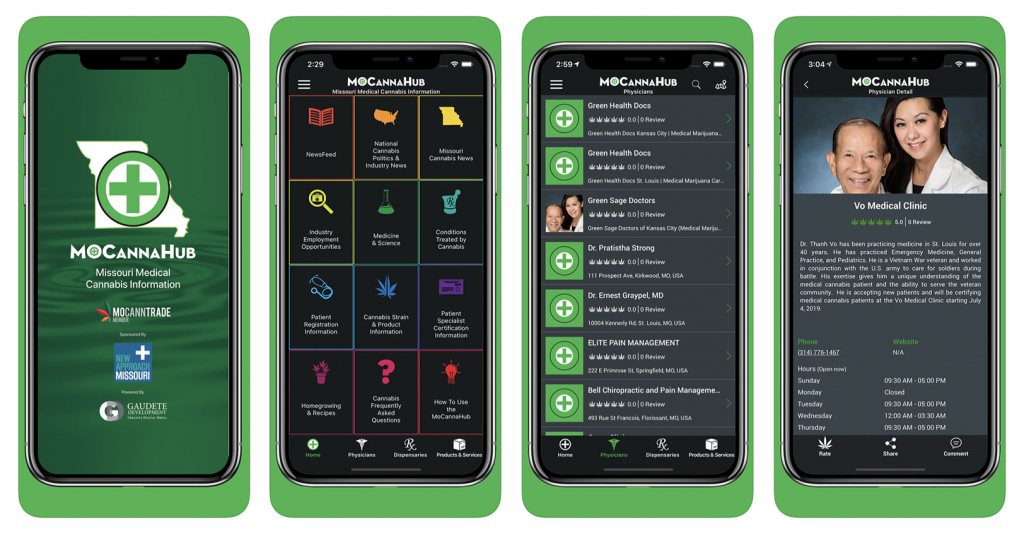
“Being able to get information can be difficult. So we’re bringing it all together in a hub for patients — but also the physicians that are certified [to prescribe medical marijuana], the dispensaries that will be coming online in early 2020 and then the service providers,” Ellis said, highlighting the way MoCannaHub stands to burn down societal judgement in the midst of a modern-day prohibition.
“One of the things that we gleaned from [MoCannBizCon in St. Louis] … I mean, everybody started their sentences with ‘I wish’. ‘I wish there was a place where all the stuff you just mentioned existed,’” added Blake.
Click here to download MoCannaHub from the Apple app store or here to visit the android marketplace.
Enlightened, the pair rode the high of consumer affirmation and pushed forward with MoCannaHub — a product that when used correctly could revolutionize education in the cannabis space for Missourians, they said.
“It’s a source of information on how to become a patient, how to get certified, how to have their medical conditions verified, how to find a physician that will certify their condition and eventually — as dispensaries come online, how to find a dispensary,” Ellis said in example of the way the app serves a cannabis cache.
As more consumers begin to accept cannabis as a common place good, they’re often in the weeds when it comes to product safety and certifications. With MoCannaHub, the smoke is cleared, acknowledged the pair.
“There’s a lot of examples out there of what to do and how to do it correctly, what’s worked and what’s not. Missouri seems to be really on the right track, to doing it and doing it right,” Ellis said. “ … The state itself has guidelines in terms of submissions … we’ll put them up on the hub as a listing [to ease app users frustrations.]”
Education needs in the cannabis space will hold steady as the industry evolves, Blake added.
“This is such a new and really exciting opportunity that I think everyone’s going to be amazed when the studies — they’ve kind of been suppressed over the last 50 to 100 years — when the testing really starts to come out about how beneficial cannabis can be for people’s health, pain management, diet, any and all types of human interaction,” he said of the way he sees the landscape evolving and the need for MoCannaHub along with it.
As CBD shops continue to line corners and growers begin to harvest hemp in open fields outside the metro, the retail high surrounding cannabis isn’t expected to come down anytime soon, the pair said.
Navigating the role tech companies could play in the growth of an emerging industry — not in stifling it — is a big task that could hold significant impact, Blake said.
“Following the rules, complying with the law, that’s where some of the tech innovation is happening and has happened in providing systems to the industry participants that have to follow a big set of rules,” added Ellis. “They’re tracking a plant from seed to sale. Think about all the growers and all the plants and all the dispensaries … just tracking all that data in itself is a challenge. So that’s what we’re seeing the tech industry kind of step up.”
Tackling financial problems for growers, dispensers, and their counterparts could prove to be tech’s biggest asset in the space, he said.
Click here for an in-depth look at another woe for cannabis based businesses: the struggle to secure bank backing.


2019 Startups to Watch
stats here
Related Posts on Startland News

The Jam KC offers space for musicians to get loud, turn up
In a small, Midtown Kansas City room brimming with musicians and their instruments, Allen Monroe peers over his 1963 Hammond B-3 organ at a handful of onlookers. A toothpick concealed by a thick grey mustache emerges as he smiles, preparing to deliver a gentle jab to the artists around him. “Remember, you don’t have to…

Video: Operation Breakthrough helping kiddos reach their full potential
Founded in 1971 by two nuns, Sister Corita Bussanmas and Sister Berta Sailer, Operation Breakthrough serves more than 450 children daily with a mission to provide a safe educational environment for children in poverty. The has adapted through the decades to meet the needs of Kansas City’s low-income community, Operation Breakthrough CEO Mary Esselman said. Implemented…

Coding at age 3? Operation Breakthrough connects STEM to program’s circuitry
Two small boys are standing on stools at a workbench, pretending to talk on outdated handset telephones. They might not yet know how the phones work, but they’re clearly familiar with how to take them apart. And they do. A few feet away, three children from low-income families are on iPads beginning a new lesson.…

Education network CAPS snags $145K from Kauffman Foundation
A homegrown education innovation network announced Wednesday it was awarded a $145,000 grant to expand its programming across the nation, courtesy of the Ewing Marion Kauffman Foundation. The Center for Advanced Professional Studies (CAPS) program began in the Blue Valley School District in 2009 and is now expanded to 33 programs encompassing 69 school districts…