

Father turns grief over son’s loss into healthtech solution for speedier medical records transfers
June 6, 2019 | John Jared Hawks

Chris Jones’ quietly sunny disposition belies the hard knocks peppered throughout his past. Then again, the full-time consultant, masters candidate, and now startup founder sees all past experience as a catalyst for growth, he said.

Chris Jones, MatchRite Care
“Everything you’ve been through in life prepares you for this moment, now,” said Jones, founder of MatchRite Care. “So you pull from that — the good the bad and the ugly — you learn how to pull from it all.”
MatchRite Care is one of five companies selected to present their software this weekend at DevDays US 2019, the largest Fast Healthcare Interoperability Resources (FHIR — pronounced “fire”) event in the world. MatchRite aims to solve a complex problem decades in the making: how to quickly and effectively transfer patient medical records between service providers.
“Many patients are forced to rely on their provider to send their medical records to them in a timely manner,” Jones said. “It is even more cumbersome to have your records moved or shared with another provider. According to a recent Black Book survey, 41 percent of surveyed health administrators face challenges when attempting to exchange electronic health records [EHR] between providers — specifically, providers operating on different EHR platforms.”
A fateful medical delay
On many levels, the self-described “adopted native” of Kansas City is intimately familiar with the problem.

Chris Jones and Christopher “CJ” Jones Jr.
In June 2008, Jones’ 5-year-old son, Christopher “CJ” Jones Jr., was diagnosed with an inoperable brain tumor. The news led Jones to search for clinical trials, cutting-edge therapy, and any other option to heal his child. Near the end of CJ’s one-year prognosis, a clerical delay common to the current medical records system caused a missed clinical trial opportunity for Jones’ son.
“There is no proof that the trial would have helped, but it could have given CJ a chance at life as he later transitioned in May of 2009,” Jones said.
The grieving father became a healthcare information technology director, where he witnessed firsthand the cumbersome nature of utilizing existing EHR systems, which still hearken back to the days of government-mandated medical record digitalizations.
“Everybody started to develop their own electronic medical records systems, with no standards to it,” Jones explained. “You can’t really backtrack and get rid of all of those systems, you can only try to create interoperability between them.”
Current antidotes to the problem revolve around regional Health information exchanges (HIEs). After getting caught up in a round of layoffs, Jones found himself with time to gain perspective on why the current industry standards are ineffective.
“Every system goes into this one bucket, the HIE,” Jones said. “But there is no organization, and the patient is not going to know how to go dish their information out.”
Just getting started
With the problematic Health information exchanges in mind, Jones imagined a patient-centric, easy-access medical records system. Over the course of 11 months, this vision morphed from spare hours tinkering to passion project to a full-blown startup, branded MatchRite Care. Jones secured the organization’s patent in April and has since been met with enthusiasm from investors and health-care providers, already numbering several doctors among his investors.

Click here for MatchRite Care updates.
Jones said his mindset — and life experience — are making investors take notice.
“Investors, they want to know that you are true to your product and you are going to see your product out,” Jones said. “Because my focus has always been on my son and what happened to him and trying to fix it, I have never strayed away from my ultimate purpose, which is to put medical records in the patient’s hands.”
For now, Jones is prepping his DevDays talk and working toward his masters degree in software development.
“Not really [to say I have a] degree, but more to understand what’s going on in technology today,” Jones said. “I’m trying to be in a constant state of learning.
“I know I’m not finished yet – I’m actually just getting started,” he said.


2019 Startups to Watch
stats here
Related Posts on Startland News

KC Rising red flag: Educated talent leaving KC, metro tech jobs unfilled
More college-educated workers are leaving Kansas City than being drawn to the region, according to a new KC Rising report. That means local companies are forced to look outward for qualified talent, said Ryan Weber. “Most of those tech firms are hiring; it’s just for skill sets that few people have,” said Weber, president of…

Students struck by KC gun violence search for solutions at MECA Challenge
Editor’s note: MECA Challenge and Startland News are both programs of the Kansas City Startup Foundation, though the content below was produced independently by Startland. For more information on the relationship, click here. Escaping the cycle of gun violence can seem impossible, said Lea Thompson, still wearing a cast on her hand after being shot…
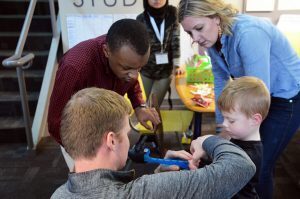
STEAM Studio team coding best fit for boy’s 3-D-printed prosthetic arm
Four-year-old Hudson Borton extended his arm Wednesday, as his father fitted a 3-D-printed prosthetic to the boy’s upper arm and elbow. The light blue plastic piece mimicked the size and length of Hudson’s right arm, though his father and Mandi Sonnenberg, co-founder and director of STEAM Studio, agreed the new device wasn’t yet a perfect…

KC-based SouveNEAR vending machine startup prepping to scale up
SouveNEAR offers travelers a piece of KC — from KC, said co-founder Tiffany King. The Kansas City-based startup, which repurposes vending machines to sell locally made souvenirs, is in its fourth year of steady, organic growth, King said. As a member of ScaleUP! KC new class, SouveNEAR is preparing to grow the business and turn…