

Connecting for Good refurbishes The Surplus Exchange with merger championing digital inclusion
May 16, 2019 | John Jared Hawks

Two Kansas City nonprofits are melding their expertise into a spearhead against the digital divide.
“This is just the beginning of what will be a long-term love affair between Connecting For Good, digital inclusion, environmental leadership, and the Greater Kansas City metro and regional area,” said Tom Esselman, CEO of Connecting for Good.
The Kansas City nonprofit — dedicated to fostering digital inclusivity through providing affordable internet, computers, digital skills and partnerships to low income communities — recently announced its consolidation with The Surplus Exchange (TSE), a longtime area nonprofit specializing in electronics recycling and used office furniture resale.
“Changing market conditions have challenged our operations and leadership to adapt to our business model to better support an increasingly robust mission,” said Jessica Merrigan, TSE board co-chair. “We could not be happier with Connecting For Good as the partner we have selected to preserve and grow the legacy that TSE has created with all of our clients and community partners over the past 20-plus years.”
The “marriage,” as Esselman describes it, is advantageous to both organizations and the greater community in a number of ways, he said. Foremost among them is the potential synergistic impact of two established nonprofits running under one roof, he said.
Click here for the history of Connecting for Good in KC.
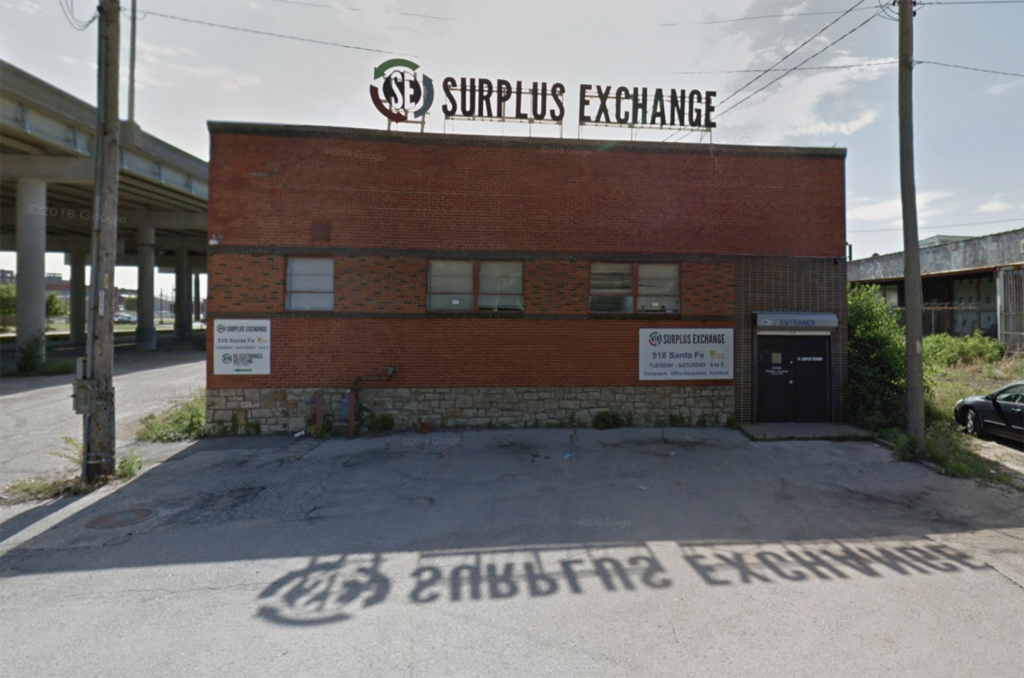
The Surplus Exchange, West Bottoms
“TSE and CFG are community organizations dedicated to helping low income communities to improve their conditions in a sustainable fashion,” Esselman said. “TSE has long been a environmentally responsible recycler, focusing on both office furniture and equipment, including computers. CFG has been, for a much shorter time, a digital inclusion champion, providing low cost internet access, computers, and digital skills training to help bridge the digital divide.”
“By combining both groups, we have formed an emerging social enterprise with the hopes of elevating both digital inclusion and environmental stewardship to new levels of relevance among the broader community outside the urban core,” he added. “Kansas City has been recognized, and has an opportunity to grow its reputation as a national leader in this combination of digital leadership and environmental responsibility.”
TSE’s operations will also augment the existing funding engine keeping Connecting for Good’s educational resources free: electronics refurbishing.
“We provide digital skills training, financial literacy training, and job skills training, all this to get people on a path toward not only productively using the Internet, but doing in a way that they can see their way as a path out of poverty,” Esselman explained. “Those are services that we provide at no charge. In order to sustain that work targeting low income populations, we view the operations of The Surplus Exchange as providing an opportunity for us to create some financial sustainability for our organization.”
As alluded to by Merrigan, the consolidation also gives TSE an out for dealing with increasingly difficult market conditions.
“About two years ago, the commodities market pricing — particularly for broken down materials like metals and plastics — became a little more challenging,” Esselman said. “Tariffs and other things limited the ability of United States suppliers to sell off these materials — it made the whole aspect of being a recycler a lot more challenging for The Surplus Exchange.”
Work is currently under way to complete the transition and re-opening, and Esselman teased as-of-yet-unannounced activities and events tied to The Surplus Exchange’s West Bottoms warehouse, located at 518 Santa Fe St. For now, the throughline of TSE and Connecting for Good’s story will continue.
“This year we’ve got a theme, and the theme is, ‘Building resilient communities,’” Esselman said. “I like the word ‘resilient’ because communities all over the country face challenges, but the beautiful thing about using digital technology to keep people connected and is it gives people the skills and resources they need to advance to a better situation.
“That’s the common thread that goes through the individuals that make up The Surplus Exchange and Connecting For Good as organizations. We are committed first and foremost to making our community a better place.”
For more on the digital inclusion movement, check out the National Digital Inclusion Alliance.

Featured Business

2019 Startups to Watch
stats here
Related Posts on Startland News

‘My soul is being fed’: Shonta Dabney sips the small wins in her round-the-clock quest to bring Black-roasted coffee home
While most kids were drinking milk, juice, or plain old water — Shonta Dabney held a warm mug in her hands, sipping coffee at the kitchen table with her grandparents, she recalled. “I have to be one of the very few Americans whose grandparents gave her coffee as a toddler,” Dabney laughed, looking back on where…

Just funded: First wave of Alchemy Sandbox grants aim for ‘snowball effect’ in KC
A new grant program has selected its first five awardees — with 15 more to come in 2022 — aiming to create rolling momentum for Kansas City’s main street businesses, said Miranda Schultz. The Alchemy Sandbox Program on Friday announced its first quarter grantees with entrepreneurs selected to receive as much as $5,000 for their…

SnapIT scores lucrative government contract with $50B ceiling in emerging tech space
An Overland Park IT firm’s selection to deliver technology solutions to federal agencies is the latest evolution of the Johnson County business, which has seen rapid growth over the past three years as it expanded its focus. SnapIT Solutions, a high-tech services and tech training firm headquartered in Johnson County, was tapped for the second…
Just another day in Paradise (EDU): Urban nursery turns soil to nurture STEAM students
When learners dig into the Paradise Garden Club STEAM program, they unearth non-traditional learning opportunities in a classroom cased in chlorophyll. “It starts on a very base level — using your hands to work with raw soil,” said Jessica Teliczan, owner and operator of Crossroads-planted Paradise Garden Club, teasing the newly launched effort — formally branded…