

KCMO ready to do business with marijuana startups; entrepreneurs of color see ‘catalyst for empowerment’
April 20, 2019 | John Jared Hawks

A green rush is soaking up sunshine in Missouri, and if attitudes of state officials, businesses owners and marijuana advocates are any indication, Kansas City is fertile ground for the movement.
“We have a huge diversity of business opportunities,” said Rick Usher, KCMO assistant city manager for entrepreneurship and small business.

Rick Usher, KCMO
Usher is spearheading the city’s preparation for implementation of Amendment 2, a landmark constitutional amendment passed by Missouri voters in November 2018. The vote legalized marijuana for medical purposes, paving the way for a vanguard generation of entrepreneurs in the state hoping to capitalize on the law change.
Per the amendment, up for grabs are (at minimum) two testing facility licenses, 60 cultivation facility licenses, 86 marijuana-infused products manufacturing facility licenses, and 192 dispensary licenses (24 per congressional district). While the Missouri Department of Health and Senior Services is currently accepting application fee payment, the department won’t begin accepting the applications proper until August.
In the meantime, a spectrum of professionals are hard at work preparing for the licensing
process. For Usher’s part, Kansas City is trying to make itself appealing to cannabis startups based on regulatory ease.
“I think what we are hoping to get to — once the process is set — is that it would be easy as licensing a local pharmacy or similar type of business,” Usher said. “With the state handling most of the higher-level regulatory side of things, we don’t see the need to create another bureaucracy at the city level.”
Midwestern cities actually have a red-tape advantage, Usher said.
“Regulatory burdens, if you did a bar graph of them, it would look like a jump rope from coast to coast,” he said. “There are super high regulatory burdens on the coasts, and really low regulatory burdens in the Midwest. Processes that would take two years elsewhere takes six months here.”
Check out KC Bizcare for more startup resources.
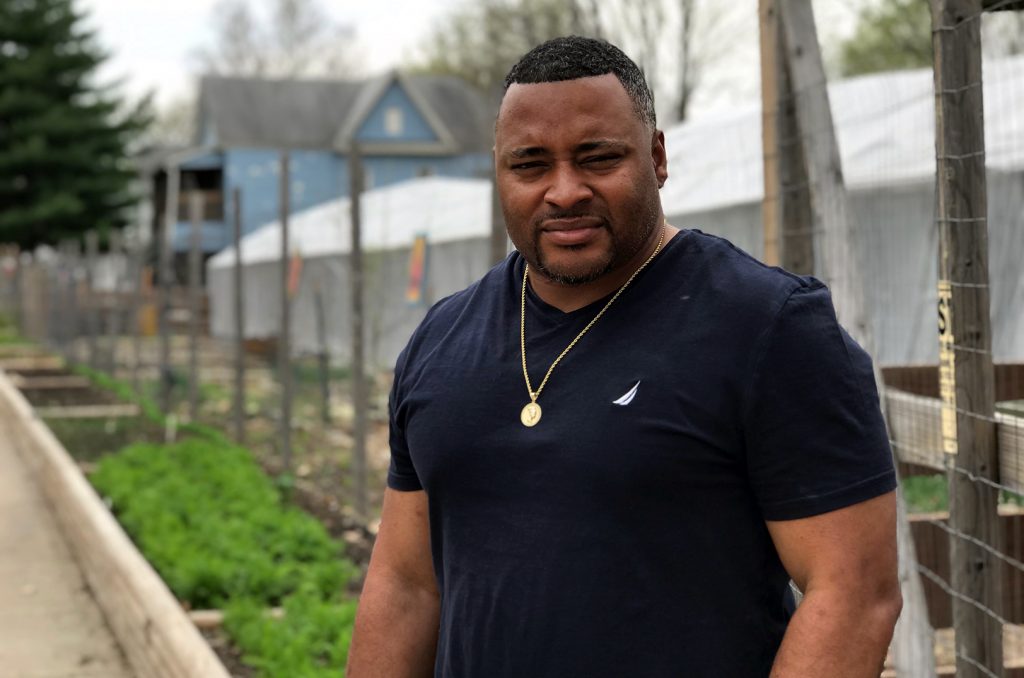
Dre Taylor, Nile Valley Aquaponics
Urban ag and the War on Drugs
Usher also anticipates ancillary positive industry effects on KC.
“The research is out there that there are a lot of community benefit from medical marijuana being legalized,” he said. “We are positioned well for that, and we have had strong support for urban agriculture.”
A leading voice in Kansas City’s urban ag scene hopes to join the cannabis startup movement with an as-yet unbranded initiative of his own.
Dre Taylor, founder of Nile Valley Aquaponics, sees Missouri’s green rush as a chance for members of minority communities to recoup familial and socio-economic losses sustained during the now-infamous “War on Drugs,” a federal initiative started by the Nixon Administration shown to have unfairly targeted minorities.
“That was going on for over 30 years, and now that it’s legal, [minorities] don’t have the same leg up as other groups do — groups who weren’t specifically targeted and who’s families and communities weren’t destroyed,” Taylor said. “I want to see a portion of the energy that was put into criminalizing people put into equity programs, which some states, like Massachusetts, California, and Washington have done.”
Though he’s seen little to inspire hope by way of legislation, Taylor’s vision for his own fully integrated cultivation, manufacture and dispensary startup includes generating opportunity for east Kansas City’s urban core minority participation in the cannabis industry — despite the risk involved.
“It’s a big risk, mainly in nonrefundable fees that you have to pay during licensing, as well as paying someone to write the application,” Taylor said.
Dispensary and manufacturing license applications carry a price tag of $6,000, and cultivation licenses applications are $10,000. And that’s not counting the cost of drafting the application itself.
“It’s something a lot of people don’t talk about,” Taylor said. “It’s a 200-page application and there are companies charging up to $100,000 to write this application. Each license can be worth up to $500,000 to $1 million, so it’s a good investment, but a risky investment at the same time.”
Click here for more on Taylor’s nonprofit urban ag initiative.
Equity through entrepreneurism
Despite the complex application processes and a highly competitive field, Roz McCarthy sees a plethora of upshots to the situation. McCarthy is CEO of Minorities for Medical Marijuana (M4MM), a nationwide nonprofit with a goal of providing cannabis advocacy, education, training, and outreach to underserved communities.
“In other states, people of color and other minorities have been priced out of the cannabis ecosystem from an economic standpoint.”
— Roz McCarthy, CEO of Minorities for Medical Marijuana (M4MM)
“In other states, people of color and other minorities have been priced out of the cannabis ecosystem from an economic standpoint,” McCarthy said. “Missouri did a great job [with the $6,000 dispensary application fee and $10,000 cultivation site application fee]. I can’t tell you how many states where the entry fee is $60,000.”
McCarthy said that license volume will also factor into the positive column of Missouri’s cannabis industry equity scoresheet. Missouri’s 192 available dispensary licenses — versus, say, 10 licenses in the state of Florida — mean that smaller startups are better positioned to withstand competition from larger operations.
“The big MSO’s — multi-state operators — they don’t want to come into a market that is going to be saturated, or have that much competition,” McCarthy said. “That’s not their business model. They are geared toward markets where there is a high point of entry, and then dominating the market to reduce competition.”
According to McCarthy, these factors potentially create a system with inbuilt equity.
“We haven’t seen it come full circle, but it looks like a catalyst for empowerment,” McCarthy said.
For more on M4MM, including their ongoing St. Louis licensing boot camp, click here.
Looking to the future, Usher is confident in the greater KC startup scene’s ability to harness the green rush’s potential — it’s primed for it, he said.
“As far as a 20-year vision for our entrepreneur community, we are five years into the vision we started with, and we are building the capacity to support business like this,” he said.
“It’s another indication of the growth and maturity of the startup community.”
Want more nitty-gritty? Click here for Amendment 2 info, and here for Missouri DHSS medical marijuana licensing specifics.

Featured Business

2019 Startups to Watch
stats here
Related Posts on Startland News

Midwest crypto platform Normal aims to bring blockchain ‘banking’ to the mainstream
Cryptocurrencies are poised to radically disrupt and transform monetary systems across the globe, said Joshua Blew, noting the coming financial freedom offered by such developments is closely tied to individuals’ access to the best tools and ownership of the right assets. But connecting to them in a world of banking behemoths and entrenched financial institutions…

KC Chamber set to honor steward of economic inclusion with its 2024 ATHENA award
Transformational leadership guides Qiana Thomason’s purpose, officials with the KC Chamber said, detailing the Health Forward Foundation executive’s commitment to health equity through strategic community investments and policy influence through seasoned social capital. Thomason is set to be honored 5 p.m. Oct. 16 at Starlight Theatre during the Greater Kansas City Chamber of Commerce’s 2024…

From Cleveland Heights to KC: This streetwear brand opens season on Midwest style
As anticipation builds for Thursday’s Chiefs home opener at Arrowhead Stadium, Aric Jones is channeling that energy into his streetwear venture — a play that brings Travis Kelce’s childhood best friend’s lifestyle and clothing brand from Cleveland Heights to Kansas City. Homebred is debuting a six-month showroom at KC Beauty Collective, 1819 Wyandotte St., during…

A business strategy that never changes: Founders must learn to evolve, expert says
In her three decades as an executive leadership coach, Teresa Carey’s seen a lot of changes, she shared. But at the core, people are still the same, she added. “People still want authenticity,” said the founder of PerformancePointe. “Relationships matter. Trust matters. So some things will never go out of style. The craving for connection…