

Skip restaurant lines (and downloading another app) with text-based ordering
March 13, 2019 | Elyssa Bezner
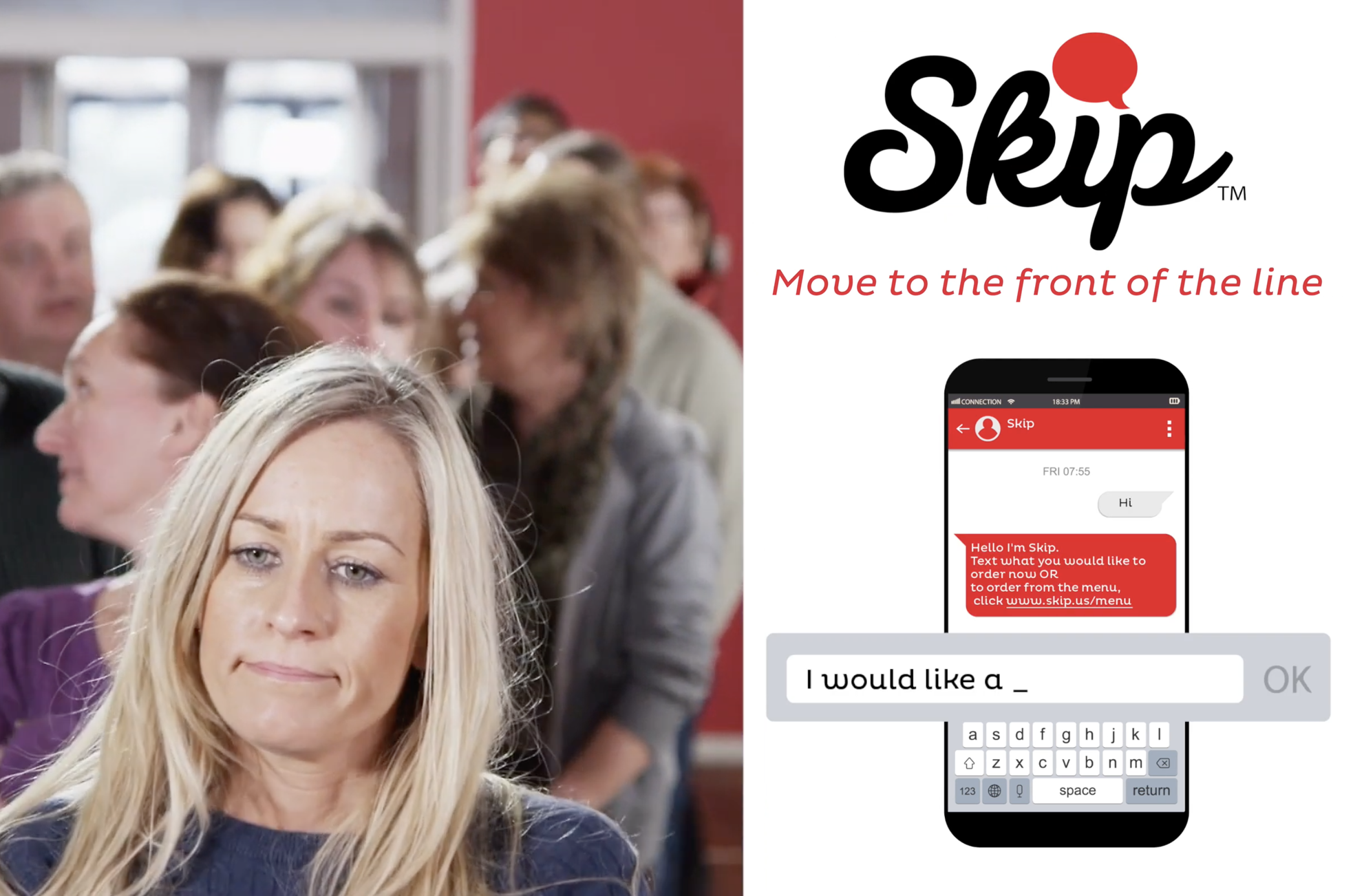
In an increasingly automated world, American consumers are experiencing app exhaustion while continuing to need innovative solutions to address daily pain points like waiting in lines at their favorite restaurants, said Eric Tucker.
Founders: Eric Tucker and Chuck Vanasse Founding year: 2015 Amount raised to date: $1.7M Noteworthy Investors: Target Hill Capital Current employee count: Six
“People are tired of downloading apps,” said Tucker, founder of KC-based Digital Baron, which delivers Skip, an app-less mobile and pay platform. “There are 50,000 different brands in the U.S. — do you think that someone’s going to have even a small portion of those apps on their phones? There’s just not enough space.”
Click here to learn more about Skip.
Skip allows customers to order via a text shortcode or kiosk in restaurants without eating up space on their phones, he added, noting the platform increases the speed and accuracy of service.
“Those fast food businesses feel like their staff has enough on their plate dealing with the rush hours, so having to also take a text message and enter it in and deal with questions [wouldn’t work],” said Tucker. “We needed to have it sent right to the point of sale, which then goes to the kitchen. Nobody touches the order.”
A recent pilot test through three locations of a large, national brand proved the platform could also increase the average amount spent by customers, he said, noting Digital Baron hopes to continue partnering with brands and other food-focused service platforms.
The platform originally took shape as a solution catered to the hearing impaired, he added, noting the idea came to him after a bad experience with a drive-thru on a rainy day.

Eric Tucker, Digital Baron
“I can’t hear out of one ear, so it was a frustrating [experience],” said Tucker.
Co-founder Chuck Vanasse pointed out that many customers are dissatisfied with the current methods of service, said Tucker, noting the duo built Skip throughout 2016 as the only natural language processor focused on the restaurant space and discussed utilizing artificial intelligence and natural language processing tools before the concepts took flight in recent years.
“Now, placing an order is as easy as sending a text — because it is sending a text,” he added.
Getting connected with local venture fund Target Hill Capital in December 2017 provided the avenues for the pilot test for the major brand, he added.
Click here to learn more about Target Hill Capital and its mission to defuse risk on startups between friends and family funding to seed stages.
“We really liked what they were doing and their vision of where they would go,” said Marshall Dougherty, partner at Target Hill. “They are really now poised to grow to the next level.”
“They’re an agile team who executes well, learns quickly, and applies the knowledge gained to improve the product,” he added. “I have no doubt Skip will soon be improving the ordering experience for consumers everywhere.”
Click here to read more about Marshall Dougherty and his four basic values that drive entrepreneurial success.

Featured Business

2019 Startups to Watch
stats here
Related Posts on Startland News
In address to Congress, Victor Hwang urges action on entrepreneurship deficit
Tapping into his own entrepreneurial story, the Ewing Marion Kauffman Foundation’s vice president of entrepreneurship testified before Congress on cutting obstacles to starting a business. Before the U.S. House Small Business Committee, Victor Hwang joined an expert panel of entrepreneurs and researchers to discuss common struggles entrepreneurs face, possible solutions and emerging trends. As Republican…

Kansas City milkman Matt Shatto launches new ag tech company
Matt Shatto — co-founder of the the popular Kansas City dairy Shatto Milk Company — is trailblazing new sustainable tech to help farmers reap more crops and reduce costs. Launched in 2016, Kansas City-based TerraManus Technologies created a patented device that helps farmers better manage soil and allocate water resources. The “TerraStar Disk” looks like a plastic…
Google Fiber losing ‘hundreds’ of employees but continues KC expansion
Google Fiber is reportedly trimming its employee count after announcing its new CEO. Business Insider reports that months after its former CEO Craig Barratt resigned, Google Fiber has hired Gregory McCray as the new leader of Access, the division of Google’s parent company Alphabet that includes Google Fiber. The gigabit provider also will lose “hundreds”…

Urban TEC is building a more diverse STEM workforce
Despite a U.S. tech workforce that’s grown more than 80 percent in the last 20 years, less than one percent of black women are employed in STEM careers. As a black women in technology herself, Ina Montgomery took this statistic as a call to action to empower black women. “You’re going to need have a…