

Federal data privacy laws are coming; Here’s what you should consider
March 29, 2019 | Ryan Weber
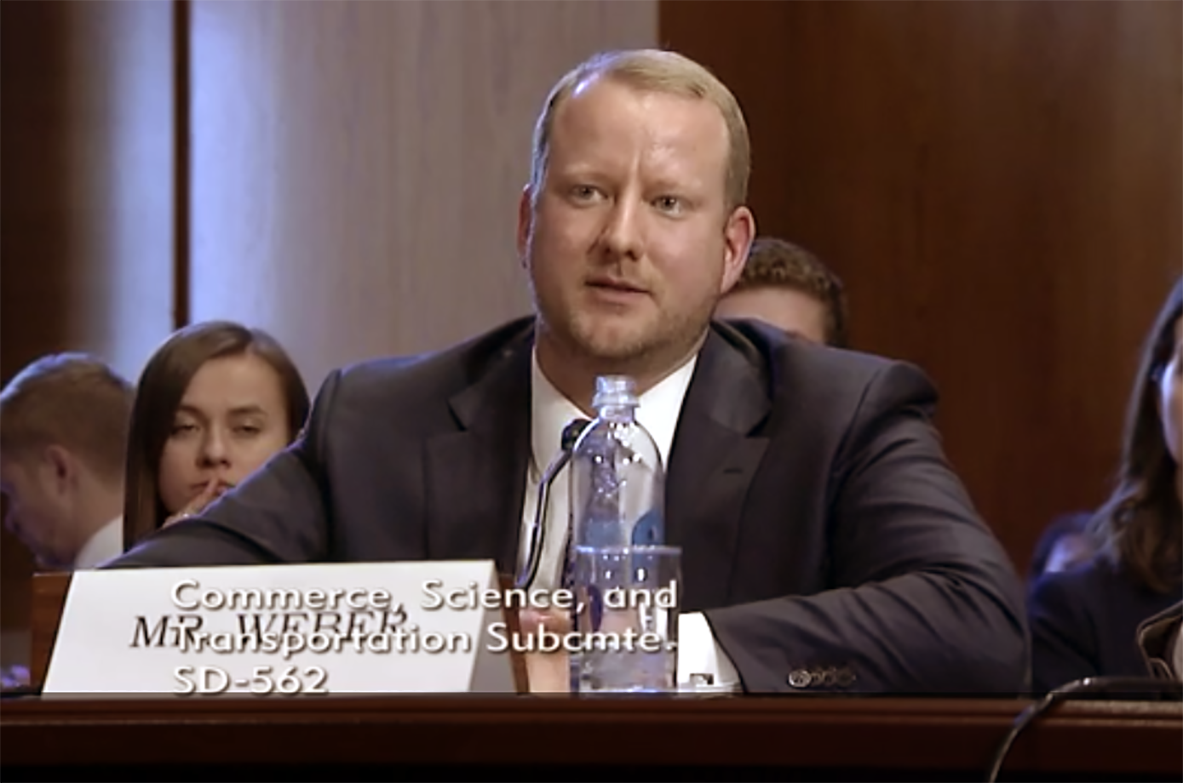
Editor’s note: The opinions expressed in this commentary are the author’s alone. Ryan Weber, KC Tech Council president, on Tuesday testified before a U.S. Senate subcommittee on “Small Business Perspectives on a Federal Data Privacy Framework.”
I recently had the privilege of testifying before a U.S. Senate Subcommittee, chaired by U.S. Sen. Jerry Moran, R-Kansas, about the potential impacts federal data privacy laws could have on small and startup tech businesses. You can read our full testimony here.
Before I ask you to contact your elected officials — and you should — it’s important everyone understand what’s coming because this law won’t only impact businesses. Anyone who stores or shares data over the web will be affected. And unless someone printed this piece for you to read, this means you.
The European Union (EU) was among the first to pass data privacy laws called the General Data Protection Rights (GDPR). These laws don’t just impact EU-based companies or those doing business there. The same rights protect the users, individuals, from the EU who visit websites, regardless of where the company with the website is located.
Last year, California passed the Consumer Protection Act (CCPA) rather swiftly and shocked many in the tech industry. Though different in many ways, the spirit of this law has some of the core principles written in GDPR. Many other states have soon followed suit and proposed their own set of statutes. The resulting effect could be a patchwork of varying state-by-state laws, confusing users and making compliance nearly impossible for companies.
In my conversations with tech companies, big and small, there is strong support for the U.S. to pursue overarching data privacy laws at a federal level. There is little to no support for states to continue and pass their patchwork of individual laws. The cost to comply with could be overwhelming for small and startup companies. Enforcement would also be inconsistent. In other words, it’d be a mess. Therefore, it’s crucial Congress act to preempt these state laws with a sensible federal law.
As this legislation is developed by Congress, here are key questions for tech companies to consider:
- How should Congress US control the “bad actors,” without overregulating everyone else?
- What entity should be enforcing these laws? Should states have a role with enforcement?
- Regarding enforcement, how should fines be determined? What about on the first offense?
- How should Congress define sensitive data?
- If exemptions for small business were created, how should Congress define a small business?
Data privacy is a complicated issue, and these questions are only a small part of the overall debate. A draft bill is forthcoming, and this conversation will continue to heat up once we have something tangible to debate. In the meantime, I encourage KC’s tech community to continue to discuss this issue. And yes, I want you to contact your elected officials, and I think they’d appreciate your thoughts on the questions above. Your voice matters and they do listen.
Ryan Weber is president of the KC Tech Council, a nonpartisan, regional advocate for the Kansas City tech industry.


2019 Startups to Watch
stats here
Related Posts on Startland News

5 ways to diversify your hiring pipeline (Hint: it starts with admitting you’ve fallen short)
Editor’s note: The opinions expressed in this commentary are the author’s alone. Stephanie Campbell is an operations and communications leader at LEANLAB Education in Kansas City. A few months back, I put the last period at the end of my hiring project plan and felt content. I had set out to completely redesign the way…

Spark MHK hopes to ignite innovation in an ecosystem often dominated by students, soldiers
MANHATTAN — An entrepreneur’s potential is anything but bite size in the Little Apple, Sarah Siders said. “I’m really excited to be able to do this,” Siders, executive director of Spark MHK, said in announcement of the recent launch of the Manhattan-based entrepreneurial support organization — which aims to ignite activity within the regional entrepreneurial ecosystem…

8 TED Talks to help build the ideal team at your startup
Editor’s note: The opinions expressed in this commentary are the author’s alone. Stacy Rose is chief operating officer and partner at AdamsGabbert, a staffing, IT services, and business consulting firm. This article was sponsored and produced by AdamsGabbert. As the country’s unemployment rate continues to improve, entrepreneurs are beginning to fill their rosters. Yet, in…

CARES Act grants 250 Kansans free tech training, equipment through SnapIT Solutions
With tech positions dominating the market for open and remote jobs, Kansas residents now can enroll in a free, government-funded certification course on IT, cybersecurity or IT project management through SnapIT Solutions, said Neelima Parasker. SnapIT — an Overland Park technology solutions and training company — received funds from the federal CARES Act grant, which…