

Federal data privacy laws are coming; Here’s what you should consider
March 29, 2019 | Ryan Weber
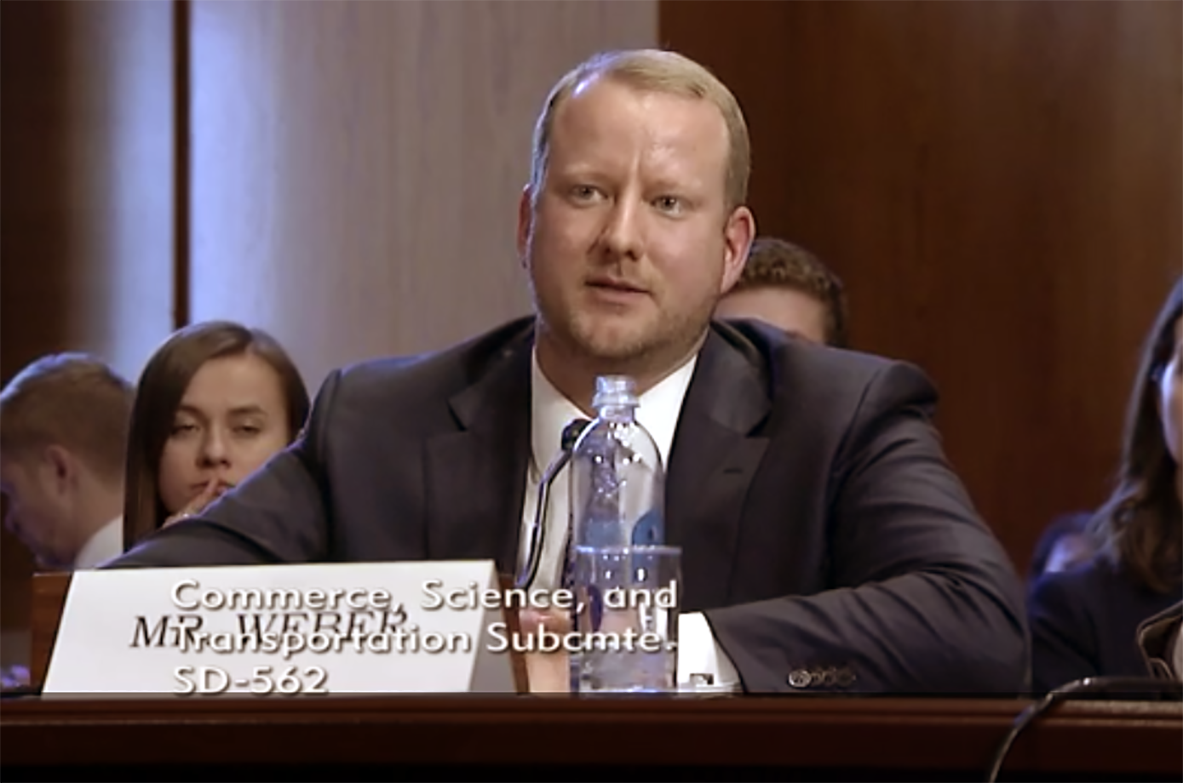
Editor’s note: The opinions expressed in this commentary are the author’s alone. Ryan Weber, KC Tech Council president, on Tuesday testified before a U.S. Senate subcommittee on “Small Business Perspectives on a Federal Data Privacy Framework.”
I recently had the privilege of testifying before a U.S. Senate Subcommittee, chaired by U.S. Sen. Jerry Moran, R-Kansas, about the potential impacts federal data privacy laws could have on small and startup tech businesses. You can read our full testimony here.
Before I ask you to contact your elected officials — and you should — it’s important everyone understand what’s coming because this law won’t only impact businesses. Anyone who stores or shares data over the web will be affected. And unless someone printed this piece for you to read, this means you.
The European Union (EU) was among the first to pass data privacy laws called the General Data Protection Rights (GDPR). These laws don’t just impact EU-based companies or those doing business there. The same rights protect the users, individuals, from the EU who visit websites, regardless of where the company with the website is located.
Last year, California passed the Consumer Protection Act (CCPA) rather swiftly and shocked many in the tech industry. Though different in many ways, the spirit of this law has some of the core principles written in GDPR. Many other states have soon followed suit and proposed their own set of statutes. The resulting effect could be a patchwork of varying state-by-state laws, confusing users and making compliance nearly impossible for companies.
In my conversations with tech companies, big and small, there is strong support for the U.S. to pursue overarching data privacy laws at a federal level. There is little to no support for states to continue and pass their patchwork of individual laws. The cost to comply with could be overwhelming for small and startup companies. Enforcement would also be inconsistent. In other words, it’d be a mess. Therefore, it’s crucial Congress act to preempt these state laws with a sensible federal law.
As this legislation is developed by Congress, here are key questions for tech companies to consider:
- How should Congress US control the “bad actors,” without overregulating everyone else?
- What entity should be enforcing these laws? Should states have a role with enforcement?
- Regarding enforcement, how should fines be determined? What about on the first offense?
- How should Congress define sensitive data?
- If exemptions for small business were created, how should Congress define a small business?
Data privacy is a complicated issue, and these questions are only a small part of the overall debate. A draft bill is forthcoming, and this conversation will continue to heat up once we have something tangible to debate. In the meantime, I encourage KC’s tech community to continue to discuss this issue. And yes, I want you to contact your elected officials, and I think they’d appreciate your thoughts on the questions above. Your voice matters and they do listen.
Ryan Weber is president of the KC Tech Council, a nonpartisan, regional advocate for the Kansas City tech industry.


2019 Startups to Watch
stats here
Related Posts on Startland News

White House expected to endorse Kansas City-built COVID-19 exposure tracking app
Editor’s note: The following is part of Startland News’ ongoing coverage of the impact of Coronavirus (COVID-19) on Kansas City’s entrepreneur community, as well as how innovation is helping to drive a new normal in the ecosystem. Click here to follow related stories as they develop. The White House is expected to announce its support for…

Blockchain Basics: It’s more than a tech buzzword, but how does it actually work?
Editor’s note: The opinions expressed in this commentary are the author’s alone. Kenyon Briggs is an attorney at Husch Blackwell in Kansas City. This op-ed is part of a limited series on blockchain sponsored by Husch Blackwell. What is blockchain technology? Technically precise definitions found on Google define it as “a distributed, decentralized, public ledger.”…

Open letter to KCMO: Entrepreneur community makes 0.1 percent budget ask ‘for backbone of our economy’
Editor’s note: The following open letter was produced independently of Startland News by a coalition of small business and entrepreneur support leaders and signed by more than 210 members of Kansas City’s startup and business community. The opinions expressed in this commentary are the authors’ alone. The signatories are provided courtesy of the authors. Mayor Quinton…

Plug and Play innovation summit unleashing Topeka’s animal health, agtech potential
Startland News’ Startup Road Trip series explores innovative and uncommon ideas finding success in rural America and Midwestern startup hubs outside the Kansas City metro. This series is possible thanks to the Ewing Marion Kauffman Foundation, which leads a collaborative, nationwide effort to identify and remove large and small barriers to new business creation. TOPEKA…