

New Kauffman indicators point to more fertile ground for startups on Missouri side of state line
February 22, 2019 | Startland News Staff
A new analysis of early-stage entrepreneurship over the past 20 years indicates a more welcoming environment for fostering startups has developed in the Show Me State.
In a state-by-state breakdown released Thursday by the Ewing Marion Kauffman Foundation, Missouri outperformed Kansas across the board. Overall, Missouri’s scores showed climbing measures of entrepreneurship, while Kansas saw activity on the decline.
Click here for an interactive data table detailing the findings across all 50 states.
The report takes into account four key indicators that track changes in entrepreneurial activity over time (1996-2017), across geographies, and among various demographics. The indicators include:
- Rate of new entrepreneurs — The broadest measure possible for business creation by population.
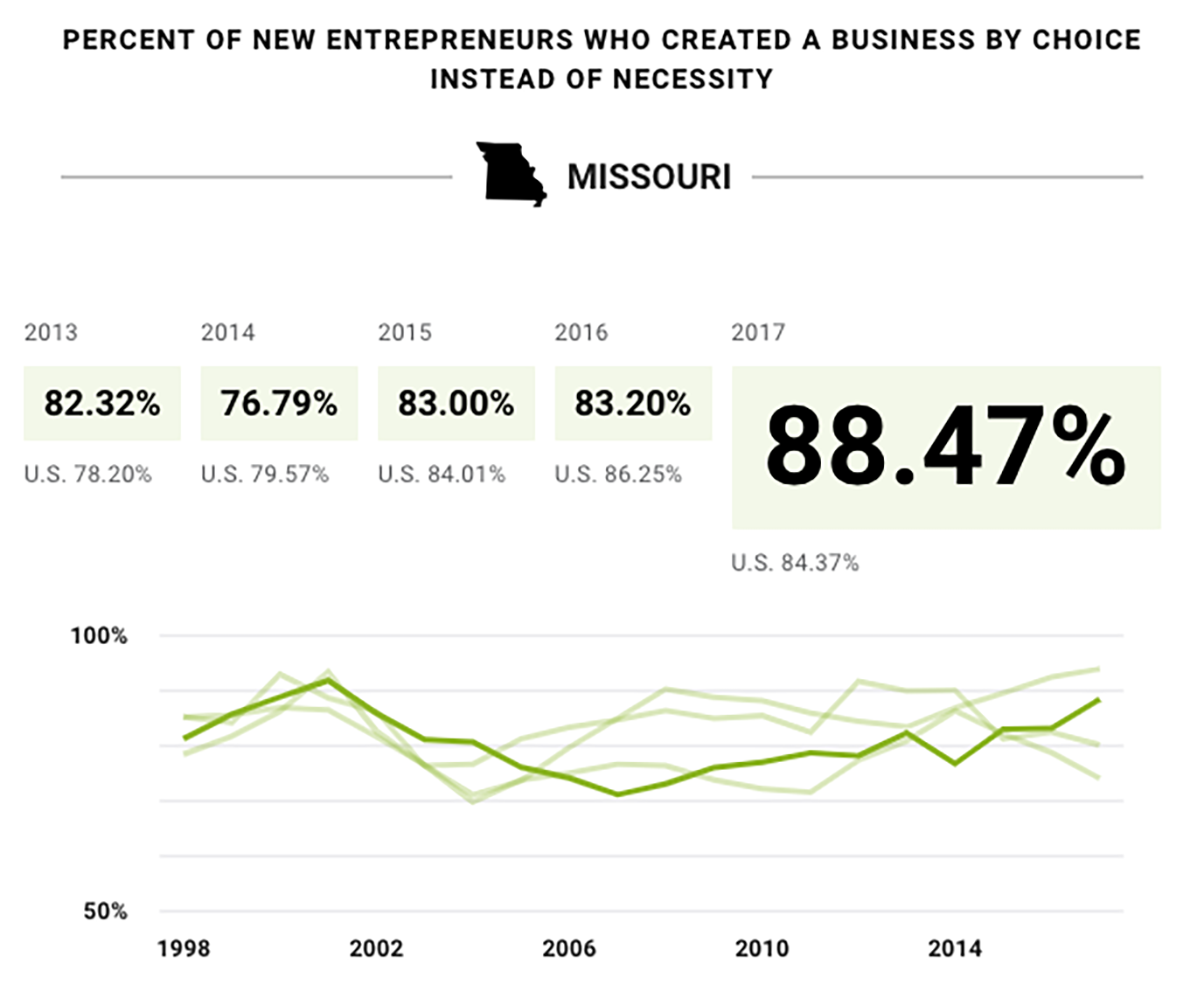
- Opportunity share of new entrepreneurs — The percentage of new entrepreneurs who created a business out of choice instead of necessity.
- Startup early job creation — The number of jobs created in the first year of business.
- Startup early survival rate — The rate of survival in the first year of business.
Click here for an interactive profile detailing Missouri’s rates.
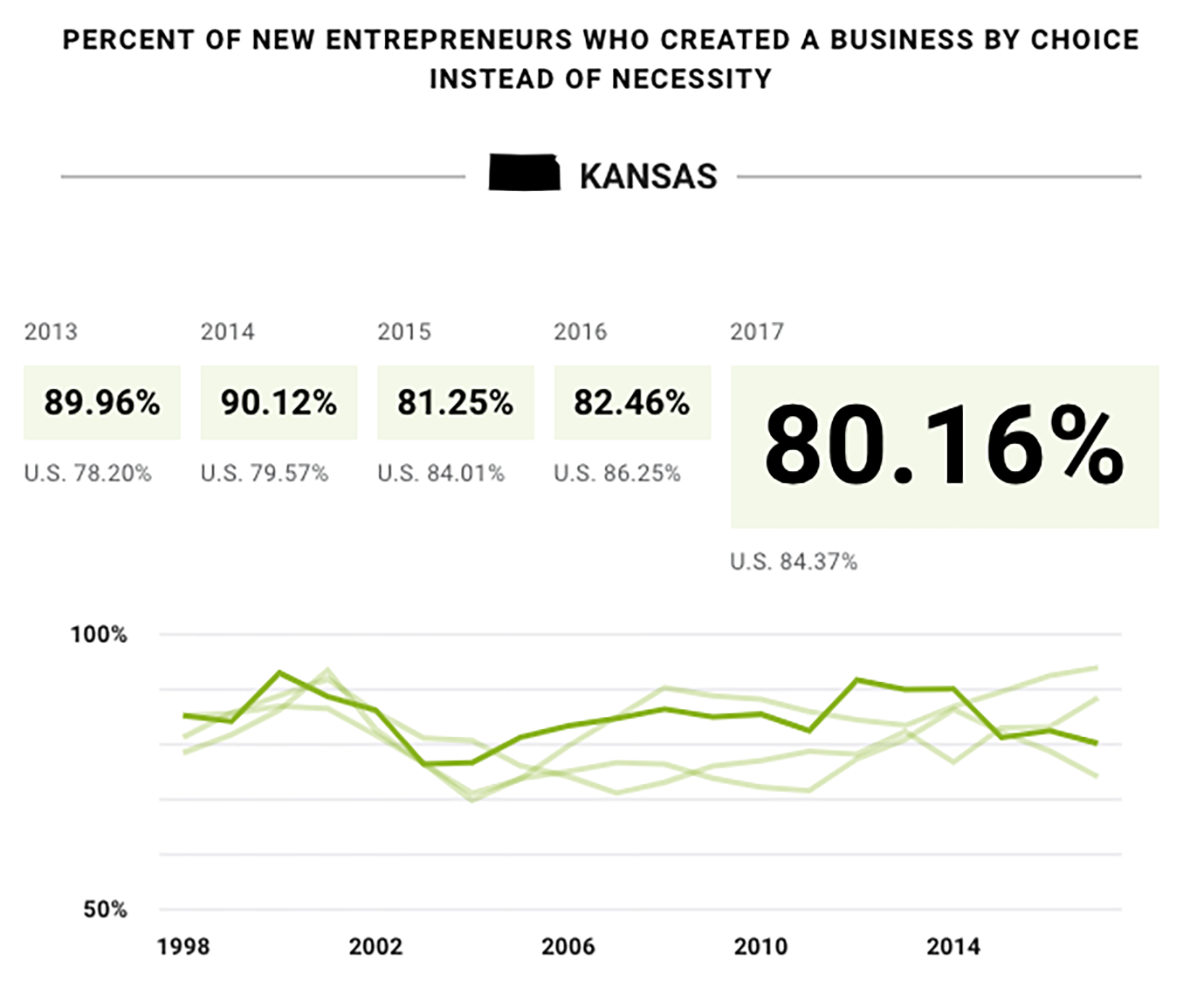
Click here for an interactive profile detailing Kansas’ rates.
Missouri topped Kansas on all four indicators, though the neighboring states were the least dissimilar on the rate of new entrepreneurs — 0.32 percent compared to 0.30 percent.
On opportunity share of new entrepreneurs, nearby states Nebraska and Iowa had the highest rates in the nation with 94.03 percent and 93.98 percent respectively (compared to 88.47 for Missouri and 80.16 percent for Kansas.)
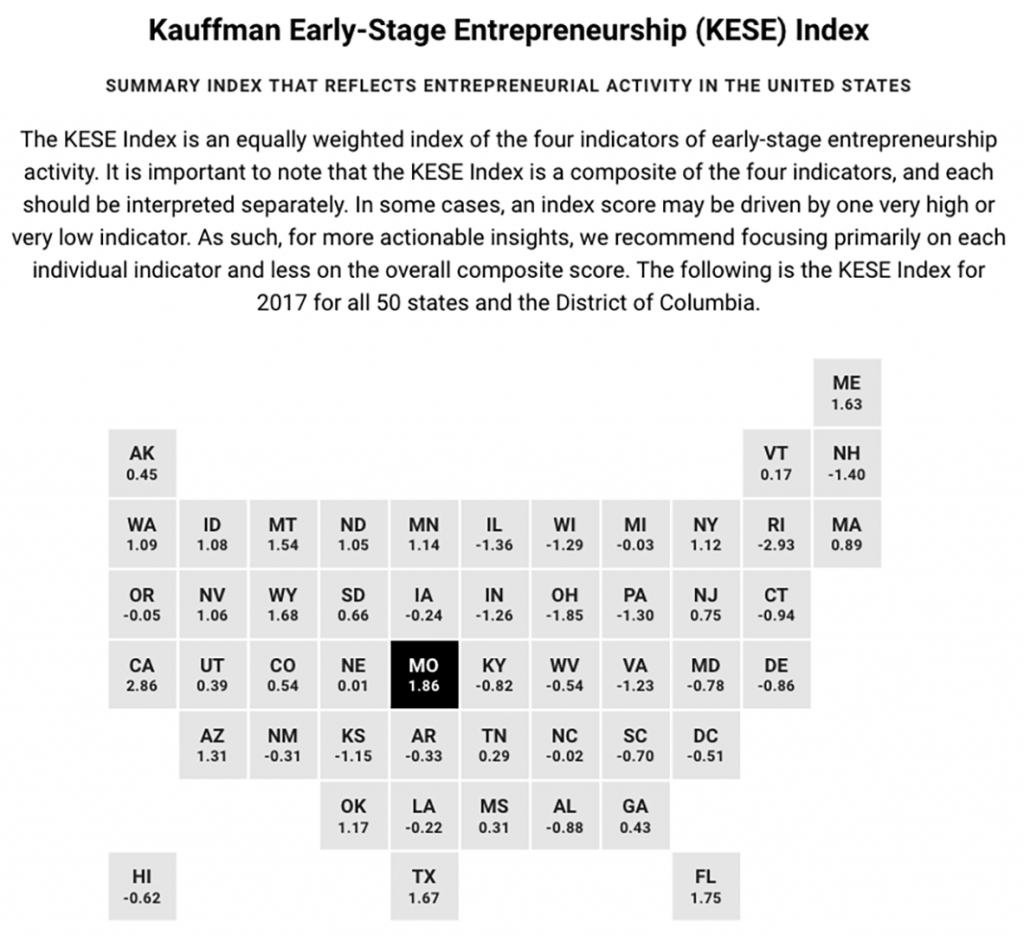
Thursday’s release also noted a slight increase in entrepreneurship nationally — a 0.68 average score using the Kauffman Early-Stage Entrepreneurship Index (the highest level recorded nationally over the past two decades). Missouri achieved a score of 1.86, compared to -1.15 for Kansas.
The debut of the four Kauffman indicators marks the retirement of the Kauffman index, which emphasizes rankings over data policymakers and others could use, according to a blog by Julie Scheidegger, senior content strategist for the Kauffman Foundation.
“It gives a lot of nuance large, traditional indicators can’t always provide,” explained Sameeksha Desai, director of knowledge creation and research in entrepreneurship at the Kauffman Foundation, in Scheidegger’s blog. “It doesn’t tell you what to do, but it can help you think about what next steps to investigate.”
For example, Scheidegger said, if the indicators reveal that a state has an exceptionally high rate of new startups, but low one-year survival, the question can be raised: What can be done to better support entrepreneurs in their first year?
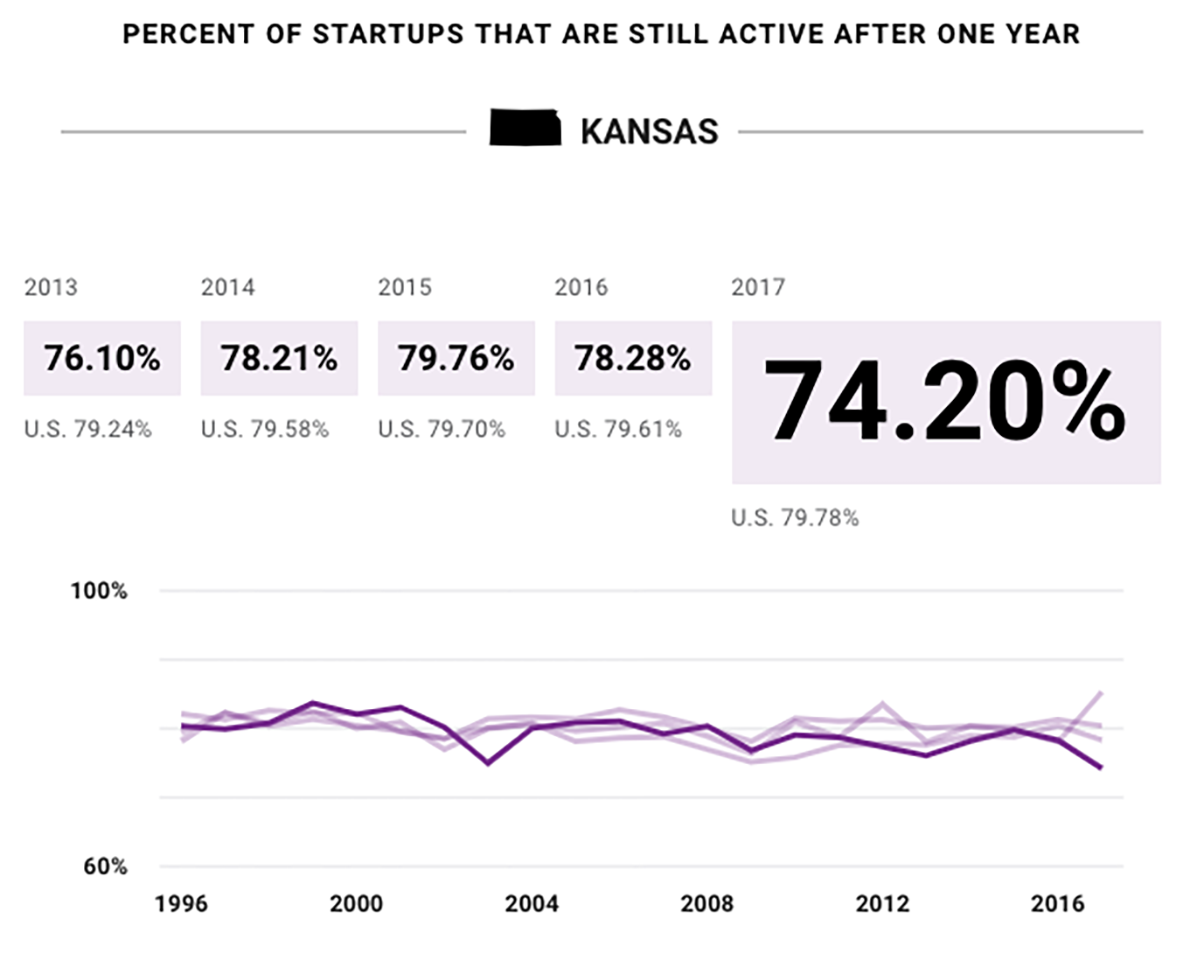
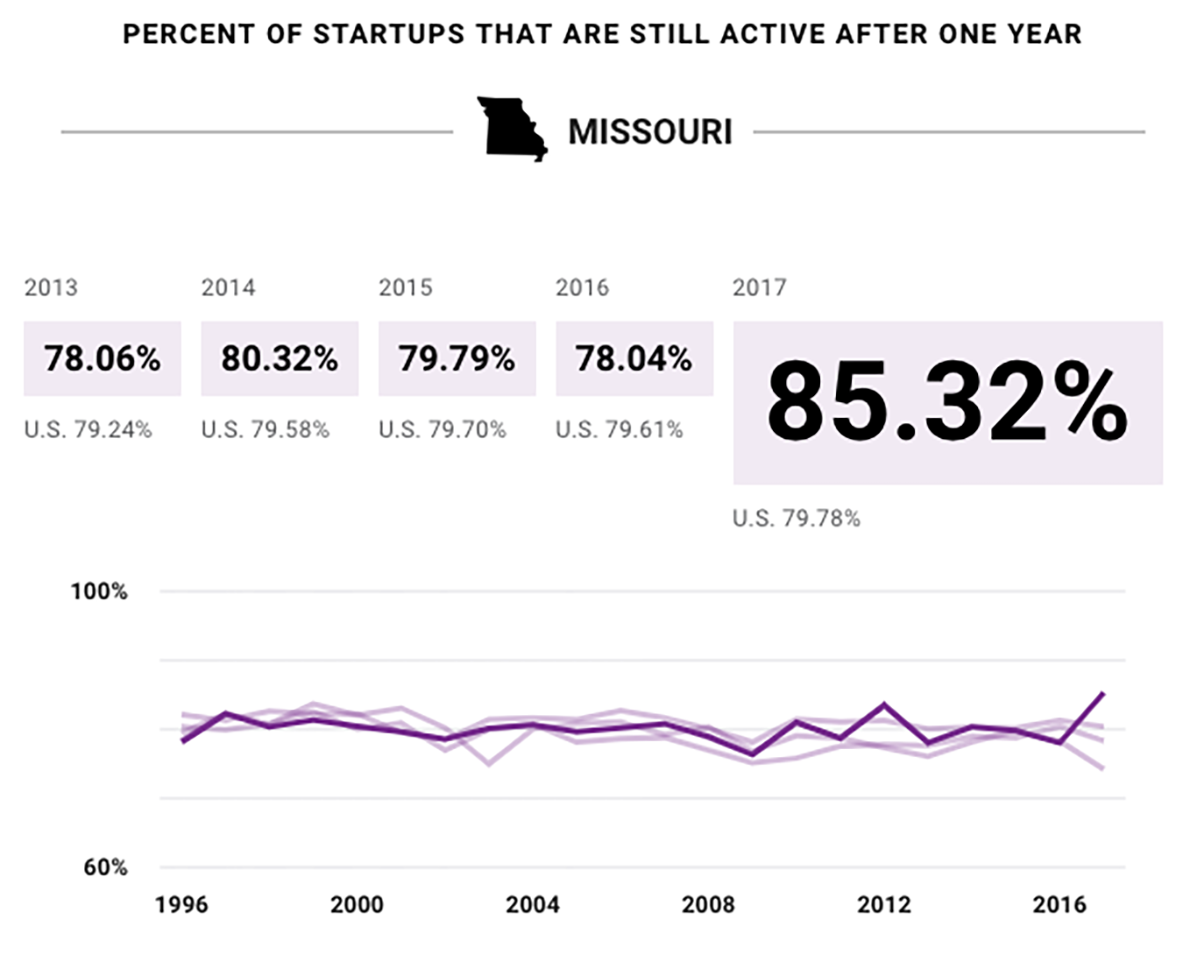
Click here for the full breakdown of the indicators, as well as the new report.
Notable findings from Thursday’s analysis include:
- A slight uptick in new entrepreneur rates from 2016 (0.31 percent) to 2017 (0.33 percent);
- A relatively constant startup early survival rate between 79 and 80 percent since 2012;
- A rising share of new entrepreneurs in the group aged 55-64. This group represented 15 percent of new entrepreneurs in 1996, and it represented 26 percent of new entrepreneurs in 2017;
- An increase in the number of jobs created by startups, from 5.23 per 1,000 people in 2016 to 5.27 per 1,000 people in 2017; and
- An increasing immigrant share of new entrepreneurs, led by the rising rate of new entrepreneurs and the growing immigrant population.
“While the data from the Kauffman Indicators show positive momentum in entrepreneurship, we still have a long process ahead to completely reverse a four-decade slump and repair the disruption caused by the Great Recession,” said Victor Hwang, vice president of entrepreneurship at the Kauffman Foundation. “We hope this new approach to measuring early-stage entrepreneurship will provide policy makers with the information to make practical decisions that support new business creation and early growth.”

Featured Business

2019 Startups to Watch
stats here
Related Posts on Startland News

ScaleUP! KC touts revenue success stories as latest small biz cohort opens applications
Growth outcomes don’t always follow entrepreneurs’ graduation from ScaleUP! KC — sometimes they come before the game-changing, no-cost program is even complete, its leaders said. Rickey Leathers made significant strides in his business, Savvy Salon — co-owned with his wife, Lenora — while enrolled in the cohort, he said. “I successfully opened a second location…

Modern-day stress triggers make life harder; getting healthy shouldn’t add to those burdens, says KC Wellness Club
The shift to focusing on wellness instead of illness should be fun, said Heath Wessling, a former wellness expert at Cerner-turned-entrepreneur, who noted sustained growth or change is unlikely if a person is unhappy with the process. “We like to find ways to show you how it’s not a drag,” said Wessling, founder and owner…

Give them a drink, get to the real: This craft KC podcast serves entrepreneur vulnerability
Two Kansas City entrepreneurs hope to amplify the voices of local change makers by getting them behind the microphone with a drink in their hand. The Behind the Bar with Ashley and Hailee podcast sees co-hosts and friends Ashley Kendrick and Hailee Bland Walsh welcome their fellow Kansas City entrepreneurs into Kendrick’s basement for a…

A sneaky wink in each brutal piece: How one artist’s work paints his reality within a world of big, heavy events
Emerging Kansas City contemporary artist Addison “A.L.” Parrish believes that to create a work of art, he must first observe and understand the world around him. “I feel like, as an artist, my main job isn’t necessarily painting,” Parrish said. “It’s seeing and being — not detached — but in a neutral state of observation.”…