

Happy Food Co. modifies meal kit options to fit paleo, keto, Whole 30, vegan lifestyles
February 21, 2019 | Austin Barnes

If a company wants to create change, its leaders have to be unafraid of emerging trends, Jen Trompeter said as Happy Food Co. serves up a strategy that could help the company cook up new business with modified meal kits.
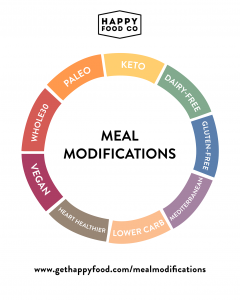
“People are doing keto or they’re doing Whole 30,” Trompeter, said. “We have some [meal kits] that fit into this pattern of categories already.”
Designed with an array of lifestyles in mind, Happy Food Co. meal kits — ready to cook, chef-created meals sold at local grocery stores — can now be modified to fit nutrition guidelines outlined in nine specific diet plans; paleo, Whole 30, keto, dairy-free, gluten-free, low carb, heart healthy, vegan, and the Mediterranean diet, Trompeter explained.
“We got with our registered dietitian and were like, ‘You know what? If you were just to take out maybe one or two ingredients, then a lot of our meals — literally a ton of our [almost 80] meals — would fit into these categories,” Trompeter said of the weeks-long process that went into adapting the Happy Food Co. menu for flexible foodies.
The company identified the nine eating plans as emerging or current food trends, but doesn’t consider them fads, Trompeter added.
Embracing modified lifestyles has become key for Happy Food Co. — now in its third year of operation under the leadership of founders Chef Kiersten Firquain and Jeff Glasco — as the company looks for ways to stand out in the meal kit space, said Christine Lau, creative marketing strategist.
Click here to read more about Happy Food Co.’s startup journey.
Keep reading after the photo.

Kick-A**! Striped Bass with Cauliflower Purée, Happy Food Co.
“The beauty of our business is that we package everything separately. So if you have cilantro, mint, or cheese — it’s all packaged in its own way [and you can leave it out without sacrificing flavor],” Lau said.
While Happy Food Co.’s staff has whittled recipes down to exact dietary science that complies with each of the nine specific lifestyle plans, their meals are not officially endorsed by companies such as Whole 30 — which distinguishes products and foods as either Whole 30 approved or Whole 30 compliant, Trompeter noted.
“Maybe there were a lot of customers that we weren’t hitting before because they thought, ‘Oh, I need this meal and you only have one of those,’” she said. “Now we can go, ‘Oh wait, I can intercede now.’ There’s four or five meals that [customers] can look at and go after. I think that shows that we can improve our sales and improve the customer experience as well.”
Click here to find Happy Food Co. meal kits in local grocery stores.

Featured Business

2019 Startups to Watch
stats here
Related Posts on Startland News
2000 Vine: Chef Shanita’s urban eatery sets the table for prospects to access power
Editor’s note: This story is part of a series from Startland News highlighting entrepreneurs, businesses, and creators leading revitalization and redevelopment efforts in and around the historic 18th and Vine Jazz District. Click here to read additional stories from this series. Renowned Kansas City chef Shanita McAfee-Bryant plans to open a “for purpose” urban eatery…
With boost to $31M in funding, how will state agency power MO innovation? Check out its plan
Two months after Gov. Mike Parson and legislators bumped the Missouri Technology Corporation’s budget back into the double digits, the state-funded investment agency introduced its plan for implementing five new strategies designed to catalyze innovation and entrepreneurship in Missouri. Presented early this month at the Governor’s Conference on Economic Development, MTC released an execution roadmap…
DHS grant boosts more than federal agents’ safety — backing Kenzen’s high-growth expansion
A federal grant program dedicated to innovating new solutions to prevent crisis-level scenarios was a timely fit for Kenzen’s wearable, heat-sensing safety tech, said CEO Heidi Lehmann, detailing the Kansas City startup’s recent funding award and move into “high-growth mode.” Kenzen this summer received a $161,600 grant through the Department of Homeland Security’s Silicon Valley…

How one founder plans to use blockchain to bring equity, transparency to the ‘American Dream’ — buying a home
After back-to-back home-buying nightmares — where predatory practices left Louis Byrd with mounting bills from unexpected repairs — the Kansas City entrepreneur and creative force plans to launch a new blockchain-infused solution to increase transparency for homebuyers. The first tech product from Byrd’s Zanago Design, Kataba is expected to allow potential buyers to verify titles,…