

Toby Rush on emerging blockchain: Layers of trust slowly building behind the scenes
November 1, 2018 | Elyssa Bezner

Much like companies’ web pages in the mid-1990s, blockchain isn’t yet consumer-ready, said Toby Rush.
Entrepreneur of the Year Awards
Toby Rush is set to be honored Nov. 14 as Regional Entrepreneur of the Year by the Regnier Institute at the University of Missouri-Kansas City’s Henry W. Bloch School of Management.
Click here to learn more about the event and other honorees.
“But [development is] going to move at an accelerated pace,” said Rush, CEO of Zoloz and senior director of international technology investments at Ant Financial. “We’re over 20 years later from ’96, and I think you’ll see [blockchain] move and develop much quicker, but you’ll see a fairly similar arc or path that you saw websites and web technologies develop.”
After selling EyeVerify (now Zoloz) to Ant Financial — the payments affiliate of Alibaba Group Holding — in 2016 for more than $100 million, Rush joined the Chinese financial services firm with a new mission in his sights: identify the innovation and business potential of blockchain applications.
Few consumer-facing applications are available right now, he said, noting that it’s difficult for the average customer to find even five options that leverage blockchain without extra technical work or understanding.
“And even buying cryptocurrency is not easy. This is far from consumer ready,” Rush said. “As much buzz and hype as there is around blockchain it’s still pretty early days.”
Ant Financial is attempting to use the secure nature of the technology to track restricted goods, Rush said, noting, for example, efforts to prevent double-filling prescriptions in China, which often involves people receiving drugs at multiple locations, then selling them on the black market.
“And we’re working on like, ‘How do you track money that was meant for a charity to know that actually got to the charity?’” he added. “That’s where we’re seeing a lot of those applications, and so one of my responsibilities is finding who else is doing things really innovative, interesting in the blockchain world that could help China, India and Indonesia and Thailand and the Philippines operate more efficiently with more trust.”
Blockchain — which Rush described as an infrastructure layer allowing for distributed file systems and tracking of stored information that allows for significant trust in it’s immutability and no central point of control — will be heavily utilized in the future, although the public will be mostly unaware of the change.
“There’s tons of low-level protocols that enable the entire Internet to work and you don’t care about content delivery networks or you don’t care about where the files are stored. There’s a lot of technologies that you have no idea about,” said Rush. “So, eventually you’re just going to see more applications that actually don’t just advertise.”
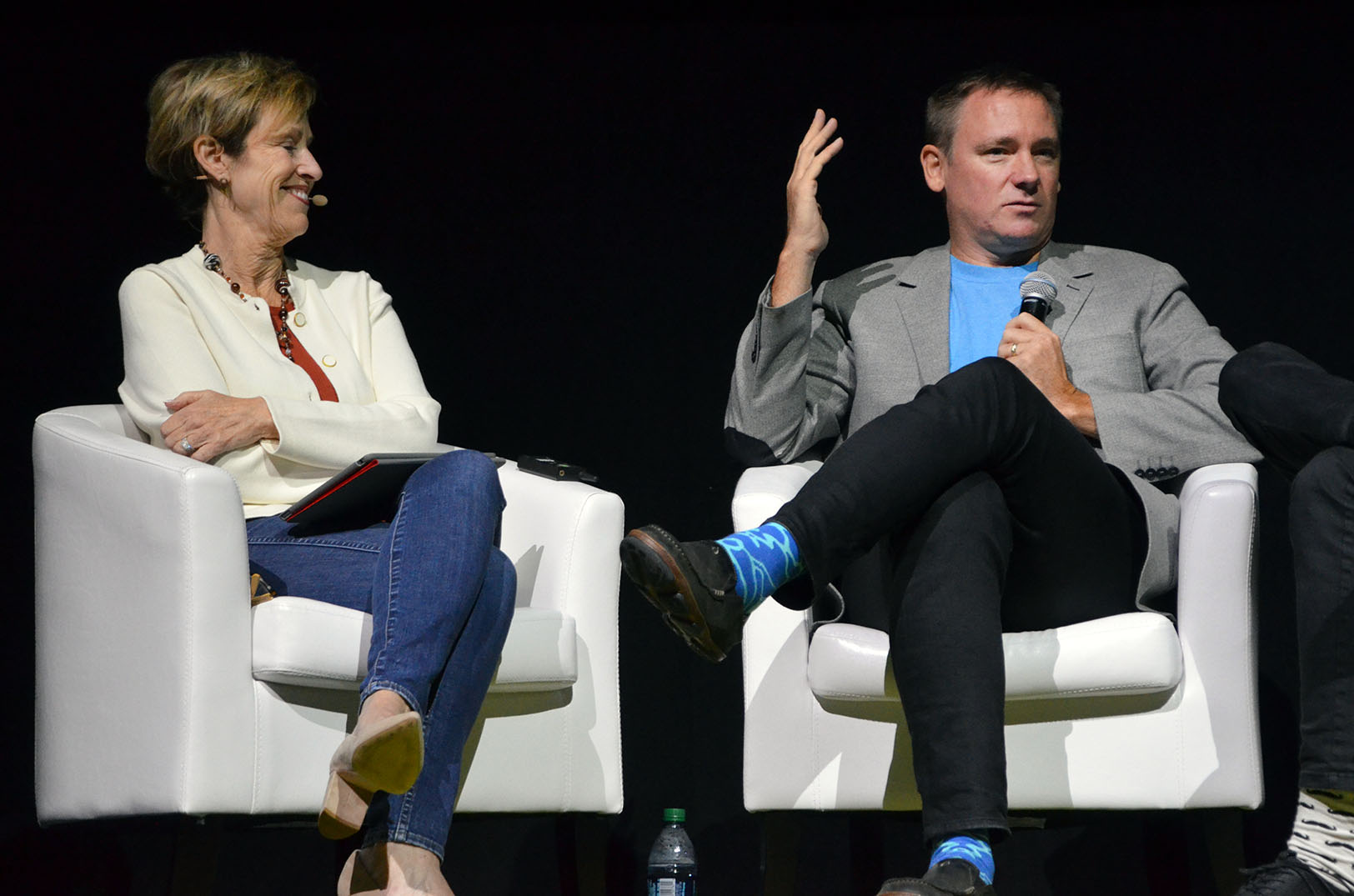
Lesa Mitchell, Techstars Kansas City, and Toby Rush, Zoloz and Ant Financial
Current models involve incentives and advertising, he said, meaning in some cases, companies will enlist and pay those with unused storage on their devices then advertise and sell the bandwidth.
Using distributed storage across a couple hundred million phones can make operations that take days — like rendering video for graphics and animation firms — take a couple of hours, he added.
“I think you’ll see a trend of incentive models that aren’t advertising and actually incent you to contribute some sort of value add to the network. And then they’ll give you tokens for that particular network,” said Rush.
The tokens will operate like loyalty points for airlines but be liquid across different places, he added.
“So it’s more of a way of democratizing the value that we as users add to the network,” said Rush. “So there’s this distributed layer. There’s an element of adding trust to the Internet. There’s an element of adding these incentive models that are really new and interesting, and that’s even before you get to the cryptocurrencies and Bitcoin and the efficiency which you can move money around.”
“There’s so many layers, but it’s super, super early,” he added.

Featured Business

2018 Startups to Watch
stats here
Related Posts on Startland News

Techweek makes intro to Kansas City
It only seems fitting that bass-thumping techno music would introduce Kansas City’s most anticipated technology conference. National tech conference Techweek — which will be in Kansas City from Sept. 14 to Sept. 20 — made its official introduction into the Kansas City community Monday evening with a party at the Sprint Accelerator. After arriving in Kansas City only six hours earlier,…

KC hosting global animal health investor forum
The premier animal health innovation conference is coming to Kansas City. The KC Animal Health Corridor — an area animal health development organization — expects about 40 venture capital funds to attend the 2015 KC Animal Health Investment Forum, set for Sept 1. Kimberly Young, president of the KC Animal Health Corridor, said that hundreds…

Who’s who of KC tech industry on Techweek 100 list
If you’ve ever worked in the Kansas City tech industry, chances are you know dozens of the faces appearing on the Techweek 100 list. Featuring such figures as Sprint CEO Marcelo Claure and Think Big Partners Managing Director Herb Sih, the list “identifies leaders who have made a significant impact on the technology and innovation…

Education innovation puts KC on the map
Kansas City and education don’t always receive positive press, but this week, the tides have changed. Kansas City is one of 27 “education innovation clusters” worldwide recognized by digital publication Education Week. Included for multi-district efforts to improve education, Kansas City was recognized by Education Week in particular for partnerships among the Ewing Marion Kauffman Foundation, Think…