

Digital Workforce launch emphasizes freelance opportunities for diverse ‘solopreneurs’
August 8, 2018 | Austin Barnes

“This room should mirror our city,” said Sly James, repeating a common refrain used throughout his time as Kansas City mayor. But as he addressed a crowd of freelance workers taking part Monday morning in the city’s launch of the Digital Workforce Development Initiative (DWDI), the remark came with a less-frequent follow-up.
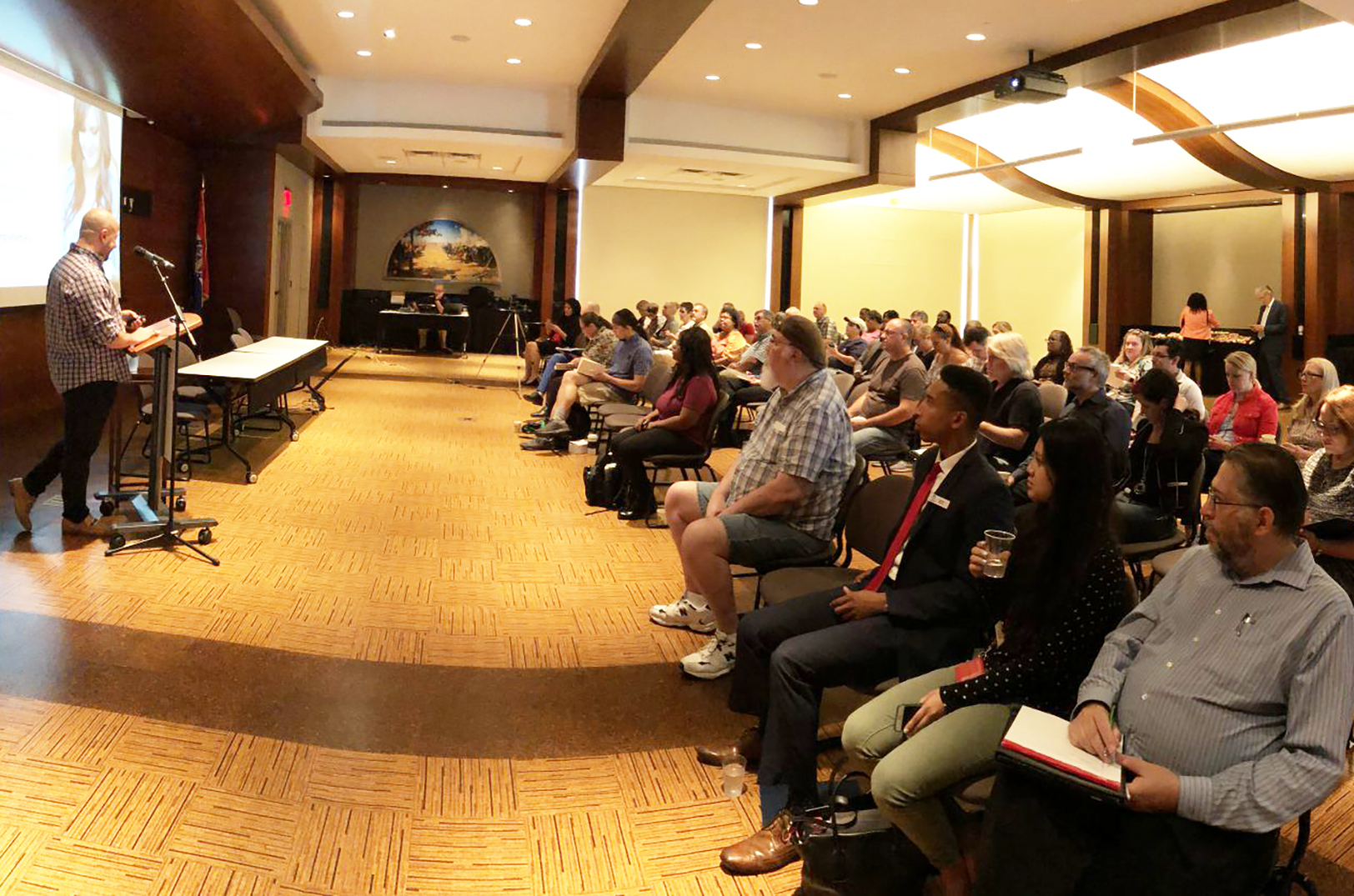
Digital Workforce Development Initiative launch
“And it does,” James added, noting the cross-section of people gathered Monday. In his March State of the City speech, the mayor challenged the startup community to be more inclusive.
He spoke with determination as he shared his vision of what Kansas City is now and what the city could be: describing a future where freelance workers and diversity are given more focus and institutional assistance.
DWDI — founded by companies Fiverr, Samaschool, and Udemy, and now in partnership with the Economic Development Corporation of Kansas City, the Mayor’s Office, and KC Social Innovation Center — aims to enhance communities by providing independent workers with training and support. The initiative was previously launched in partner cities Richmond and Stockton, California.
Two demographics James said need better access to opportunity: women and people of color.
“And Lord, don’t you know that’s exactly what I pray for,” he said as he explained the importance of finding equity in equality — an opportunity he defined as better suiting one’s unique set of circumstances and talents as opposed to more generalized opportunities.
The mayor hopes the two groups will flourish in their exposure to the relationship-minded, education-enriched environment DWDI works to provide for so-called “solopreneurs,”
On the front lines — fostering an environment that cultivates freelance opportunities — is Julie Cortes, the founder of the Kansas City Freelance Exchange and a panelist at the DWDI launch.
“After about five years of running my own business, I realized there is a super big need right here in Kansas City for education,” said Cortes, who works as a freelance copywriter. “We’re either here [freelancing] by choice or default and all of a sudden we’re running our own businesses and don’t know what the hell we’re doing.”
A series of panelists –– which included Dr. Mark Bedell, superintendent of Kansas City Public Schools; Sherri Gonzales Warren, program director for Mid-America Regional Council Community and Economic Development; Clyde McQueen, CEO and president of the Full Employment Council; and Dr. Jacqueline Gill, president of Metropolitan Community College-Blue River and MCC-Business & Technology — reaffirmed James’ belief that DWDI’s Kansas City launch could help entrepreneurs like Cortes and her client base better position themselves to thrive in an ever-evolving, self-employment sphere.
The first step in DWDI’s commitment to building a better freelance ecosystem in Kansas City is a free course — Freelancing 101 — offered by Samaschool at the Kansas City Public Library. The course is designed to arm independent workers with necessary, network and self-brand building tools that can set them apart in a corporate-minded world that hasn’t yet adjusted to their outside-the-box workflow
“Not only do we have to educate the freelancers, we have to educate the businesses as well,” Cortes said of bridging the gap between old business models and traditional employment structures.
Employers seeking employees in a modern job market must learn to embrace the flexibility freelance employees offer, Cortes and her fellow panelists said.
Although some freelancers might onboard with a company in the short term, others could offer a steady hand for years to come. One audience member suggested he’d consider working for a company two days each week, but many companies are disinterested in such arrangements, he said, opting instead to leave positions sitting vacant.
But freelancers could actually offer companies the ability to achieve the same completed workload for less money than the cost of employing a full-time employee, the panelists said.

Featured Business

2018 Startups to Watch
stats here
Related Posts on Startland News

Quartet of startups hop into the Digital Sandbox KC
Four early-stage businesses recently entered the Digital Sandbox KC program. The new startups demonstrate the ingenuity Digital Sandbox aims to attract for its grant-funding efforts, said Jeff Shackelford, director of Digital Sandbox KC. “From helping students prepare for college to analyzing voting records to predict legislative outcomes, the startups in the Sandbox are a great…
Newest Techstars KC class tackling payday loans, food safety, bots for business
Techstars Kansas City has revealed its 2018 cohort of startups. The 10 companies will make a big impact not only on Kansas City but the global economy, said Lesa Mitchell, managing director of Techstars KC. “Although our companies come from many industries, they share in common that they are all solving problems to make the…

YEP KC teen serves hope through enterprising volleyball benefit for men’s shelter
When 17-year-old Catherine Franano learned the mattresses at Kansas City Rescue Mission were old and too worn for comfortable use, the Pembroke High School senior leapt into action, she said. “Some of these people … like they’ve just had so many awful things happen to them, but not having anywhere to sleep?” Catherine said. “How…

(Video) ESHIP Summit attendees ask: Can entrepreneurial support efforts actually be sustainable?
When more than 600 attendees gathered this week in Kansas City for the second ESHIP Summit, they each came with their own ecosystems, businesses, local governments and support networks in mind. They also brought questions. “What are they doing in their cities? What’s worked and what hasn’t worked? What can we adopt back at home…