

Digital Workforce launch emphasizes freelance opportunities for diverse ‘solopreneurs’
August 8, 2018 | Austin Barnes

“This room should mirror our city,” said Sly James, repeating a common refrain used throughout his time as Kansas City mayor. But as he addressed a crowd of freelance workers taking part Monday morning in the city’s launch of the Digital Workforce Development Initiative (DWDI), the remark came with a less-frequent follow-up.
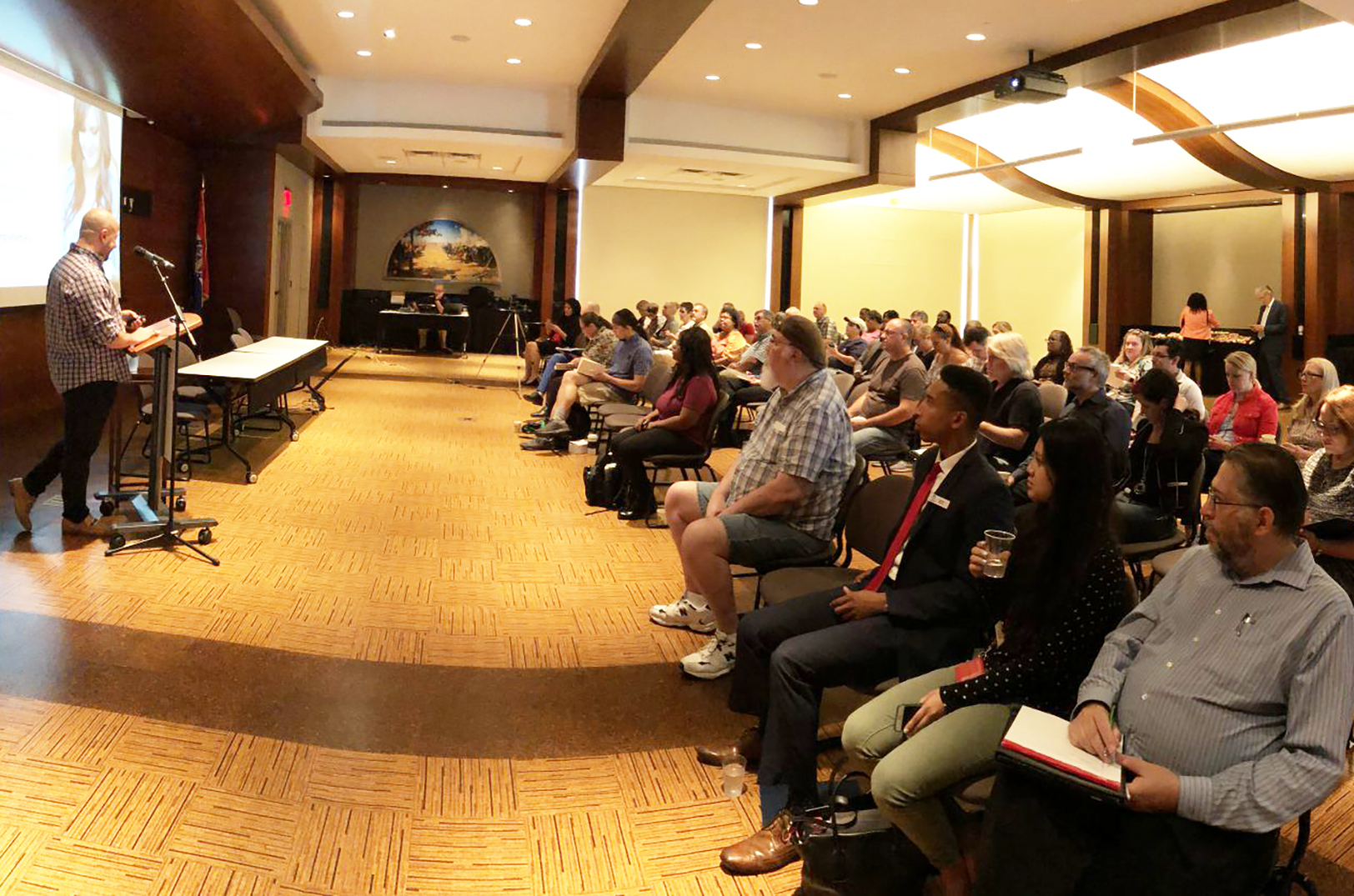
Digital Workforce Development Initiative launch
“And it does,” James added, noting the cross-section of people gathered Monday. In his March State of the City speech, the mayor challenged the startup community to be more inclusive.
He spoke with determination as he shared his vision of what Kansas City is now and what the city could be: describing a future where freelance workers and diversity are given more focus and institutional assistance.
DWDI — founded by companies Fiverr, Samaschool, and Udemy, and now in partnership with the Economic Development Corporation of Kansas City, the Mayor’s Office, and KC Social Innovation Center — aims to enhance communities by providing independent workers with training and support. The initiative was previously launched in partner cities Richmond and Stockton, California.
Two demographics James said need better access to opportunity: women and people of color.
“And Lord, don’t you know that’s exactly what I pray for,” he said as he explained the importance of finding equity in equality — an opportunity he defined as better suiting one’s unique set of circumstances and talents as opposed to more generalized opportunities.
The mayor hopes the two groups will flourish in their exposure to the relationship-minded, education-enriched environment DWDI works to provide for so-called “solopreneurs,”
On the front lines — fostering an environment that cultivates freelance opportunities — is Julie Cortes, the founder of the Kansas City Freelance Exchange and a panelist at the DWDI launch.
“After about five years of running my own business, I realized there is a super big need right here in Kansas City for education,” said Cortes, who works as a freelance copywriter. “We’re either here [freelancing] by choice or default and all of a sudden we’re running our own businesses and don’t know what the hell we’re doing.”
A series of panelists –– which included Dr. Mark Bedell, superintendent of Kansas City Public Schools; Sherri Gonzales Warren, program director for Mid-America Regional Council Community and Economic Development; Clyde McQueen, CEO and president of the Full Employment Council; and Dr. Jacqueline Gill, president of Metropolitan Community College-Blue River and MCC-Business & Technology — reaffirmed James’ belief that DWDI’s Kansas City launch could help entrepreneurs like Cortes and her client base better position themselves to thrive in an ever-evolving, self-employment sphere.
The first step in DWDI’s commitment to building a better freelance ecosystem in Kansas City is a free course — Freelancing 101 — offered by Samaschool at the Kansas City Public Library. The course is designed to arm independent workers with necessary, network and self-brand building tools that can set them apart in a corporate-minded world that hasn’t yet adjusted to their outside-the-box workflow
“Not only do we have to educate the freelancers, we have to educate the businesses as well,” Cortes said of bridging the gap between old business models and traditional employment structures.
Employers seeking employees in a modern job market must learn to embrace the flexibility freelance employees offer, Cortes and her fellow panelists said.
Although some freelancers might onboard with a company in the short term, others could offer a steady hand for years to come. One audience member suggested he’d consider working for a company two days each week, but many companies are disinterested in such arrangements, he said, opting instead to leave positions sitting vacant.
But freelancers could actually offer companies the ability to achieve the same completed workload for less money than the cost of employing a full-time employee, the panelists said.

Featured Business

2018 Startups to Watch
stats here
Related Posts on Startland News

RFP360 doubles in size since December; team back under one roof with move to new space
RFP360 is coming full circle, said Stuart Ludlow, as the software company he co-founded with David Hulsen in the Kansas City Startup Village once again levels up to accommodate a swelling team and increasing market demand. “We’re moving into a place — scale and scope — that Dave and I envisioned,” said Ludlow, who also…
Super Dispatch expands reach into auto transport, launches car shipping platform
The “Amazon experience” is coming to the world of car shipping as Super Dispatch launches a new platform to bring the auto transportation industry up to the speed companies are demanding: now, said Bek Abdullayev. “We are creating a better way to transport cars with new technology that solves major problems for shippers and carriers,”…

‘Queer Eye’ hero paints an ‘inner circle’ for young Latino artists craving a creative outlet
Deanna Munoz’s childhood dream to become an artist — once faded and long forgotten — was revived years later by her 6-year-old daughter, said Munoz, founder of the Latino Arts Foundation. “I wanted to be a graphic designer, but I kind of got caught up in a lot of different things when I was young…
Two Missouri biology students just wanted an ‘A’ — ultimately they devised a treatment for Crohn’s Disease
Launching a biotech company based on a class project took the quest for an ‘A’ to a whole new level for two Missouri University of Science and Technology students — founders of Bionic Bowell. Prompted by professors to find a use for a special ion-interacting glass compound, Vanessa Mahan and Catherine Pollman devised an ingestible…