

Former high school rivals from MADE, Local Legends ‘Play It Forward’ in bid to revive South KC
July 26, 2018 | Tommy Felts
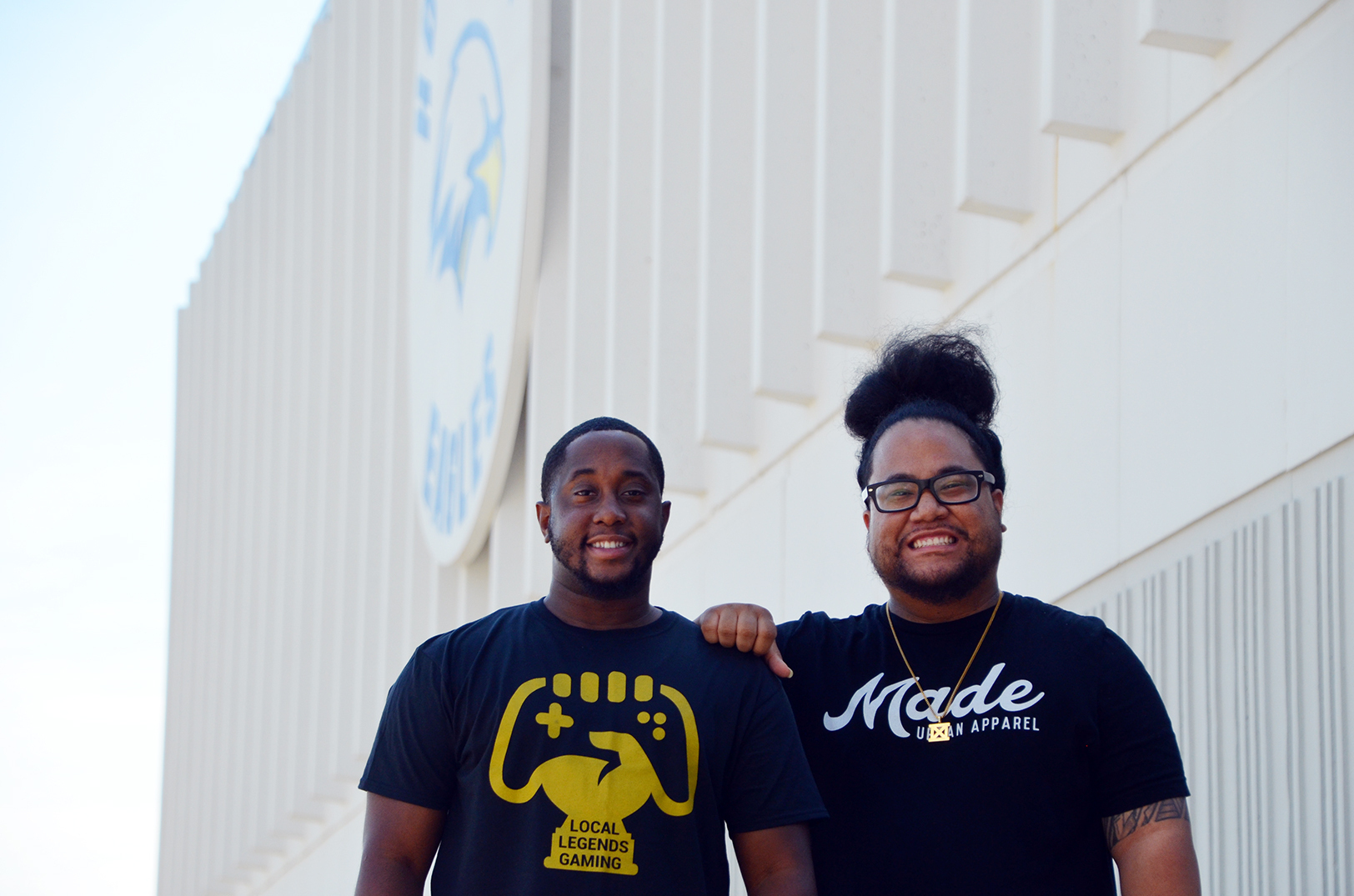
Organizers of the Aug. 12 Play It Forward charity basketball game traded playful taunts as they approached the doors of the former Hickman Mills High School gymnasium.
“They painted over your cougar,” said AbdulRasheed Yahaya, a Ruskin High School graduate, referencing the giant eagle logo affixed to the former Hickman facility that now is part of the rival Ruskin school district system.
“Man, are you kidding me?” asked Mark Launiu, a Hickman alum, half-laughing. “Hickman versus Ruskin: It lives — even after all these years.”
The duo are more than revisiting the past. They’re wielding the influence of their successful startup brands — Yahaya’s Local Legends Gaming and Launiu’s MADE Urban Apparel — to power a charity game in the heart of South Kansas City.
“We’re really fortunate that, given the circumstances, we turned out the way we did,” said Yahaya. “I’ve always been a big believer in the mentality that ‘if you can, you should.’”
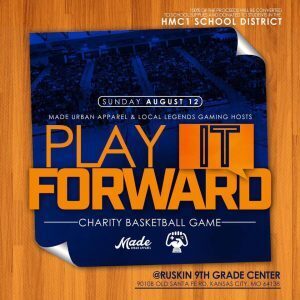
The Play it Forward event will bring together teams of Hickman and Ruskin alumni who are also business owners to help raise cash donations or school supplies for the HMC1 School District.
“We wanted to show kids that entrepreneurism is a real thing, owning a business is something you can do,” Launiu said.
Running from 3 p.m. to 6 p.m. Sunday, Aug. 12, at what is now Smith-Hale Middle School, 9010 Old Santa Fe Road, the event is expected to feature a vendor fair open to existing South Kansas City businesses, as well as college and military recruiters.
“College isn’t for everyone. It definitely wasn’t for me,” Yahaya said. “But there are so many resources out there if you’re open to the options.”
The startup leaders see a community around them that has lost confidence in itself, they said. Both have family members who still live in the same neighborhoods — some in the same homes.
“We need to get these kids to a point where their future is truly in their hands, but they have to be equipped,” Yahaya said.
Where everything changed
Driving into the parking lot of his former high school, Launiu thought he might tear up, he said.
“I’m an emotional dude, though don’t show it much. I never thought I’d come back here,” the co-founder of MADE Urban Apparel said. “I got in a lot of trouble. I wasn’t the brightest kid, but I played sports and I thought I was the coolest dude ever. I thought I was going to go to the NFL — just like every kid here thinks they’re going to do.”
Moving to South Kansas City from Samoa at 10 years old, Launiu lived in an amazing household, he said. But as one of six children being raised by a hard-working aunt and uncle, Hickman was his second family.
“This is literally where everything changed for me — in these halls, not at home,” he said. “I was at school more, building relationships. This is where I was molded.”
In those days, the community was more vibrant, Launiu said. He recalled frequent visits to busy shopping centers and grocery stores.
“My first day here — in 2001 — we went to Bannister Mall. I thought it was the most amazing thing,” he said. “I’d never been in a mall. I was like, ‘Oh, my god! What is this?’”
But as other parts of Kansas City began to thrive as part of a downtown-to-Crossroads renaissance, the neighborhoods near Launiu began to shift in the opposite direction, he said.
“As we grew older — middle school and high school — everything and everyone started moving out. Businesses were closing down. It felt like the area was getting abandoned,” he said. “Eleven years later, nothing has changed for the better. It’s gotten worse.”
“I understand how kids get in trouble because there’s nothing to do,” Yahaya added. “I don’t want to act like it’s a barren wasteland, but we can do better — instead of just building up in densely populated areas like Midtown, downtown, West Bottoms, Crossroads.”
Development in Kansas City is centered around entertainment because that’s where the money is, Yahaya said.
“I understand it because we all have businesses and we all know what drives business decisions,” he said. “Even with the Cerner development in South Kansas City, it’s going to take time to turn things back around.”
“But some of these kids don’t have time,” he added. “A business plan takes five years — that’s a child’s whole high school career.”
Reversing the trend
As the son of first-generation parents, Yahaya remembers feeling the pinch at the beginning of the school year — and heading to class without all the required supplies, he said.
“And I was the youngest of four, so I got the last of whatever we could afford,” Yahaya said.
His parents — father from Nigeria, mother from the Virgin Islands — were always employed, he said, but they still had to fight to provide for their children.
“We didn’t live in the ghetto; We weren’t hungry, but there were times when we needed an extra helping hand,” Yahaya said. “Now it’s our turn to give that helping hand. Even if I never meet any of the kids who receive these supplies from Play It Forward, it’s cool to know that I improved the quality of life for somebody — that I helped teachers focus on their lesson plans.”
More guidance in the classroom could help today’s high school students learn important life lessons faster than Yahaya and Launiu, who met not as Hickman-Ruskin rivals, but as fellow Kansas State University Wildcats, they said.
“I had dreams of doing all these crazy things when I was a kid, but I had no idea how to get there,” said Launiu, who helped start MADE before leaving K-State’s engineering program.
Today, the apparel company has a popular flagship store downtown, as well as a massive online following and clothing at retail locations across the city. MADE is launching an exclusive apparel capsule for the Aug. 12 charity game that will feature Hickman- and Ruskin-inspired pieces, Launiu said.
“You can do whatever makes you happy — like playing video games,” he said, pointing to Yahaya. “This guy started a video gaming company. It’s crazy what you can do. There are so many other ways to be a success besides playing sports and doing rap — not that you can’t get out through that, but there are other outlets. Maybe you can even sell T-shirts.”
“Find your niche,” Yahaya added.

Featured Business

2018 Startups to Watch
stats here
Related Posts on Startland News
Alone or in the club: Virtual jukebox app spins back after laying new tracks as a social experience
Former music promoter Adell Hendon said he knew he couldn’t keep the turnup going forever on his own. Now the Kansas City native is helping other people party even longer with his socially-interactive virtual jukebox app — YouSpin. “I used to throw a lot of parties with DJs and even independent artists — a lot…
Nightlife app enhances its flavor with Westport Bars, KC brewing company partnerships
A strategic partnership with Westport Bars is going to do more than drive partygoers to the UpDown Nightlife app, Joshua Lewis said; it will give the startup data needed to scale its platform nationwide. “Through this partnership, we’re going to be able to really build out our business model,” said Lewis, the founder and CEO…
They told him to build it in California; this agtech founder came back to Kansas instead
When it came time to plant Trevor McKeeman’s agtech startup, he refused to farm the groundbreaking company’s future out to the coasts — specifically California where potential funders said he could find “money and talent.” “I was actually in Boston at the time,” explained McKeeman, founder and CEO of HitchPin, a digital marketplace for farmers…

Stream smarter, safer: Former Cisco engineer aims to replace Zoom as top video conferencing platform
Kenneth Yancy has been live streaming since the early 2000s — a time when not many were interested in the technology, he said. But 20 years later, a virtual-hybrid work model featuring video conferencing is the norm. “In 2001, I was working for Cisco as an engineer. My team and I built the first live…