

Lawrence-based Ainstein taking flight with jetpack founder in Red Bull Air Race
June 12, 2018 | Elyssa Bezner

When the founder of JetPack Aviation blasts to the sky later this month in Red Bull’s Air Race World Championship, it will be a testament to the innovation and quality at Ainstein, a Kansas radar tech firm, said Bryan C. Boots.
“Although our products are widely deployed today in unmanned aviation (drone) applications, this will be the first time that we know of that one of our products will be used in a manned flight,” said Boots, business development manager for the Lawrence-based company. “It represents a big leap for us as a company in that our products have been recognized as being ultra-safe and reliable, and the confidence that JetPack Aviation has put in them (that’s actually the founder of JetPack Aviation [David Mayman] who is flying the jetpack, demonstrating his own personal commitment to the safety of the product).”
JetPack Aviation’s wearable flight apparatus is intended for ultra-fast military transportation, Mayman told DailyMail.com in January at the Consumer Electronics Show in Las Vegas, where the entrepreneur and investment director displayed a prototype of the technology.
“I can take off in here if I wanted to, and I can land vertically, which is different to a lot of the wind suit concepts you hear about, where you have to jump out of an airplane,” he said. “We can do like 15, 20, 25 miles really fast – like 150 miles an hour.”
The working jetpack is expected to debut using Ainstein’s radar altimeter technology during the June 23-24 Red Bull competition, he said. The firm’s sensor and control products are widely used by other tech companies working to create the next emerging smart technology, said Sheen Xiao, director of operations for Ainstein.
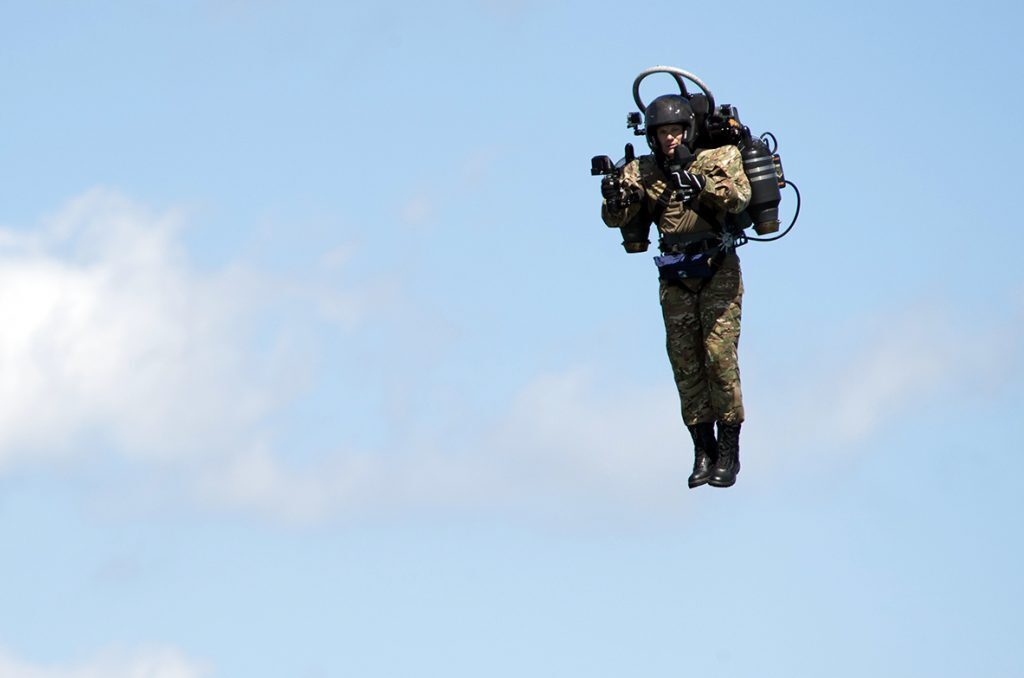
David Mayman, founder and CEO, Jetpack Aviation
It’s largely based on the company’s “sense-and-avoid” technology first applied to the commercial drone market. Sense-and-avoid refers to tech that enables airborne collision and obstacle avoidance.
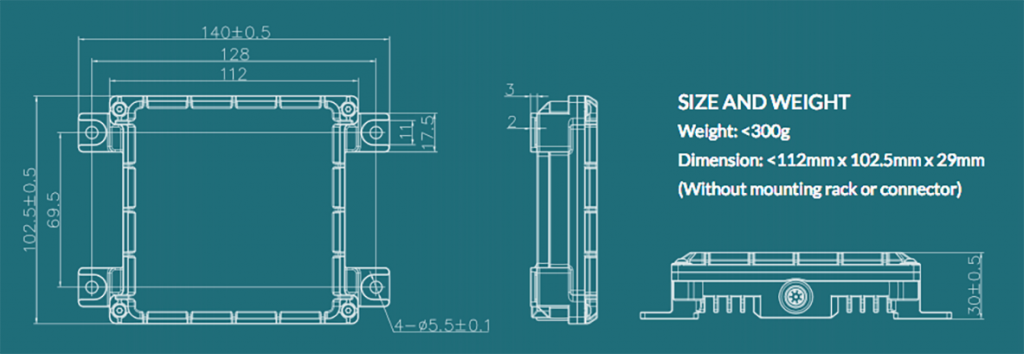
“We’re faster in adopting the latest radar technology. Our radar on the market has a smaller platform than what [others] offer,” Xiao said, noting the 100-gram weight of the radar altimeter.
The Ainstein technology is built for a tough environment. It’s dust proof, water proof — that includes ocean water, rain and fog, as well as chemical sprays — and features a single board electronics design that “leaves no room for failure,” according to the company. It’s compact size means the device fits in the palm of a hand and is light enough for camera drones.
Powered by Aerotenna, a sister company founded by Zongbo Wang, a former research professor at the University of Kansas, the three year-old Ainstein has experienced quick growth,Xiao said.
It’s a credit to reliable partners, guidance from advisors, as well as a hustling team, she said.
“We are a young company and the team is very effective. In my observation, every single one of us is doing four times the work of larger size companies,” she said. “Even though we’re small, like about 40 employees, we are able to penetrate four verticals and very effectively for our customers and contacts.”
Those market verticals — agriculture, automotive, industrial measurement and sports — each have grown at their own pace, with the most significant customer base in the ag realm.
The fastest-developing, however, falls within the automotive industry — both in the United States and China — where Xiao and Boots said have great potential for self-driving and assisted driving using sensors that make roadways safer.
“We are able to offer something that is not on the market right now,” said Xiao. “Either it’s the latest radar technology or it is cutting at what others are not actually offering at all.”

Featured Business

2018 Startups to Watch
stats here
Related Posts on Startland News

Why coastal investors ignore the Midwest and what’s next for federal startup policy
Here are this week’s watercooler conversation-starters on why inland states struggle to find funding, coming issues in federal entrepreneurship policy and the success of innovation districts that are cropping up around the U.S. (and in Kansas City). More in this series here. International Business Times: Finding venture capital far from the coasts Of the $48.3…

Ebb and flow: The Kansas City Startup Village by the numbers
Startland News created an infographic on the growth and shrinkage of the Kansas City Startup Village since its 2012 founding. Here’s a colorful interpretation of its ebb and flow, as presented by Startland’s Kat Hungerford. Read more about the KCSV’s history, successes and possible future here.
Shawnee passes tax measure to attract startups
A tax incentive program that aims to attract high-growth startups to the City of Shawnee unanimously passed a city vote, paving the way for firms to tap a variety of benefits to alleviate initial costs. The city council voted 8-0 on the “Startup Workforce Relocation and Expansion Program,” which aims to encourage job growth and…

Animal health firms can now apply for key Kansas City investor forum
The Kansas City Animal Health Corridor is now accepting applications for its eighth-annual investor forum that brings together the top decision makers in the animal health industry. The forum — set for Aug. 30 — will welcome dozens of venture capital organizations from around the world and offer animal health companies the chance to score…