

Merit-based economy is an illusion ripe for AI disruption, talent coop founder says
April 20, 2018 | Elyssa Bezner

Organizing Midwest talent to use artificial intelligence and machine learning to combat societal challenges like income inequality could be a powerful tool for a new generation of problem solvers, said Brian Curry.

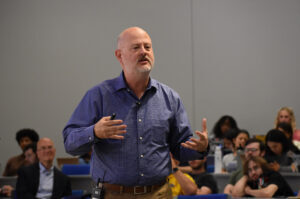
Brian Curry
“I truly believe in the possibility of artificial intelligence for changing the way we look at jobs, income, capitalism, poverty, wealth disparity, disease and many other things that we face in modern society,” said Curry, founder of the Kansas City AI Lab (KCAIL).
The talent cooperative, which has grown to include more than 900 industry professionals since its conception in 2016, most recently partnered with Kansas State University to conduct research using machine learning for drug discovery effort and has several other partners in the pipeline for further into 2018, he said.
“We have an estimated $3 million worth of talent in our group already,” Curry said.
The building stages
While experimenting with machine learning in 2015 to solve marketing and advanced analytics questions, Curry quickly realized its potential, along with artificial intelligence, as a solution for real world issues, he said.
He first organized a small meetup group, which grew into the idea for a cooperative that could more effectively use the passion and talent of its members.
“As I thought about ways to possibly disrupt what I view as an antiquated higher education system and broken business funding model, I came upon the idea of reverse engineering the entire education and business startup process,” said Curry.
Coordinating the expanding group and funding the concept have been the biggest challenges so far, he said, but Kansas City has lent its significant talent base, it’s low cost of doing business, and supportive community.
Revolutionizing the human experience
Curry hopes the group will work on bigger issues as it further develops to better realize the full potential of artificial intelligence and machine learning, he said. The cooperative’s focus will shine a spotlight on age-old problems like poverty, humans as labor, and particularly wealth disparity, Curry said.
Closing the gap between poverty and riches is a particular passion project for Curry, he said, noting most of the world’s wealth is concentrated with small percentages of people, many of whom are inheritors, overpaid founders and executives.
“From my perspective, this is a broken and inefficient system that is ripe for AI disruption,” Curry said. “The illusion of a meritocracy in that kind of system has the potential to be disrupted using machine learning and AI to determine systemic inefficiencies in capital and income flows using value-added modeling and other tools.”
KCAIL’s plan for the future also includes building the skills of its members, solving problems for their partners, and giving back to Kansas City.
“We hope to find partners who want to help us continue our mission and expand our footprint while also building up the Midwest as an AI and ML hub,” said Curry.

Featured Business

2018 Startups to Watch
stats here
Related Posts on Startland News

This hard swap plays easy: How one KC producer juggles community, breaking the club music cookie cutter
Tyler Jordan’s new spin on DJing: amplify fellow artists and unite people through music, he shared. Jordan — who produces electronic music and DJs under the name Oblivinatti (a mashup of his favorite video game growing up, The Elder Scrolls: Oblivion, and his interest in conspiracy theories) — is evolving his sound production business Vibration…

Art and technology too often butt heads, festival planners say; River Market event paints a reality where they coexist
The River Market Art Festival is back after a 20-year hiatus — with a nod to the past and an eye toward the future, shared The AI Hub’s Taylor Burris and James Spikes, startup founders who are hosting the event in partnership with the River Market Community Association. The revival of the art festival —…
PayIt co-founder: No one-size-fits-all formula for scaling one of KC biggest startup ideas
Mike Plunkett’s journey with PayIt came to an early, but critical crossroads when a wealthy entrepreneur offered half-million dollars to support the Kansas City-built govtech venture, he recalled. The catch: this investor insisted on imposing control and veto power as they committed more funds. Despite being low on funds, the PayIt team — led by…

Pure Pitch Rally reveals 2023 competitors: Meet 8 founders redefining the future of tech
One of KC’s most-anticipated startup events is set to tease a room full of sharks with the innovations of tomorrow — being built in Kansas City today, said Karen Fenaroli, announcing the eight competitors set for the Oct. 23 Pure Pitch Rally stage. The one-of-a-kind event helps startups grow by offering nondilutive spot-cash funding to…