

Letter to the editor: Former KC innovation officer weighs in on new short-term rental law
March 2, 2018 | Ashley Z. Hand

The following is a letter to the editor written by former Kansas City, Missouri, chief innovation officer Ashley Z. Hand in response to a recent series of Startland articles focused on Kansas City’s new short-term rental regulations. All opinions in the commentary are the author’s alone.
I find it interesting that there is no discussion about the unintended consequences and systemic impacts of the sharing economy in any of the debate about the ordinance to regulate home sharing services in Kansas City.
Yes, it is sexy to have these services in our city and convenient for visitors who use these platforms around the world. As a visitor, it is a great way to see different neighborhoods and experience a city “like a local.”
There is evidence, however, that these services do impact the cost of housing and affordability in our cities. Isn’t the cost of living something desirable when attracting the tech sector to our region?
As an entrepreneur and renter who has moved back to Kansas City, Missouri, from Los Angeles, I was shocked by the cost of housing in downtown Kansas City with some rents comparable to neighborhoods in Los Angeles. We need to be thinking ahead.
The argument of leaving the sharing economy completely unregulated fails to address the reality that technology companies are motivated by different goals for our community than the city government and that the impact of these services is not fully understood. The proposed ordinance should be considered a starting point that can be assessed and re-evaluated. After all, being a data-driven city is part of City of Kansas City, Missouri’s legacy as an innovator.
Cities across the country have learned the hard way that waiting to “see what happens” when the technology defines the outcomes for its community. Technology companies are not focused on the public good — nor are they necessarily accountable to the interests and goals of balancing sustainability, equity and access. In some cases, when these companies claim they are driven by the triple bottom line, there is evidence that they are not transparent or honestly representing their impact (e.g. distorting data in reporting to city government).
In one article in Startland’s recent series on the proposed ordinance, there was a reference to how the City of Kansas City, Missouri, first attempted to regulate transportation network companies. And, yes, it wasn’t easy. There were many fumbles by cities across the nation as these new services disrupted traditional industries that were heavily regulated such as taxis and other livery services. Every city attempted to recreate the regulatory wheel in response and often missed the opportunity to look at leveling the playing field for existing players while trying to figure out how to protect the public good in the digital age.
These companies looked to states to preempt local control and pulled every legal tactic possible to shape the market to serve their bottom line. Years later, however, we now know that these services are taking choice riders from transit systems, creating additional vehicle miles traveled (more trips = more congestion + pollution), and do not serve neighborhoods equitably.
I am a huge proponent of technology and innovation in cities. If I were to make any addition to the ordinance passed by the Kansas City Council, I would request that the Kansas City Planning Department partner with a local university to track and study the impact of this ordinance and the sharing economy at-large has on our city over time. The data is not conclusive and there should be feedback loops for continuous improvement on this first round of regulations. After all, this is not a zero-sum game: some regulation will not stifle all future innovation and the sharing economy offers an interesting model that rethinks ownership and resource availability in the 21st century.
We need to get over our personal passions — Not in My Backyard proponents and technophiles alike — and focus on what is most important: creating an equitable, safe, livable city for all residents and visitors.
Ashley Z. Hand is a co-founder of Los Angeles-based City-Fi and is the former chief innovation officer for the City of Kansas City, Missouri. Follow her on Twitter at @azhandkc.

Featured Business

2018 Startups to Watch
stats here
Related Posts on Startland News

Eyeing jobs potential, KC Tech Council celebrates MO governor’s signing of STEM education bill
Support for STEM and the Missouri tech space is uploading in Jefferson City, Ryan Weber said in light of successful legislation that will reformat the way high school students benefit from technology courses. A bill increasing access to computer science courses — which gained a second life during a special session in September after previously…

Skipping the line: PayIt driver’s license renewal tech iKan puts DMV stigma in reverse
The market is hungry for consumer-grade digital experiences, said John Thomson, founder and CEO at Kansas City tech startup PayIt. Tuesday’s launch of the firm’s iKan driver’s license renewal technology is a step toward satisfying motorists starved for time and frustrated with inconveniences like long lines and packed parking lots at licensing offices. “Kansas residents…

Collaboration in the air: Cough detection sensors combine Sickweather, Mycroft tech
You can’t manage what you can’t measure, said Sickweather CEO Graham Dodge, describing the need for cough detection sensors that are slated to be rolled out in public places across Kansas City in 2019. Illness forecaster Sickweather is teaming up with fellow Kansas City startup Mycroft, a leader in artificial intelligence-infused tech, to develop the…
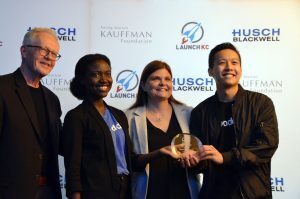
LaunchKC earns honors of its own, must still keep hustling, KC eco devo leader says
Receiving the Bronze Excellence in Economic Development Award proves the real market value for programs like LaunchKC, said Drew Solomon. The win has been energizing, said Solomon, senior vice president of business and job development at the Economic Development Corporation of Kansas City, which partners with the Downtown Council of Kansas City to make the program…