

Is government helping startups enough? Founders feel isolated, Kauffman survey finds
March 13, 2018 | Leah Wankum

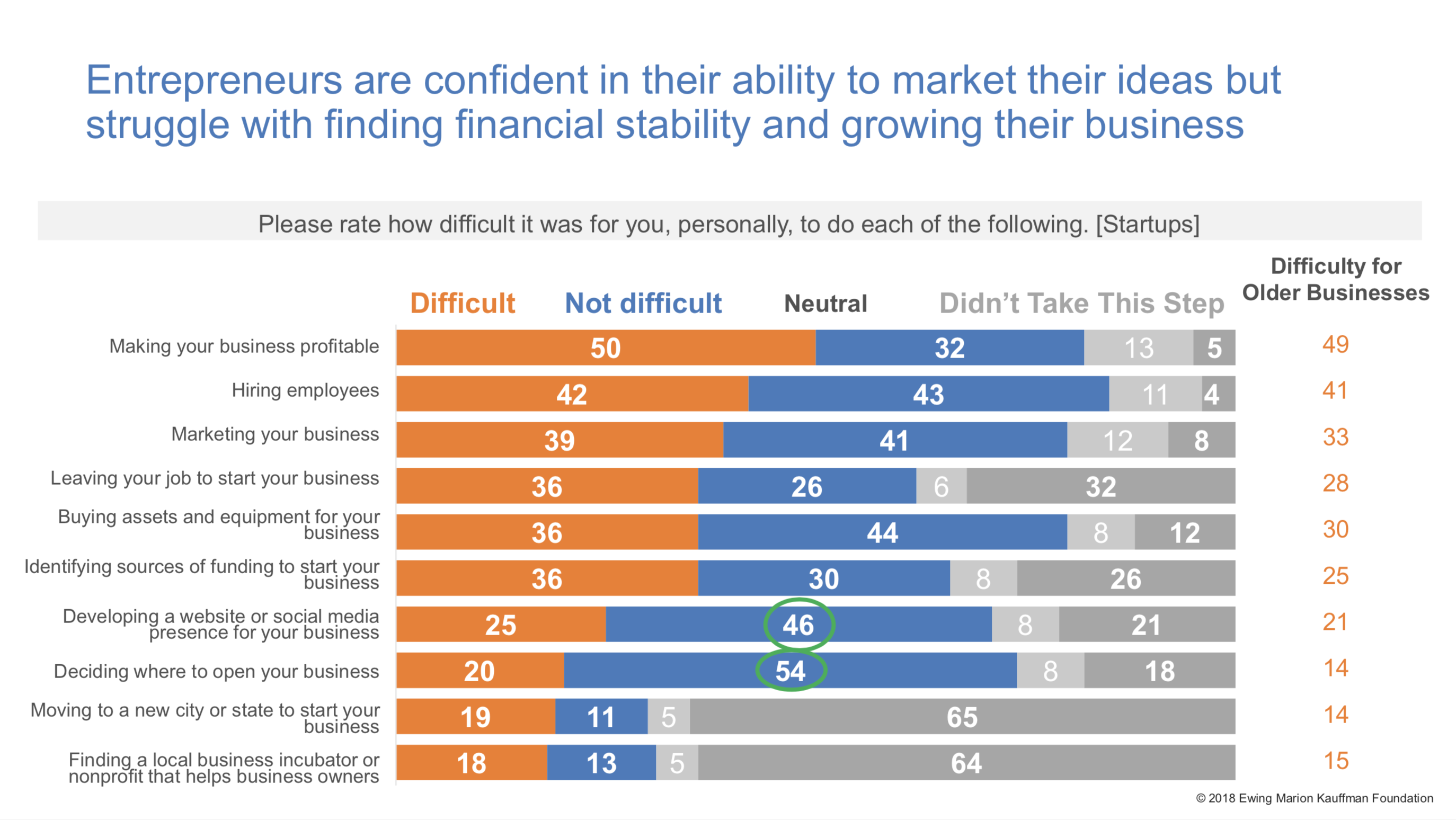
Early stage entrepreneurs struggle with the technical steps to getting started, a new Kauffman survey found, and founders don’t believe the government is helping them.
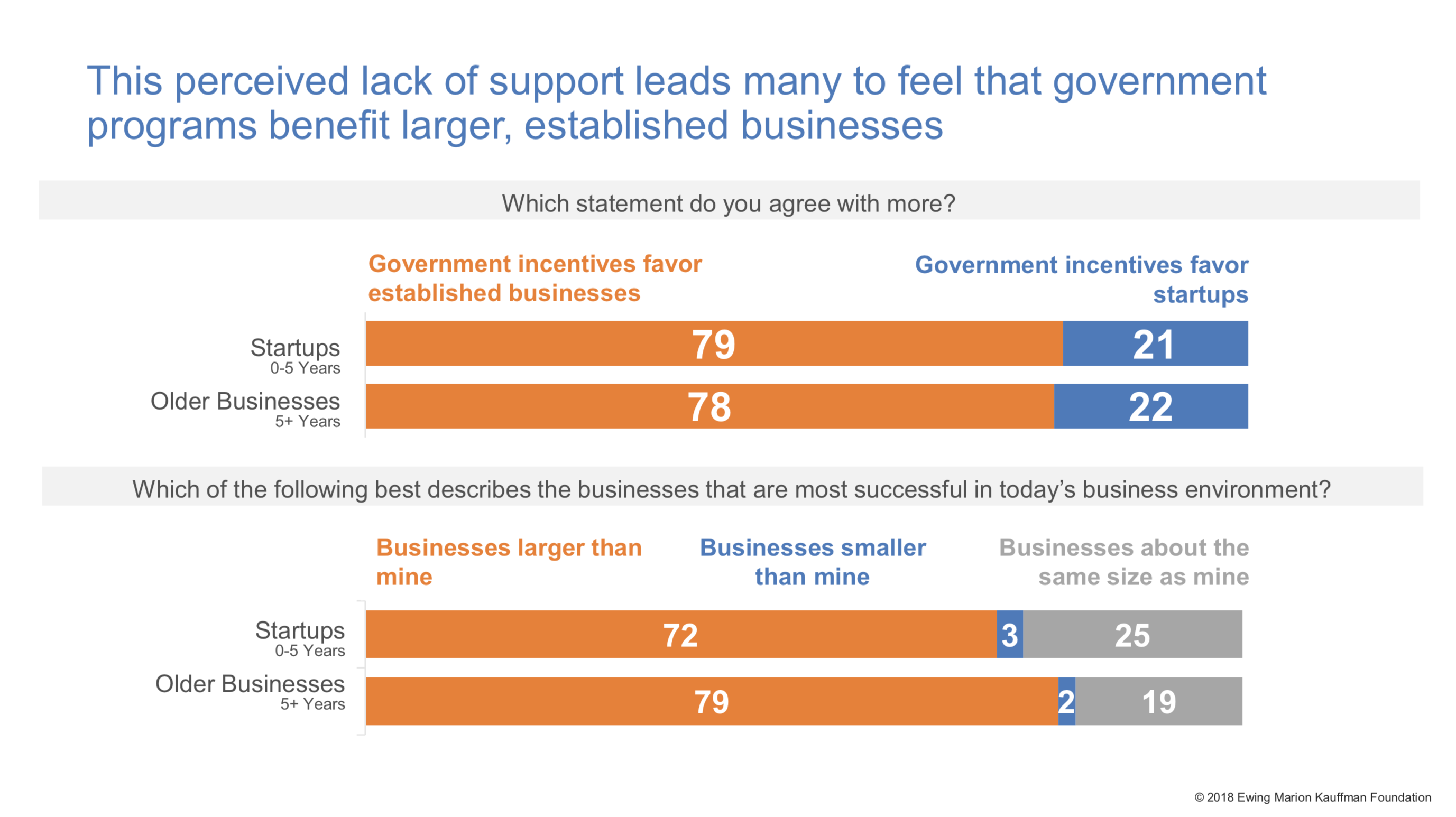
The prevailing sentiment that entrepreneurs view themselves as isolated from assistance is understandable, said Melissa Roberts, vice president of strategy and economic development at the Enterprise Center in Johnson County. Only about 20 percent feel supported by government, according to the Kauffman Foundation survey.
“The incentives for government to invest in entrepreneurship and invest in entrepreneurial economic development are somewhat misaligned,” Roberts said. “When you attract a big company that has 300 jobs and you hold a ribbon cutting, you get immediate gratification and somebody in politics can then turn around and say, ‘I created 300 jobs today in the state.’
“But the reality is a little bit different. When somebody starts a new venture, you don’t have a ribbon cutting for them buying a computer and sitting in their basement. The traditional structures don’t know how to celebrate that. We’ve created an economic development world that works for a great deal of companies — it works for big businesses; it works for big chunks of jobs being moved or being retained — but it doesn’t always work for supporting new and high-growth businesses, and clearly, those businesses agree.”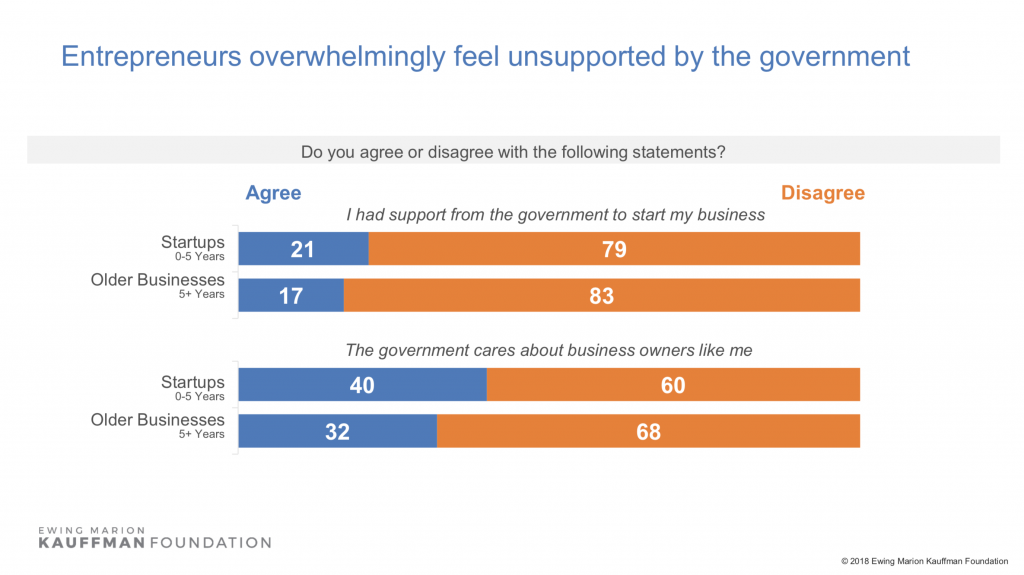 While startup founders tend to be optimistic, some leaders can’t always see the potential in entrepreneurs who grow their businesses from 10 employees to 100, she said.
“We do have the benefit of a lot of economic developers in Kansas City that are forward-thinking and are friendly to the entrepreneurial environment, but everybody is judged by the metrics that apply to, in my view, an older mode of economic development that suits larger businesses best,” Roberts added. “So if we can start to create political incentives to support entrepreneurial economic development, I think the whole community is going to benefit.”
Searching for support networks
Many entrepreneurs lack mentors to help them grow their businesses. For example, nearly a quarter of black (26 percent) and Hispanic (24 percent) first-year startups have one or fewer business owners in their network, the study found.
Janice Omadeke, founder and chief executive officer of The Mentor Method, a D.C.-based startup, said she can only speak for her experiences, but a lack of mentorship is more prevalent in minority communities, she said. Omadeke gave the keynote speech at the 2018 State of Entrepreneurship Address last month in Washington, D.C.
“I think that this is very on point with what I’m seeing in the trenches, being an early-stage startup,” Omadeke said. “I think that this reflects exactly what’s going on, but I think that every entrepreneur has a different set of struggles.”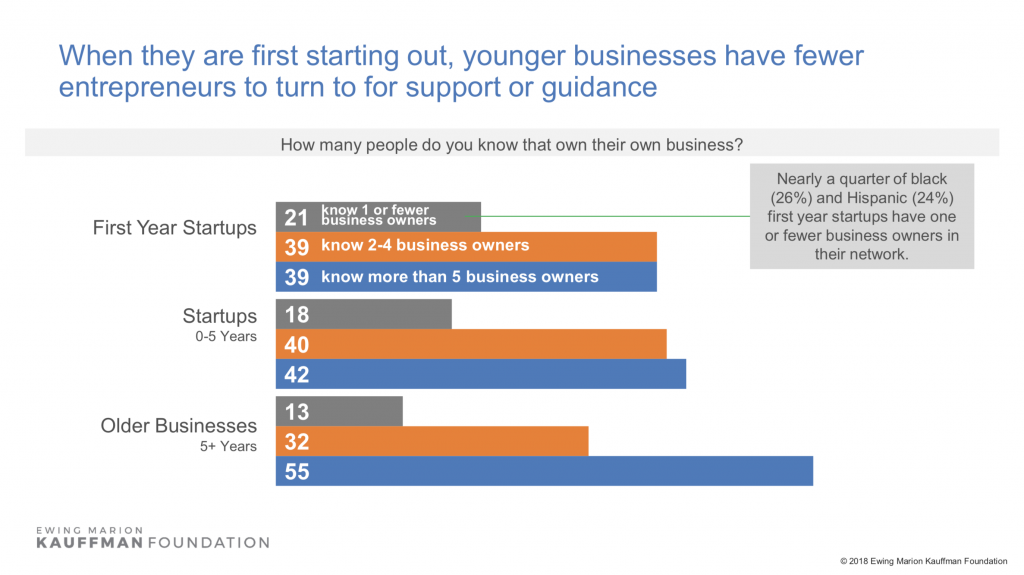 Sprout Solutions’ Gretchen Henry can also relate to other entrepreneurs who struggled with knowing how to grow their business, she said. In her venture’s early days, she tapped into such local resources as the Missouri Small Business and Technology Development Centers and the UMKC Innovation Center’s ScaleUp! program.
“I can’t overemphasize the impact that SBTDC and ScaleUp! have given to me personally in my business growth,” she said. “I think that that’s something that Kansas City really excels in, the mentoring programs that are available.”
Before she learned about SBTDC, Henry was “on an island” struggling with the logistics of growing her business, she said.
“Until I really became aware of what Kansas City had to offer and those programs, it was a struggle,” Henry said. “That opened up so many doors for me in so many great mentoring opportunities and helped me find the right business partners as well, which was so critical to what we’ve been able to do over the past year.”
Nevertheless, the technical aspects of starting a business — setting up tax IDs and an employer identification number, for example — can be difficult, said AbdulRasheed Yahaya, co-founder of Local Legends Gaming.
“It’s very hard to find out the right path to take with your business,” Yahaya said. “There really isn’t a QuickBooks guide to do some of the things that all businesses should establish, whether you’re a for-profit or a not-for-profit; it can be a very confusing world. I have a family, so we really want to make sure that our business is set up the right way the first time so my family isn’t affected by mistakes that we made.”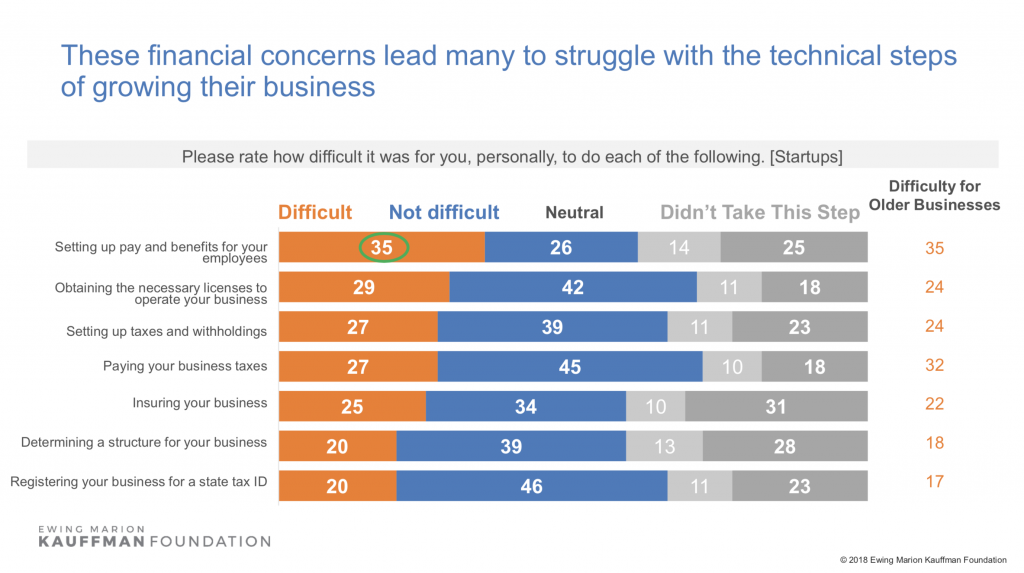 Yahaya wishes the government had a specialized area where his business could seek financial help, such as advice on investments and tax write-offs, he said.
“It kind of just feel like we’re paying taxes and that’s how we interact with the government and that’s it, and you need to follow whatever state and national rules align with the industry that you work in, and it feels like that’s about all we get,” Yahaya said. “You don’t generally feel like there’s a lot of assistance from the government. You feel like you’re giving the government more than you’re actually receiving.”
Help is out there
Organizations like Digital Sandbox KC actually receive most of their funding from the government to help entrepreneurs get started, said Jeff Shackelford, executive director of the popular accelerator program. The Missouri Small Business Technology Development Centers in Kansas City is also effective, but people might not realize it too is a government program — operating under the umbrella of the Small Business Administration, he added.
Digital Sandbox is primarily funded by the U.S. Department of Commerce and the Missouri Technology Corporation, Shackelford said.
“When I see some of these results that say, ‘Is the government doing enough?’ and so on, I’m wondering if a lot of the folks in Kansas City don’t realize that the Digital Sandbox is actually predominantly a government-funded program,” he said.
Roberts sees the potential for how government can be a great partner for entrepreneurs, she said.
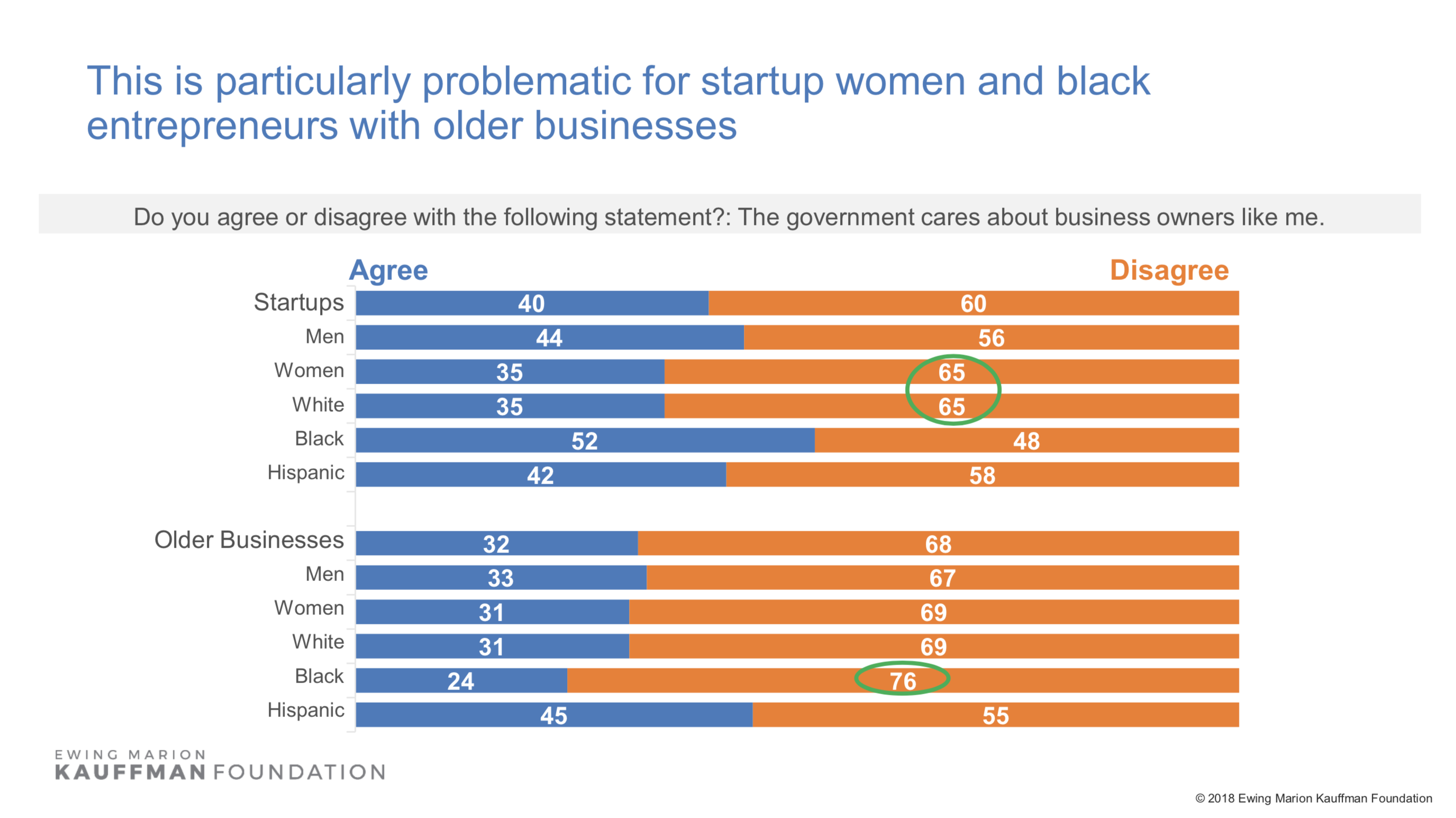
“To see that upwards of 60 percent of entrepreneurs, generally speaking, don’t feel well supported by government, don’t feel like it’s a partner in their growth, don’t feel like there’s any focus from public officials on helping their businesses grow, that’s sad,” she said. “It’s sad because I see the people in government that are focused on this.”
Other cities might not have the early-stage resources Kansas City has, such as KCSourceLink, Shackelford said. But when more people think of becoming entrepreneurs, the volume of early-stage entrepreneurs who struggle with getting started grows as well, he added.
“That’s why I think we need to spend lots of time and effort early on with helping folks just get their arms around what is it you’re trying to do and how do we get you to the best resource to help you start to do that,” Shackelford said, adding that Kansas City should keep finding more ways to engage women entrepreneurs and other underserved populations “to sustain the kind of entrepreneurship that this country needs.”
The Kauffman Foundation, alongside research firms Public Opinion Strategies and Global Strategy Group, conducted its nationwide representative survey of 2,165 entrepreneurs. Click here to download complete results of the survey, “Breaking Barriers: The Voice of Entrepreneurs.”

Featured Business

2018 Startups to Watch
stats here
Related Posts on Startland News
KC wants to be the nation’s most equitable hub for biologics; prestigious MIT pick could help
Biologics is the entryway to personalized medicine, said Sonia Hall, and Kansas City is aiming to create the most inclusive hub for the development, production and distribution of biologics as part of its acceptance to the Massachusetts Institute of Technology Regional Entrepreneurship Acceleration Program. “When you talk about personalized medicine, you’re talking about greater equity…
PropTechHD looks beyond the façade of drone use to see sky-high potential for capturing high-quality data
A lot can go wrong when flying a drone around a high-rise building, acknowledged Andrew Patch. Think restricted airspace, pigeons, hawks, turbulence, swirling winds, pressure changes, trees, powerlines, and other unexpected obstacles. But behind the sticks of a controller, Patch steers into the challenge. In February 2017, he founded Heartland Drone Company, an Federal Aviation…

Hack Midwest is back with $20K in prizes, space for tech talent to flex app-building muscles
More than prize money is on the line when Hack Midwest returns this weekend to Kansas City, Michael Gelphman said, detailing how the contest could ignite progress in the local tech ecosystem. “We can get people to think entrepreneurially and create new ideas,” said Gelphman, the competition’s founder, noting the power and potential of the…

GiftAMeal posts food selfie milestone: 1 million meals donated through Missouri-made app
Foodie photos shared to social media through a Missouri tech startup’s app have provided more than 1 million meals — representing more than 1.2 million pounds of healthy groceries for families in need — thanks to GiftAMeal’s network of restaurant and food bank partnerships, the company said. St. Louis-based GiftAMeal this week announced the milestone donation…