

Kauffman survey: Women more critical of their own early-stage entrepreneurial efforts
March 13, 2018 | Leah Wankum

Women entrepreneurs are more likely than their male counterparts to grade their performances harshly during the first year of business, though that tendency typically fades over time, according to a new survey by the Ewing Marion Kauffman Foundation.
It often is about approaching the venture a realistic viewpoint, said Jeff Shackelford, executive director of Digital Sandbox KC.
“[Women are] anticipating things being difficult,” he said, noting men frequently “want to think everything’s going to be rosy right from the start.”
Of the first-year startups who rated their business performance in 2017, 52 percent of women said they performed well, compared with 67 percent of men, according to the Kauffman Foundation survey. For older businesses, it evened out: 77 percent of both women and men rated their business performance as well.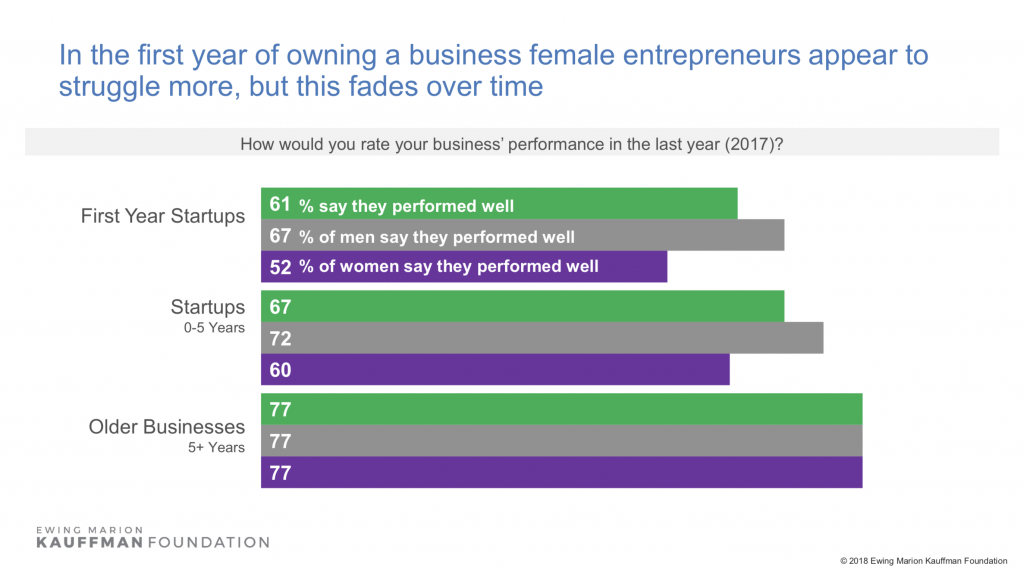 Of the projects Digital Sandbox KC has funded, more than a third of them are for startups founded or co-founded by women, Shackelford said, conceding that Kansas City may be “an anomaly.”
Women tend to think more about immediate milestones and challenges, he said, adding that female entrepreneurs focus on reaching goals two to four months from now instead of looking years ahead.
Such tendencies also manifest themselves in women being “less likely to toot their own horn,” even across other industries or when running for office, said Melissa Roberts, vice president of strategy and economic development at the Enterprise Center in Johnson County.
“It tells me that maybe there are some women that are doing really well, but flying below the radar because maybe they feel a little less confident or they’re a little less open with their successes that we could really do a good job of highlighting in the future,” Roberts said.
The Kauffman Foundation, alongside research firms Public Opinion Strategies and Global Strategy Group, conducted its nationwide representative survey of 2,165 entrepreneurs. Click here to download complete results of the survey, “Breaking Barriers: The Voice of Entrepreneurs.”
While women were found to be more critical of themselves and their businesses success, Kauffman’s overall findings pointed to an overwhelming optimistic crop of entrepreneurs.
Eighty-eight percent of startups, including those in their first years, predicted their business would perform well in 2018, according to the survey. More than 70 percent were satisfied with their profitability. And more than 80 percent felt support from their friends and family to even start their business.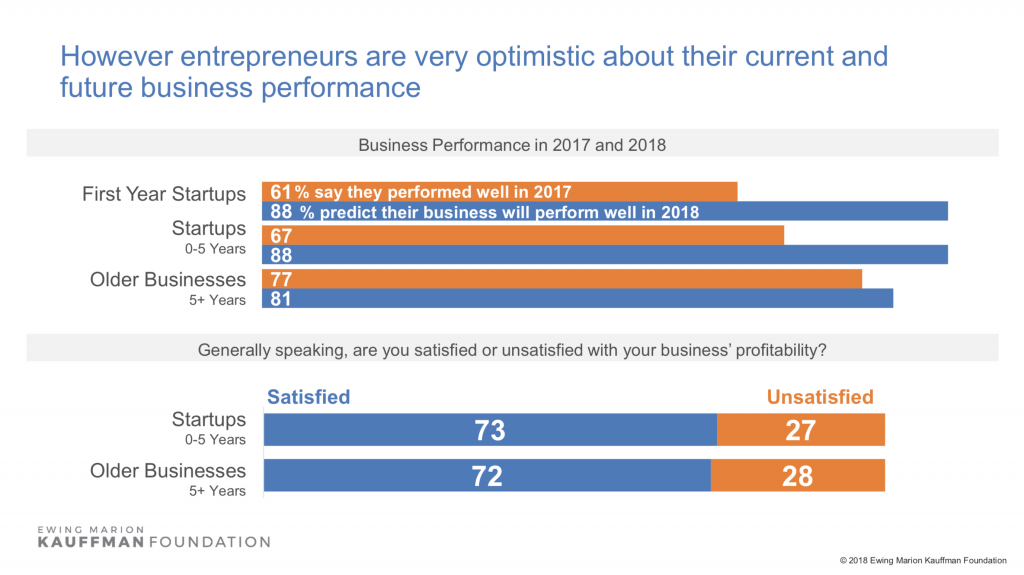 Shackelford wasn’t surprised, he said.
“To be an entrepreneur, you’ve got to be optimistic,” Shackelford said. “I oftentimes tell folks, ‘The most optimistic you’re going to be is before you’ve even started or launched the business, and you need to be because you’re going to run into a lot of obstacles.’”
Some of those roadblocks appear almost immediately, as founders must navigate through the technical aspects of starting a business — often with little guidance, the survey found.
Still, Gretchen Henry is among those with a positive outlook, she said. The chief executive officer of ConsultUS Technology, she most recently launched Sprout Solutions, one of Startland’s 2017 Under the Radar startups.
“If I didn’t feel optimistic, I wouldn’t be a business owner,” Henry said. “Quite frankly, I would be working in corporate America. I’m very passionate in what I’m doing.”
While optimism is definitely a good thing, at a certain point, that optimism could become a departure from reality, Roberts said.
“A lot of times, when we talk about the entrepreneurial community, we say only positive things,” Roberts said. “We don’t always talk about the difficulties of entrepreneurship. Yes, there’s a story about optimism and these numbers, but there’s also a story about false expectations.”
The most striking figure in the survey, according to Roberts: At least 95 percent of entrepreneurs felt excited to start their business.
“That’s the number in this entire survey that speaks most strongly to optimism,” she said. “They felt like they had control of their lives. They felt they were taking a step in a positive direction in starting their businesses.
“It makes me feel good because this is the world that I live and breathe, and to be reminded of just the positive impact that entrepreneurship can have on people and, in the aggregate, on communities, it makes my heart warm.”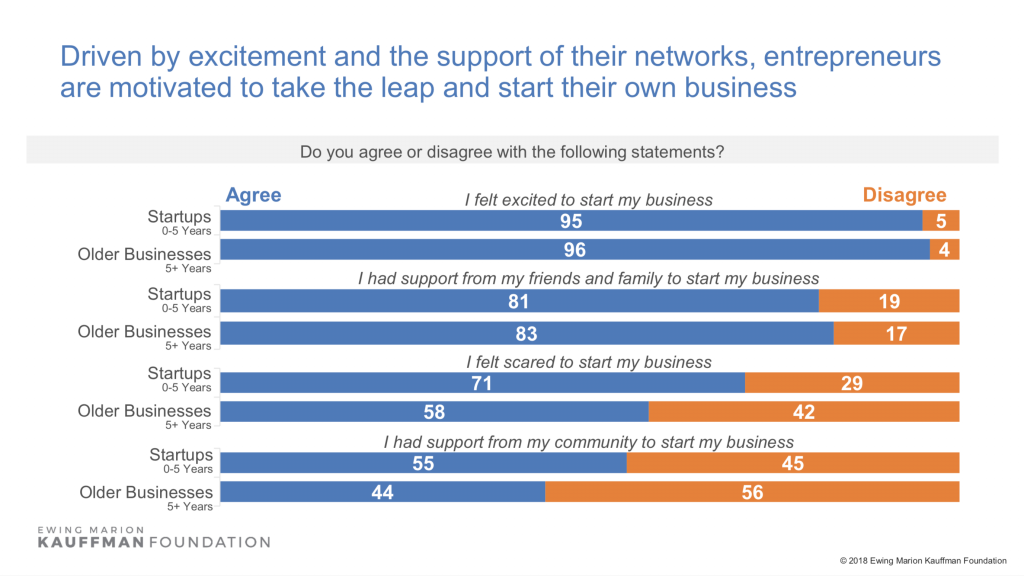

Featured Business

2018 Startups to Watch
stats here
Related Posts on Startland News
T-shirt printer GOEX hopes to clad workers in dignity
A Kansas City T-shirt screen printer has a lofty mission: Turn local purchases into global impact. “Your dollar has value in how it’s treating others across the world,” said Ryan Hudnall, engagement director at the Global Orphan Project. Tucked away near Wyandotte and 31st streets, GOEX serves as an offshoot of the Global Orphan Project,…

Looping back? Missouri partners with Hyperloop to study 23-minute KC-St Louis route
Missouri’s prospects for landing a Hyperloop route apparently aren’t off the rails after all. Despite the company revealing four U.S. finalist routes in September — which did not include a proposed route through the Show Me State – Hyperloop One announced Tuesday it has entered into a public-private partnership with the State of Missouri to conduct…

Techstars Spotlight: GRIT Virtual builds 3-D tech into 2-D construction mindset
3-D should stay 3-D, said Chris Callen, CEO of GRIT Virtual. And with the rise of virtual reality and augmented reality technology, that philosophy can be applied to the construction of 3-D buildings, Callen said. Wichita-based GRIT Virtual is a software-as-a-service platform for large contractors. It uses VR software to streamline the workflow for construction…

Cherry Pit Collective offers community-first workspace for female artists, makers
For artists and makers, coworking is often more than just a preference for a non-traditional space – it can be a necessity. When Kelsey Pike graduated from the Kansas City Art Institute in 2011, she came to the realization that she wouldn’t be able to continue her craft — papermaking — without the tools and…