

HomeAway, Airbnb critics fearful of strangers in neighborhoods, apathetic landlords
February 21, 2018 | Tommy Felts
Feb. 22 update: After a robust, 40-minute conversation Thursday, the full Kansas City Council voted 7-4 to pass a proposed ordinance that would prohibit short-term rentals in residential neighborhoods zoned as R-7.5 and R-10.
Voting yes: council members Scott Wagner, Heather Hall, Dan Fowler, Lee Barnes, Jr., Alissia Canady, Scott Taylor and Kevin McManus. Voting no: council members Quinton Lucas, Jermaine Reed and Katheryn Shields, as well as Mayor Sly James. Not voting: council members Teresa Loar and Jolie Justus.
So-called “stranger danger” is a legitimate concern, said Carol Winterowd, even if it doesn’t tell the whole story of why some Kansas City neighbors have become HomeAway and Airbnb critics.
Noise and increased traffic around homes are a start, Winterowd, representing the Center Planning and Development Council, told Kansas City’s Planning, Zoning and Economic Development committee Feb. 7 during the body’s fourth and most recent public hearing on short-term rentals.
Related Stories
• Balancing disruption: Proposal might ban big parts of KC from short-term rentals
• Tech leaders: City needs more innovative approach to regulating the sharing economy
“The third [reason is] more elusive, but it is what someone mentioned: strangers in and out of our neighborhoods,” she said. “We’ve got to make our neighborhoods comfortable for people to live in. We cannot erode the residential part of our city. We’ve got to protect our neighborhoods.”
To listen to public testimony on short-term rentals, skip to the 1:34:00 mark of this video.
The three-year saga over regulating short-term rentals in Kansas City, Missouri, has veered into what critics are calling an attempt to redline areas from services like Airbnb and HomeAway.
Members of the Kansas City Council on Thursday are expected to take up the the most recent proposed ordinance that would ban short-term rentals in specific residential zones comprising huge areas of southern and northern Kansas City. At the issue’s core lies an enduring challenge for the city to balance residents’ concerns and a desire to embrace innovation and transmit a tech-friendly ethos to the nation.
“This ‘stranger danger’ about rolling [luggage] in the neighborhood is getting totally blown out of proportion,” said Bob McCollum, who has operated a short-term rental in Kansas City for the past nine years. “The minute [a neighbor] sees someone who isn’t from their neighborhood with a roller bag, they’re worried.”
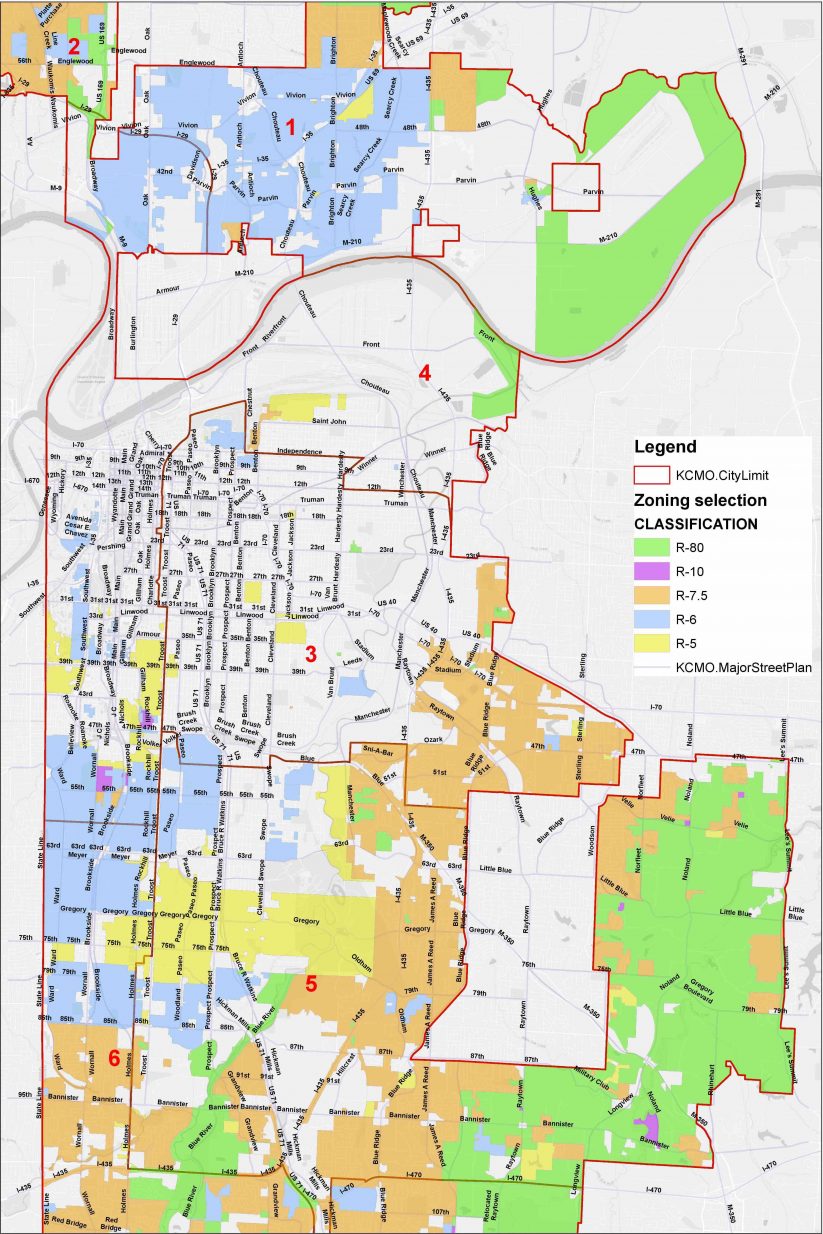
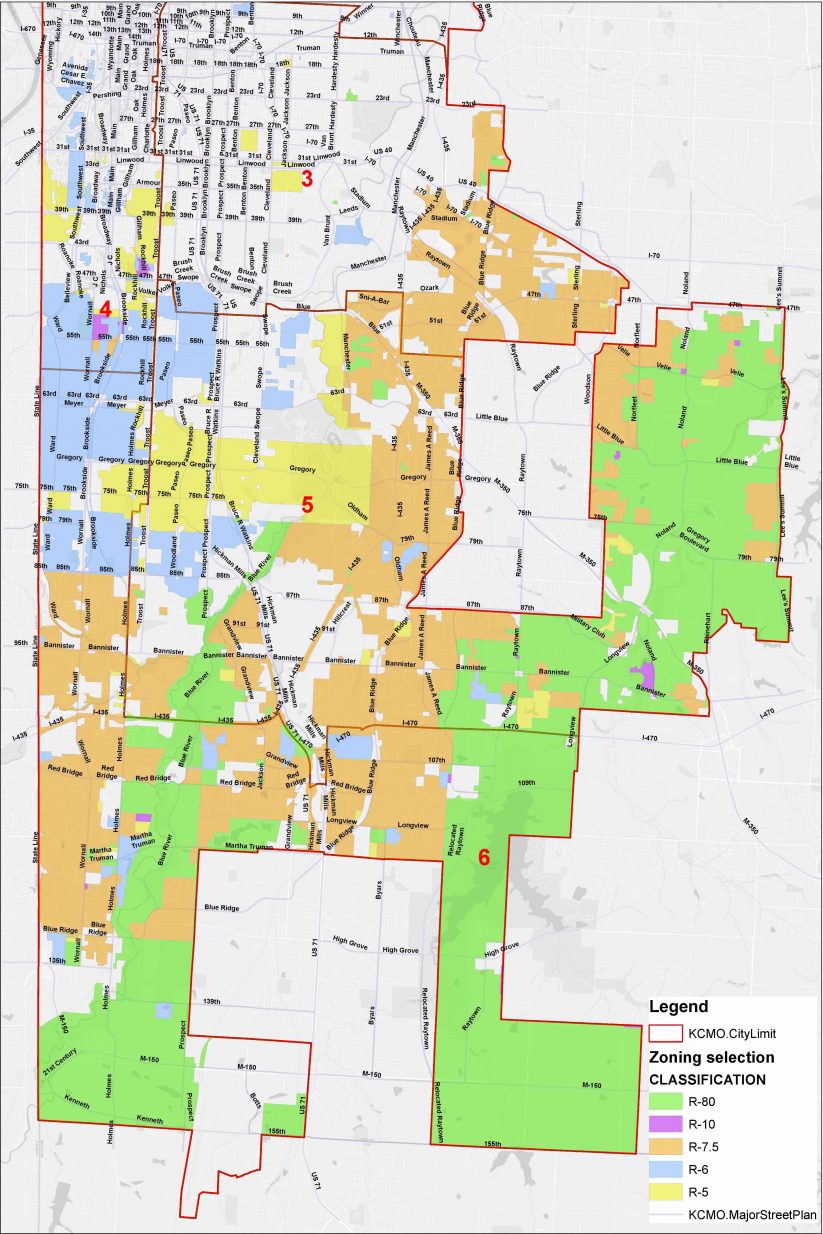
Here are residential district maps of north, central and south Kanas City. Orange and purple areas represent R-7.5 and R-10, respectively.

Restricting homeowners in select districts — in this case, R-7.5 and R-10 — from earning income off a spare room is reaching into their pockets and stealing money, McCollum told city council members during the lengthy Feb. 7 public comment section. Airbnb hosts in Missouri earned a combined $28.8 million in supplemental income while welcoming about 289,000 guest arrivals to the state in 2017, according to the company.
Kansas City alone saw $7.7 million in host income, Airbnb reported.
“This isn’t the American way — to deny people income from a valuable asset that they have,” he said. “Just because there are [short-term rental users] in the neighborhood who don’t match the people in the neighborhood and look different, that doesn’t mean they’re dangerous. It means Airbnb’ers are coming here to visit Kansas City, take advantage of all of the things we have to offer, and find a reasonable place to stay.”
John Sharp, South Kansas City Alliance
Opponents of largely unregulated short-term rental services aren’t necessarily worried about operations like McCollum’s, which could obtain special use permits under the proposed new rules, said John Sharp, a representative of the South Kansas City Alliance and a leading voice against home sharing in residential neighborhoods.
It’s the potential for abuse of short-term rental services by non-owner-occupied operators that causes the most concern, he said. That’s in part because such landlords could essentially use single-family homes for larger-scale commercial operations not intended by the zoning, Sharp added.
“There’s nothing wrong with multi-family housing, but we don’t put in multi-family housing in low-density, single-family residential,” Sharp, a former 6th district councilman told the zoning board. “There’s nothing wrong with hotels, whether they be the traditional hotels we’re all accustomed to or the new short-term rentals, which are basically mini hotels. But that doesn’t mean they should be in low-density.”
Many proponents of short-term rentals have glossed over legitimate skepticism about bringing non-residents into Kansas City’s neighborhoods, he added.
“I think we’d be awfully naïve to think there will never be problems, particularly when you allow it for non-owner-occupied residences where there’s nobody there to keep an eye on what’s going on,” Sharp said. “If any of us think that there won’t be parties there — that there won’t be improper activity that is a real blight to the neighborhood — I think we’re being tremendously naïve.”

Steve and Barbara Mitchell
Zoning regulation changes in 2011 banned short-term rentals of fewer than 30 days, meaning the nearly 800 current home-sharing operations in the city technically are being conducted illegally.
All except for one, Barbara Mitchell said.
She and her husband, Steve, run a short-term rental in the Hyde Park neighborhood, having been grandfathered via a certificate of legal non-conformance under the former zoning regulations that were in effect from 1923 to 2010, she said.
The Mitchells’ property, as well as other such short-term rentals in the surrounding blocks, fit into the neighborhood fabric, she said, and efforts to curtail such operations come from individuals who “lack a robust understanding of the digital age.”
“To exclude such participation in innovative and entrepreneurial progress would be egregious,” she told the zoning board. “This practice of arbitrarily redlining residential zones is unconstitutional and plays to the dark history Kansas City has had with real estate segregation. … I look forward to the day when every homeowner who wants to use his or her property as a short-term rental can do so legally in Kansas City, Missouri.”
Despite such criticisms, tighter regulations within residential neighborhoods are worth a try, said Carol McClure, co-chair of the Southern Communities Coalition.
“I wish I had a magic potion. Then we could just say it’s over with, but I would hope that after all this hard work [by the zoning committee] that we would at least give it a year,” she said. “It goes by pretty fast, as we all know, and I think it’s worth it … We have a lot of nice neighborhoods and they need the peace and quiet.”
For more in this short-term rental series, click here for a piece on the details of the ordinance and here for the tech industry’s perspective.

Featured Business

2018 Startups to Watch
stats here
Related Posts on Startland News

How one KC startup studio helps feel-good ventures grow impact while actually making money
Running a social venture comes with an inherent challenge for founders, shared Jacqueline Erickson Russell, emphasizing they must balance purpose and profit. Social Venture Studio — powered by LaunchKC — offers support along that journey, added Erickson Russell, the founder and CEO of Social Impact Advising Group and consultant for the Kansas City-based program. “Complex…

This hard swap plays easy: How one KC producer juggles community, breaking the club music cookie cutter
Tyler Jordan’s new spin on DJing: amplify fellow artists and unite people through music, he shared. Jordan — who produces electronic music and DJs under the name Oblivinatti (a mashup of his favorite video game growing up, The Elder Scrolls: Oblivion, and his interest in conspiracy theories) — is evolving his sound production business Vibration…

Art and technology too often butt heads, festival planners say; River Market event paints a reality where they coexist
The River Market Art Festival is back after a 20-year hiatus — with a nod to the past and an eye toward the future, shared The AI Hub’s Taylor Burris and James Spikes, startup founders who are hosting the event in partnership with the River Market Community Association. The revival of the art festival —…

PayIt co-founder: No one-size-fits-all formula for scaling one of KC biggest startup ideas
Mike Plunkett’s journey with PayIt came to an early, but critical crossroads when a wealthy entrepreneur offered half-million dollars to support the Kansas City-built govtech venture, he recalled. The catch: this investor insisted on imposing control and veto power as they committed more funds. Despite being low on funds, the PayIt team — led by…