

Harvard University recognizes KCMO digital inclusion map
December 11, 2017 | Bobby Burch
Kansas City’s geographic work to illustrate the area’s digital divide earned high praise from a prestigious university.
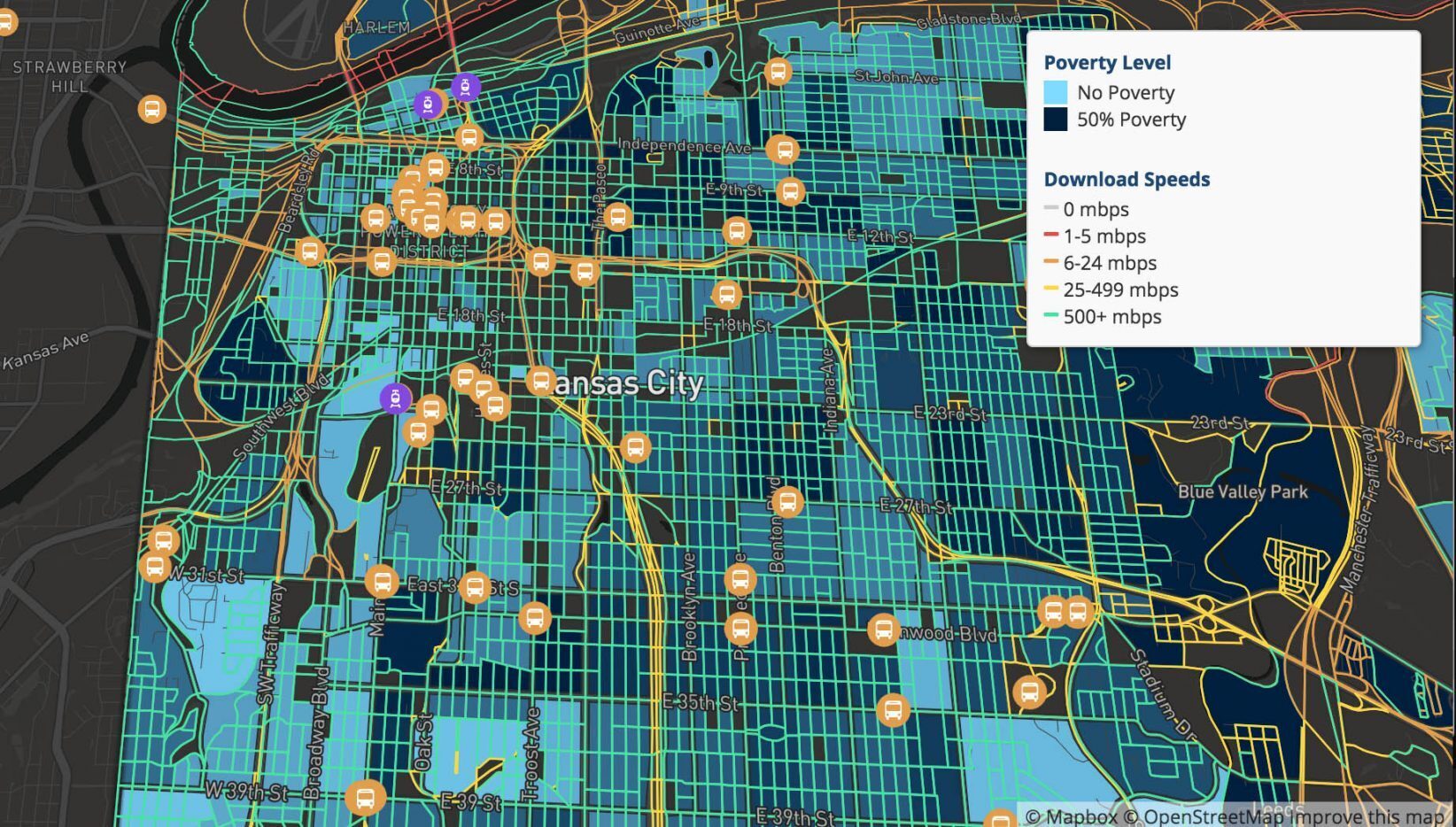
Harvard University recently highlighted the City of Kansas City, Missouri’s Digital Inclusion map, a tool that — at a block-by-block scale — detail residents’ access to internet connectivity overlaid with poverty levels.
“This visualization was chosen as Harvard’s Map of the Month for its ability to reveal insights on the far-reaching influence of Internet connectivity,” Harvard’s Chris Bousquet wrote. “By comparing broadband speeds and poverty data, the map shows a correlation between high-speed Internet and resident’s economic prospects, and displays this relationship in a striking UX.”
Created in collaboration with the KCMO Smart City initiative and software firm Xaqt, the map pulls data from the Federal Communications Commission and U.S. Census Bureau to show the correlation between internet access and poverty. Users can hover a cursor over various areas in Kansas City, Missouri, and compare poverty levels with the maximum advertised broadband speeds, as provided by various internet service providers.
Released in May, the tool was created to equip city officials, nonprofits and private organizations more information on how to most effectively connect residents to the internet.
Internet access has a profound impact on residents economic and educational opportunity, said Rick Usher, assistant city manager for small business and entrepreneurship for KCMO. While the Harvard recognition is satisfying, the city must continue pursuing its goal of digital equity for Kansas City’s more than 500,000 residents, Usher added.
“Our digital inclusion efforts should be focused on assisting residents of our most economically distressed neighborhoods in understanding the benefits and relevance of internet use in today’s economy,” he said. “The map has helped us recognize opportunities across city departments to collaborate in shared efforts to serve residents in neighborhoods that have suffered disinvestment and economic distress.”
Thanks to a HireKCYouth Internship project this summer, the map will be even more robust, Usher said. KCMO will soon be adding internet adoption data to the map, as well as Community Learning Center Network locations where residents can tap free access to computers and the internet, he added.
The map also marks a blossoming relationship between the KCMO Smart City initiative and the city’s digital equity efforts, Usher said. That collaborative spirit is spreading to other that are creating similar high tech efforts.
“It’s now becoming a positive trend in cities implementing smart city concepts across the U.S.” Usher said. “Our map underscores the capabilities of smart city data visualization tools to assist in informing decision making across city departments focused on improved quality of life for our residents.”
To learn more about the recognition, click here or to use the map, click here.

Featured Business

2017 Startups to Watch
stats here
Related Posts on Startland News

Meet the winners: Pitch Black competition rewards founders’ vision with $60K in prizes
Founder Godfrey Riddle was overwhelmed with emotion Saturday, he said, after accepting the $30,000 grand prize at the Pitch Black Business Summit — a game-changing development for his sustainable, affordable housing venture, Civic Saint. “I’m feeling phenomenal. Shocked, relieved — just elated,” said Riddle, following the announcement of his win. “It’s crazy because when you…

This young baker tore up the instructions for starting a business (but kept all the best recipes)
Overland Park cookie shop gets a new baker behind the counter, adding a frosted twist to familiar favorites She learned to bake as a child by her grandmother’s side. So by middle school, Maddie Callicott was so proficient she not only held popular bake sales, she printed up business cards for her “You Take the…

Brick by brick: How used LEGOs are making innovation more tangible for KC kids in need
Solopreneur Rhonda Jolyean Hale believes that all children deserve access to play — no matter their circumstances. As the Kansas City ambassador for the Pass the Bricks initiative, she’s working to build that reality by giving new life to donated LEGO bricks. “We take gently used LEGO bricks — not the stuff the dog chews…

Novel Capital teams with Crux KC to offer growth-focused marketing to early-stage tech companies
An exclusive partnership between two Kansas City-based innovators is expected to help remove a traditional financial hurdle to business growth, said Ethan Whitehill, president and chief strategy officer for the KC Chamber-lauded marketing firm Crux KC. The collaboration between Crux and Overland Park-headquartered capital provider Novel Capital is expected to offer B2B SaaS and tech…