

Harvard University recognizes KCMO digital inclusion map
December 11, 2017 | Bobby Burch
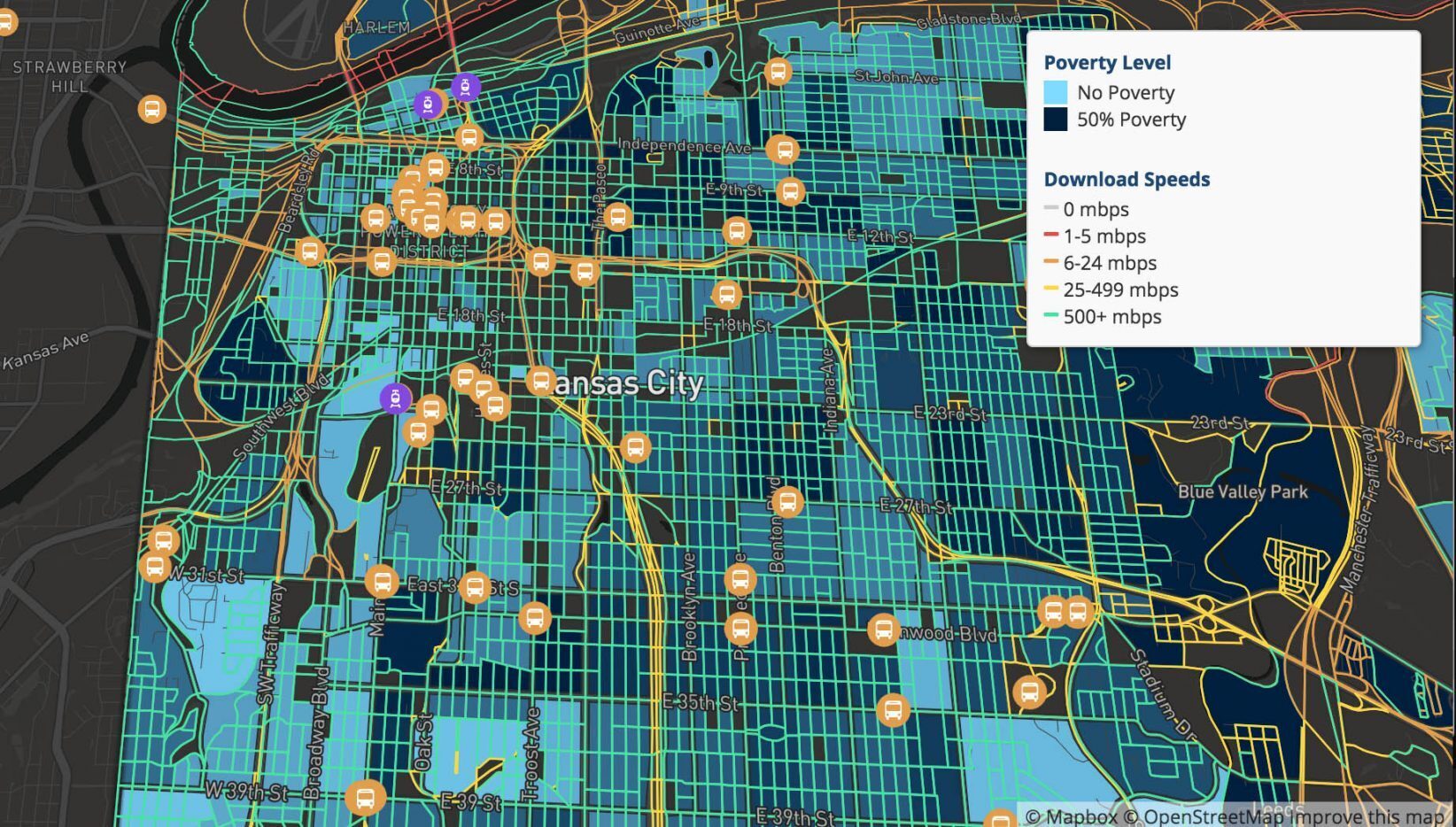
Kansas City’s geographic work to illustrate the area’s digital divide earned high praise from a prestigious university.
Harvard University recently highlighted the City of Kansas City, Missouri’s Digital Inclusion map, a tool that — at a block-by-block scale — detail residents’ access to internet connectivity overlaid with poverty levels.
“This visualization was chosen as Harvard’s Map of the Month for its ability to reveal insights on the far-reaching influence of Internet connectivity,” Harvard’s Chris Bousquet wrote. “By comparing broadband speeds and poverty data, the map shows a correlation between high-speed Internet and resident’s economic prospects, and displays this relationship in a striking UX.”
Created in collaboration with the KCMO Smart City initiative and software firm Xaqt, the map pulls data from the Federal Communications Commission and U.S. Census Bureau to show the correlation between internet access and poverty. Users can hover a cursor over various areas in Kansas City, Missouri, and compare poverty levels with the maximum advertised broadband speeds, as provided by various internet service providers.
Released in May, the tool was created to equip city officials, nonprofits and private organizations more information on how to most effectively connect residents to the internet.
Internet access has a profound impact on residents economic and educational opportunity, said Rick Usher, assistant city manager for small business and entrepreneurship for KCMO. While the Harvard recognition is satisfying, the city must continue pursuing its goal of digital equity for Kansas City’s more than 500,000 residents, Usher added.
“Our digital inclusion efforts should be focused on assisting residents of our most economically distressed neighborhoods in understanding the benefits and relevance of internet use in today’s economy,” he said. “The map has helped us recognize opportunities across city departments to collaborate in shared efforts to serve residents in neighborhoods that have suffered disinvestment and economic distress.”
Thanks to a HireKCYouth Internship project this summer, the map will be even more robust, Usher said. KCMO will soon be adding internet adoption data to the map, as well as Community Learning Center Network locations where residents can tap free access to computers and the internet, he added.
The map also marks a blossoming relationship between the KCMO Smart City initiative and the city’s digital equity efforts, Usher said. That collaborative spirit is spreading to other that are creating similar high tech efforts.
“It’s now becoming a positive trend in cities implementing smart city concepts across the U.S.” Usher said. “Our map underscores the capabilities of smart city data visualization tools to assist in informing decision making across city departments focused on improved quality of life for our residents.”
To learn more about the recognition, click here or to use the map, click here.

Featured Business

2017 Startups to Watch
stats here
Related Posts on Startland News

Grab your Zhoug sauce: Lawrence-built eatery launching brand across KC (starting with this famous food spot)
Shuttered for three years, the former d’Bronx pizzeria space — the now-defunct hometown brand’s original location along 39th Street’s famed “Restaurant Row” — is reopening Wednesday with a fresh look and flavors from the other side of the globe (via a Kansas college town). Zhoug Mediterranean is expected to debut its fare at 3904 Bell…

Homegrown startups can redefine KC, leader says; they just need help surviving long enough to do it
Editor’s note: The following is the third in a four-part series exploring the verticals and impact of initiatives within the Economic Development Corporation of Kansas City through a paid partnership with EDCKC. Leave KC better than you found it: How matching growth to city’s needs is paying off Wrong tool can wreck a neighborhood; Precision development…

This AI scans for auto damage in 30 seconds; Here’s how it’s gaining instant trust, KC tech industry veteran says
A growing number of automotive-sales and related businesses are turning to Click-Ins, an AI-assisted startup on a rapidly upward trajectory, to solve a long-standing problem: how to inspect vehicles quickly, accurately and consistently without relying solely on human judgment. But the value isn’t in replacing humans in the workforce, said Josh Parsons, a 20-year auto…

Power moves: Electric vehicle infrastructure stalled in Kansas where liquid fuels still dominate
Editor’s note: This article was written for a class at the University of Kansas’ William Allen White School of Journalism and Mass Communications and distributed through the Kansas Press Association. The number of people buying electric vehicles in Kansas is steadily growing, and as the number increases, the need for accommodation will be balanced with…