

Harvard University recognizes KCMO digital inclusion map
December 11, 2017 | Bobby Burch
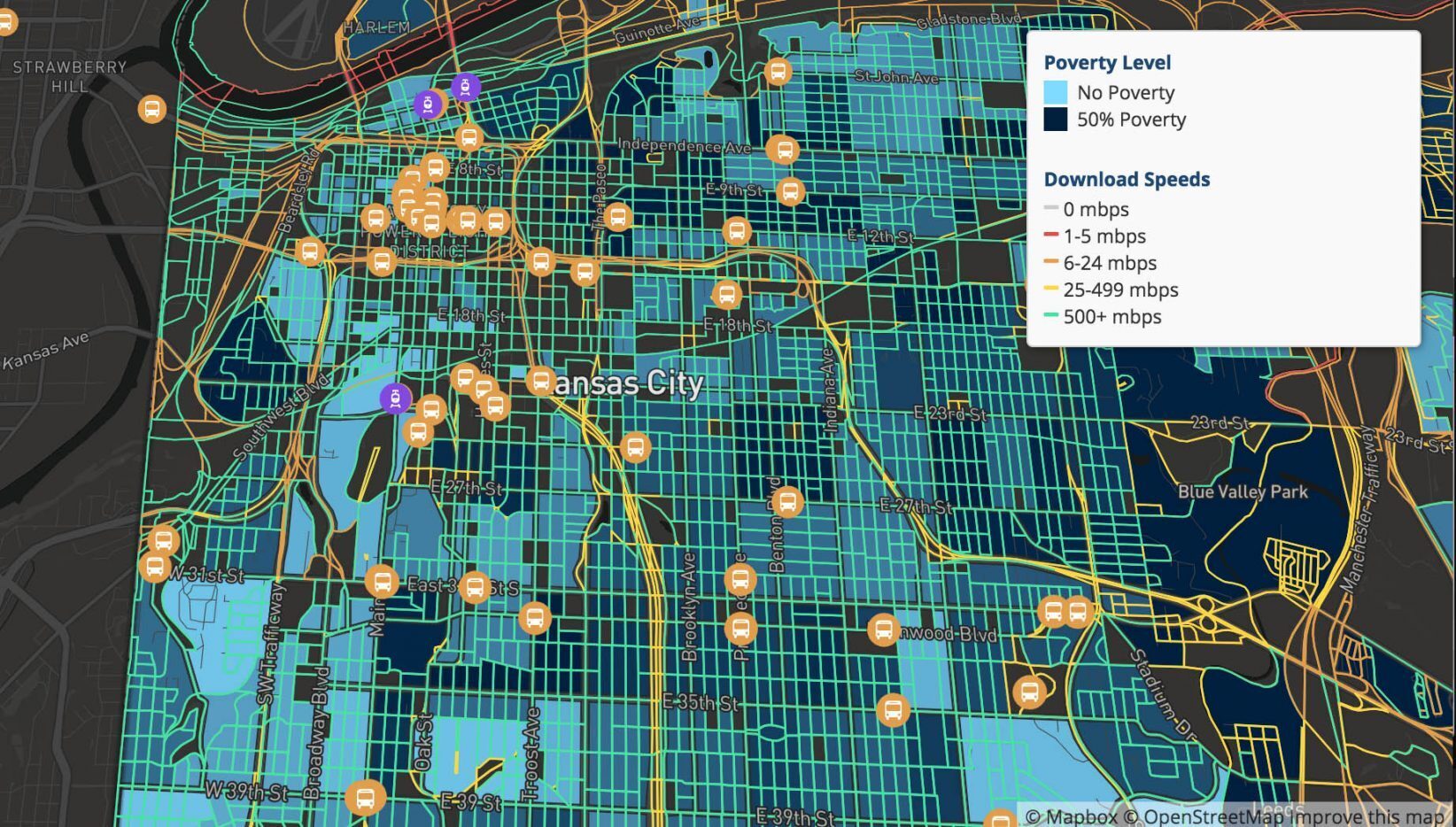
Kansas City’s geographic work to illustrate the area’s digital divide earned high praise from a prestigious university.
Harvard University recently highlighted the City of Kansas City, Missouri’s Digital Inclusion map, a tool that — at a block-by-block scale — detail residents’ access to internet connectivity overlaid with poverty levels.
“This visualization was chosen as Harvard’s Map of the Month for its ability to reveal insights on the far-reaching influence of Internet connectivity,” Harvard’s Chris Bousquet wrote. “By comparing broadband speeds and poverty data, the map shows a correlation between high-speed Internet and resident’s economic prospects, and displays this relationship in a striking UX.”
Created in collaboration with the KCMO Smart City initiative and software firm Xaqt, the map pulls data from the Federal Communications Commission and U.S. Census Bureau to show the correlation between internet access and poverty. Users can hover a cursor over various areas in Kansas City, Missouri, and compare poverty levels with the maximum advertised broadband speeds, as provided by various internet service providers.
Released in May, the tool was created to equip city officials, nonprofits and private organizations more information on how to most effectively connect residents to the internet.
Internet access has a profound impact on residents economic and educational opportunity, said Rick Usher, assistant city manager for small business and entrepreneurship for KCMO. While the Harvard recognition is satisfying, the city must continue pursuing its goal of digital equity for Kansas City’s more than 500,000 residents, Usher added.
“Our digital inclusion efforts should be focused on assisting residents of our most economically distressed neighborhoods in understanding the benefits and relevance of internet use in today’s economy,” he said. “The map has helped us recognize opportunities across city departments to collaborate in shared efforts to serve residents in neighborhoods that have suffered disinvestment and economic distress.”
Thanks to a HireKCYouth Internship project this summer, the map will be even more robust, Usher said. KCMO will soon be adding internet adoption data to the map, as well as Community Learning Center Network locations where residents can tap free access to computers and the internet, he added.
The map also marks a blossoming relationship between the KCMO Smart City initiative and the city’s digital equity efforts, Usher said. That collaborative spirit is spreading to other that are creating similar high tech efforts.
“It’s now becoming a positive trend in cities implementing smart city concepts across the U.S.” Usher said. “Our map underscores the capabilities of smart city data visualization tools to assist in informing decision making across city departments focused on improved quality of life for our residents.”
To learn more about the recognition, click here or to use the map, click here.

Featured Business

2017 Startups to Watch
stats here
Related Posts on Startland News

How this reality TV star is using his platform to help tech students start life-changing careers without heavy debt
Nehemiah Clark stands at the crossroads of reality TV and inclusive tech education. As a former cast member on MTV’s “The Real World: Austin” and a frequent competitor on the Paramount+ “The Challenge” series, Clark leverages his audience to further the mission of SnapIT Solutions, he shared. “On [‘The Challenge’], I’ve talked about what I…

How Charlie Hustle’s wholesale expansion, collegiate licensing is growing its brand beyond the KC Heart
Chase McAnulty is on a mission to build Charlie Hustle into a national brand, he shared, without losing the company’s roots in Kansas City. “We’ve really driven the narrative that not only celebrates culture, but civic pride. It’s a challenge to go to these other markets and give them their version of the KC Heart,…

Two UMKC-linked research teams earn Comeback KC Ventures funding for COVID innovations
Two research teams tied to the University of Missouri-Kansas City have received proof-of-concept funding support through Comeback KC Ventures and will take the next step toward bringing their innovations from the university lab to market to solve problems related to the COVID-19 pandemic, the funding program announced. Funds from Comeback KC Ventures focus on the…

She sends food to the dinner table, instead of the trash can; how one social venture is saving family mealtime with would-be waste
A Kansas City nonprofit’s innovative approach is reducing food waste, fighting food insecurity, and restoring family mealtime. Pete’s Garden, founded in 2019 by Tamara Weber, partners with caterers, restaurants, and food service organizations to save unserved, prepared food that would otherwise be thrown out. Weber and a team of volunteers portion and package that food…