

Harvard University recognizes KCMO digital inclusion map
December 11, 2017 | Bobby Burch
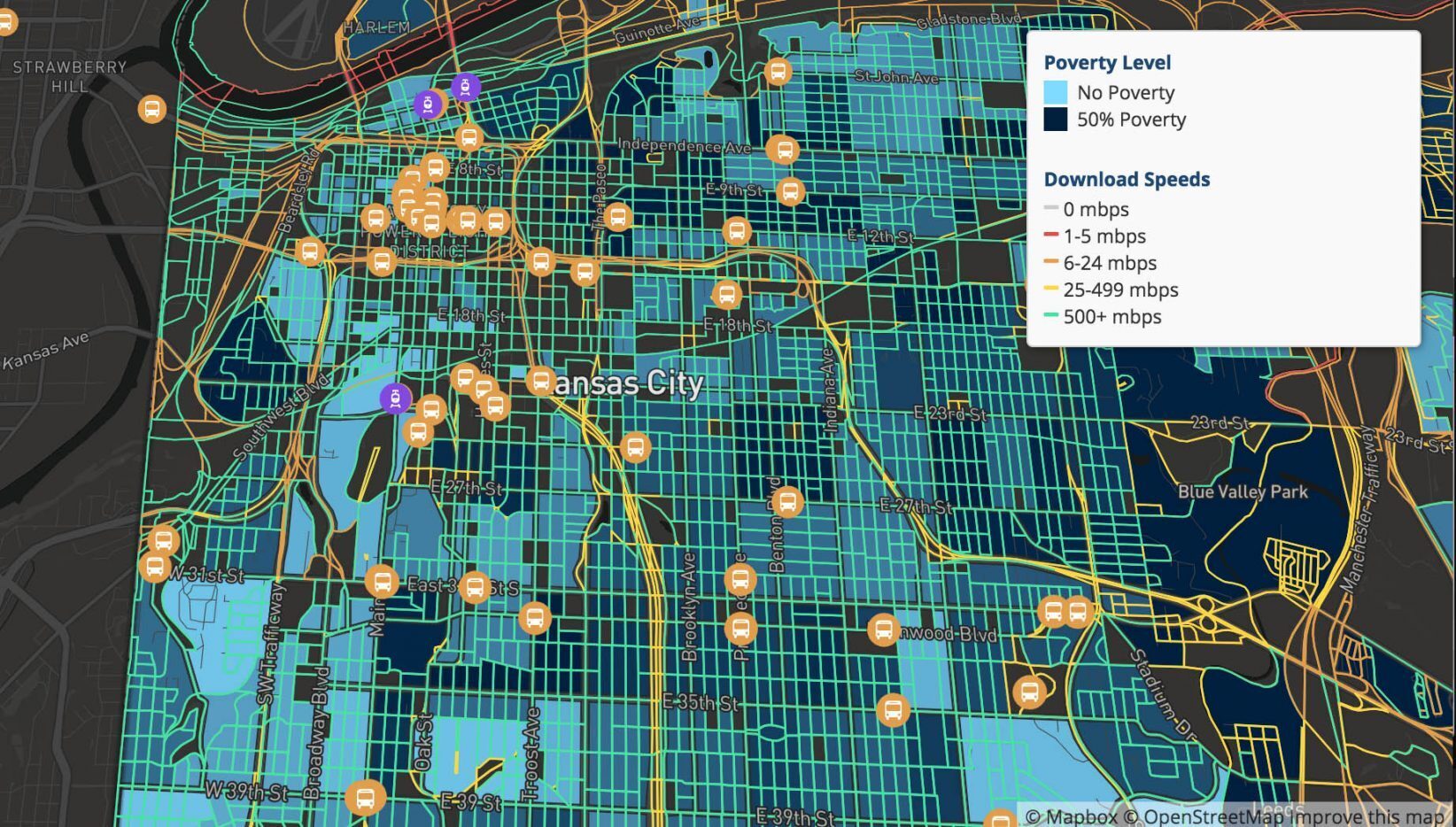
Kansas City’s geographic work to illustrate the area’s digital divide earned high praise from a prestigious university.
Harvard University recently highlighted the City of Kansas City, Missouri’s Digital Inclusion map, a tool that — at a block-by-block scale — detail residents’ access to internet connectivity overlaid with poverty levels.
“This visualization was chosen as Harvard’s Map of the Month for its ability to reveal insights on the far-reaching influence of Internet connectivity,” Harvard’s Chris Bousquet wrote. “By comparing broadband speeds and poverty data, the map shows a correlation between high-speed Internet and resident’s economic prospects, and displays this relationship in a striking UX.”
Created in collaboration with the KCMO Smart City initiative and software firm Xaqt, the map pulls data from the Federal Communications Commission and U.S. Census Bureau to show the correlation between internet access and poverty. Users can hover a cursor over various areas in Kansas City, Missouri, and compare poverty levels with the maximum advertised broadband speeds, as provided by various internet service providers.
Released in May, the tool was created to equip city officials, nonprofits and private organizations more information on how to most effectively connect residents to the internet.
Internet access has a profound impact on residents economic and educational opportunity, said Rick Usher, assistant city manager for small business and entrepreneurship for KCMO. While the Harvard recognition is satisfying, the city must continue pursuing its goal of digital equity for Kansas City’s more than 500,000 residents, Usher added.
“Our digital inclusion efforts should be focused on assisting residents of our most economically distressed neighborhoods in understanding the benefits and relevance of internet use in today’s economy,” he said. “The map has helped us recognize opportunities across city departments to collaborate in shared efforts to serve residents in neighborhoods that have suffered disinvestment and economic distress.”
Thanks to a HireKCYouth Internship project this summer, the map will be even more robust, Usher said. KCMO will soon be adding internet adoption data to the map, as well as Community Learning Center Network locations where residents can tap free access to computers and the internet, he added.
The map also marks a blossoming relationship between the KCMO Smart City initiative and the city’s digital equity efforts, Usher said. That collaborative spirit is spreading to other that are creating similar high tech efforts.
“It’s now becoming a positive trend in cities implementing smart city concepts across the U.S.” Usher said. “Our map underscores the capabilities of smart city data visualization tools to assist in informing decision making across city departments focused on improved quality of life for our residents.”
To learn more about the recognition, click here or to use the map, click here.

Featured Business

2017 Startups to Watch
stats here
Related Posts on Startland News

‘Return of the Shihan’ live screening just a teaser, says filmmaker who wants KC to build its own Hollywood
Kansas City’s “first superhero” is set to debut on the big screen for a live audience Saturday evening at the Gem Theater — the first installment of a planned “Return of the Shihan” TV series from local filmmaker Victor Wilson, Jr. Wilson — better known to many by his alter ego “Pudgy PoKCettz” — created…

Remote control cattle: Virtual fencing tech reduces herds’ carbon hoofprint, puts rancher pain points out to pasture
Startland News’ Startup Road Trip series explores innovative and uncommon ideas finding success in rural America and Midwestern startup hubs outside the Kansas City metro. LINCOLN, Nebraska — Corral Technologies is taking cattle control virtual, founder Jack Keating shared. Using satellite maps and solar collars, the agtech startup offers a virtual fencing system to help…
White Castle invented sliders (and the playbook for fast food); then the Kansas-fried chain vanished from its home state
Editor’s note: The following story was originally published by KCUR, Kansas City’s NPR member station, and a fellow member of the KC Media Collective. Click here to read the original story or here to sign up for KCUR’s email newsletter. For more stories like this one, subscribe to A People’s History of Kansas City on Apple Podcasts, Spotify or Stitcher. The White Castle chain began in 1921…

DevStride founder finds himself ‘locking arms with frontline customers’ in bid to catch their mistakes early
Implementing and monitoring complex software cycles is a tedious process, Phil Reynolds said, which is why he and his team are working to drive better project management principles and improve outcomes through their software solution. “We are really trying to transform the way that teams go about implementing and managing agile software development cycles. Our…