

Harvard University recognizes KCMO digital inclusion map
December 11, 2017 | Bobby Burch
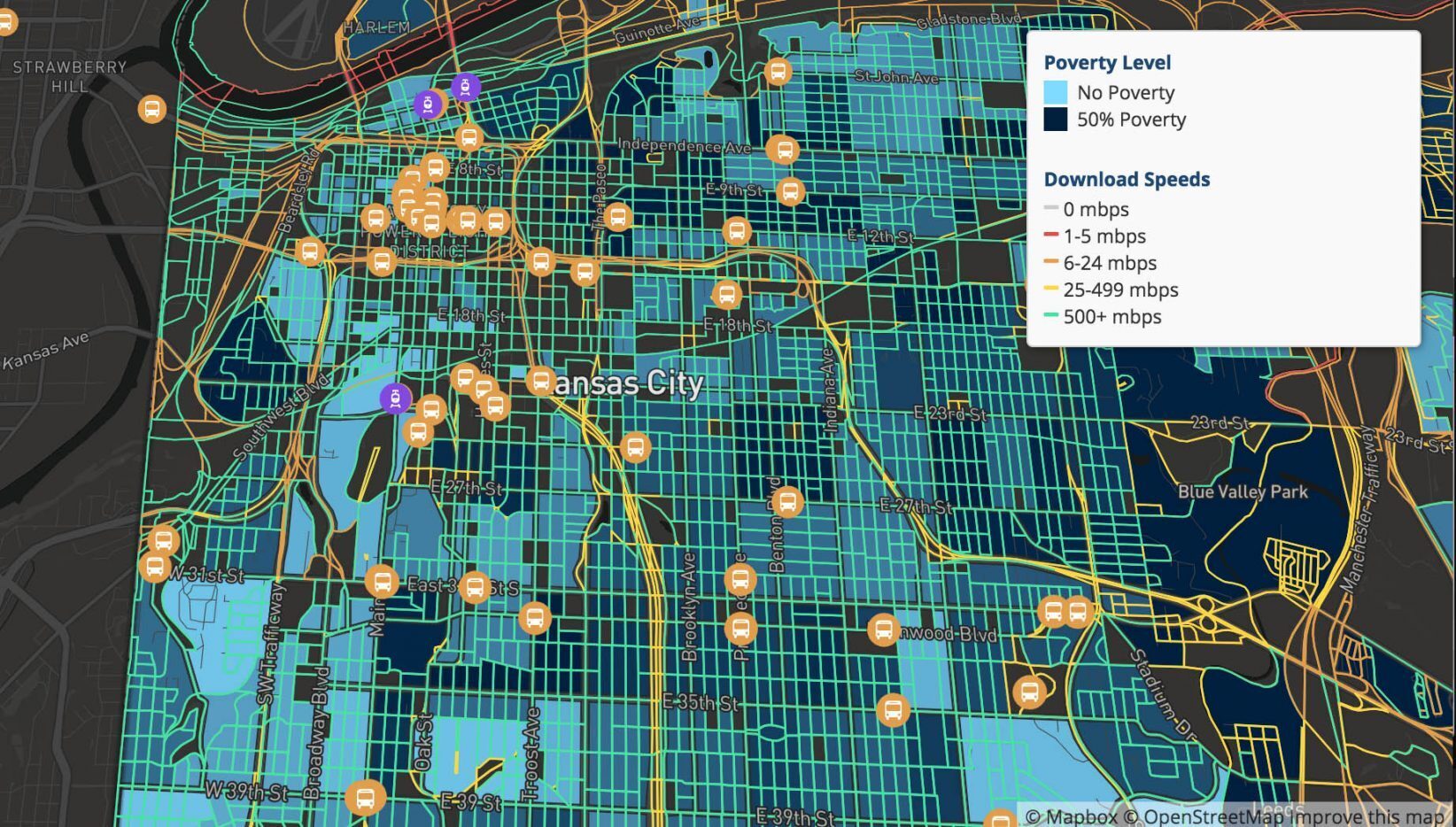
Kansas City’s geographic work to illustrate the area’s digital divide earned high praise from a prestigious university.
Harvard University recently highlighted the City of Kansas City, Missouri’s Digital Inclusion map, a tool that — at a block-by-block scale — detail residents’ access to internet connectivity overlaid with poverty levels.
“This visualization was chosen as Harvard’s Map of the Month for its ability to reveal insights on the far-reaching influence of Internet connectivity,” Harvard’s Chris Bousquet wrote. “By comparing broadband speeds and poverty data, the map shows a correlation between high-speed Internet and resident’s economic prospects, and displays this relationship in a striking UX.”
Created in collaboration with the KCMO Smart City initiative and software firm Xaqt, the map pulls data from the Federal Communications Commission and U.S. Census Bureau to show the correlation between internet access and poverty. Users can hover a cursor over various areas in Kansas City, Missouri, and compare poverty levels with the maximum advertised broadband speeds, as provided by various internet service providers.
Released in May, the tool was created to equip city officials, nonprofits and private organizations more information on how to most effectively connect residents to the internet.
Internet access has a profound impact on residents economic and educational opportunity, said Rick Usher, assistant city manager for small business and entrepreneurship for KCMO. While the Harvard recognition is satisfying, the city must continue pursuing its goal of digital equity for Kansas City’s more than 500,000 residents, Usher added.
“Our digital inclusion efforts should be focused on assisting residents of our most economically distressed neighborhoods in understanding the benefits and relevance of internet use in today’s economy,” he said. “The map has helped us recognize opportunities across city departments to collaborate in shared efforts to serve residents in neighborhoods that have suffered disinvestment and economic distress.”
Thanks to a HireKCYouth Internship project this summer, the map will be even more robust, Usher said. KCMO will soon be adding internet adoption data to the map, as well as Community Learning Center Network locations where residents can tap free access to computers and the internet, he added.
The map also marks a blossoming relationship between the KCMO Smart City initiative and the city’s digital equity efforts, Usher said. That collaborative spirit is spreading to other that are creating similar high tech efforts.
“It’s now becoming a positive trend in cities implementing smart city concepts across the U.S.” Usher said. “Our map underscores the capabilities of smart city data visualization tools to assist in informing decision making across city departments focused on improved quality of life for our residents.”
To learn more about the recognition, click here or to use the map, click here.

Featured Business

2017 Startups to Watch
stats here
Related Posts on Startland News
Spokes Café banks on new downtown coffee spot, cycling operations under same roof as neighboring customers
A new home inside the Commerce Bank Building in downtown Kansas City moves Dan Walsh’s popular coffee shop across the street — and saves him the struggle of finding a different location amid Spokes Café’s pending displacement as a longtime fixture at 10th and Walnut streets. Walsh recently announced the relocation — the artisanal breakfast and…

Three-peat threads: 30+ Super Bowl-bound Chiefs fan fits (haters will say the refs wrote this)
With the Chiefs ready to stand on business in the Big Easy, Kansas City fans — at home or at the big game — will need to dress for the win they want. Here’s how small business owners from across the region stand ready to help them suit up ahead of the Chiefs-Eagles Super Bowl…
How ’bout those cheeeeeese mochis? Korean chicken spot gets into the game with its own head-turning plays
After their decade of conversation got old, three lifelong friends finally achieved their dream of opening a restaurant together, Kue-Jin Hwang shared. Now they’re hoping to capture Chiefs’ fans’ hunger for a three-peat at their Overland Park restaurant. Hwang, Kyoungmin Kim, and Sung Jo — friends for more than 30 years (each represented in the…
KC startup founder pivots into pickleball haters’ biggest complaint, eliminating court noise
SLN/CR is serving the sweet sound of silence to neighbors of outdoor pickleball courts, said Eliot Arnold, a serial entrepreneur-turned avid pickleball player who’s taking a swing at the source of critics’ irritation. His Kansas City-based startup — pronounced “silencer” — offers a fabric-based noise mitigation system that uses nanotechnology to absorb nuisance noise, said…