

Football tech startup Lazser Down scores big with NCAA championship game
December 14, 2017 | Bobby Burch
When two out-of-state foes face off Saturday at Children’s Mercy Park, the NCAA Division II Championship game will still host a hometown team.
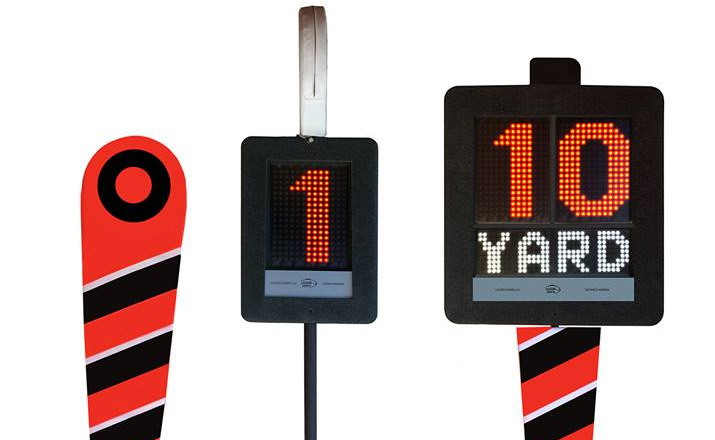
The title game — between West Florida University and Texas A&M University-Commerce — features local tech created by Lazser Down, a Kansas City-based startup that created a new down marker system that uses lasers to display the yardage teams need on a bright LED screen.
It’s the biggest validation yet for the football firm, which has a goal to be the go-to solution for leagues from pee-wee to the National Football League, Lazser Down founder Mike Foster said.
“It’ll be awesome — it’s the first time we’ll be in anything of this magnitude,” said Foster, a retired college football coach of more than 30 years. “The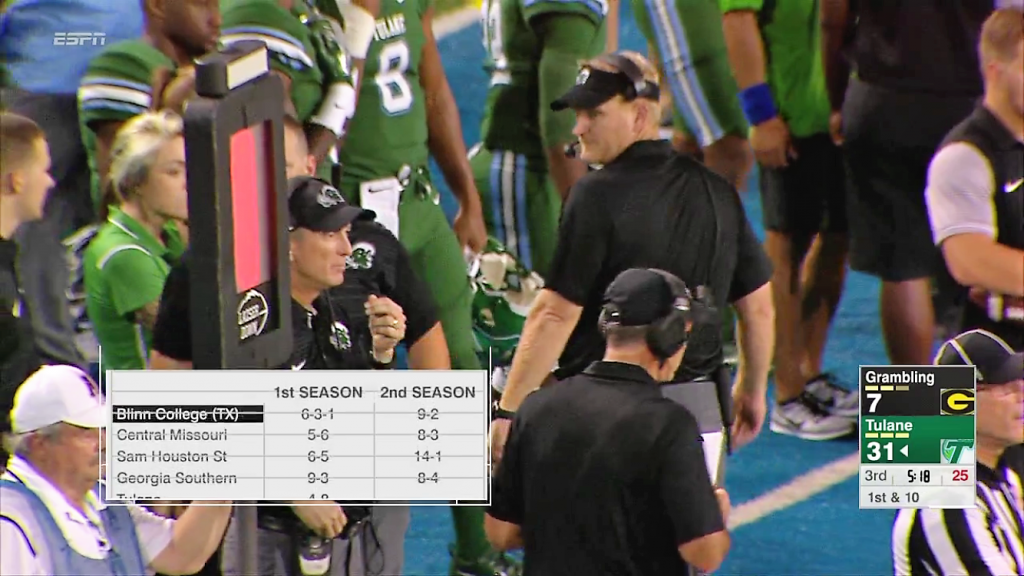 cherry on top is that it’s here in Kansas City. Being in our hometown makes it even better.”
Using an infrared laser similar to what’s in surveying equipment, Lazser Down provides instant information on the distance needed to gain a first down via a large LED screen, helping coaches and players with strategy, Foster said. An operator need only push a button to change the down, Foster said. The technology does not yet sync with scoreboards, but that is in the works, he added.
The bright LED screen also improves the experience for fans, who’ve come to expect yellow lines on TV broadcasts indicating how far a team must travel to nab the first down, Foster said.
“The NFL wants people to be able to experience the same things in the stadium that they do at home,” Foster said. “They’re losing butts in the seats because of the technology available on television. We help bridge that gap.”
The technology represents the next step in down and distance technology for football teams, officials and leagues — a shift that hasn’t occurred for about 30 years, Foster said.
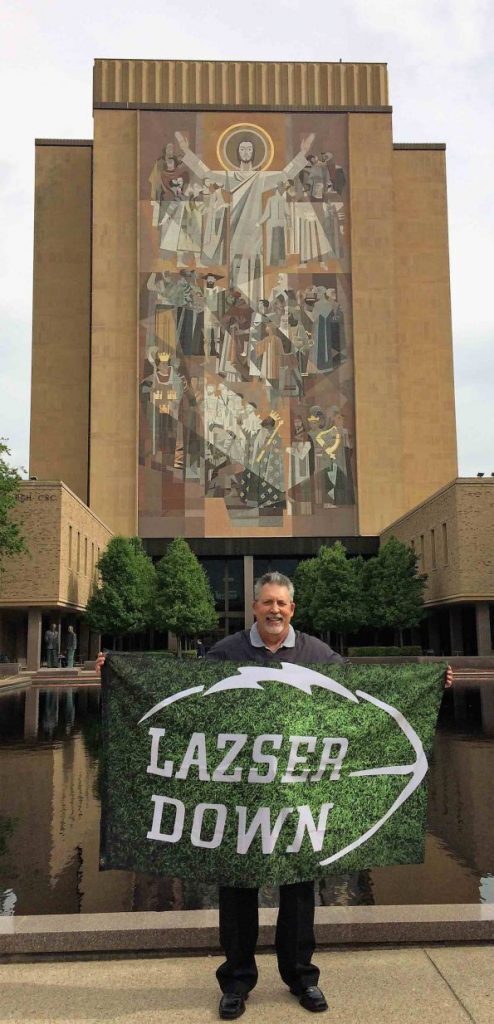
Foster at Notre Dame
Football began with a cube that rotated to show the down, then to a flipboard and in 1987 transitioned to what’s still ubiquitously used across leagues and in the NFL: the Dial-a-Down. Kansas Citian Jim Egender invented the Dial-a-Down device and now sits on Lazser Down’s advisory board, Foster said.
Notre Dame and Tulane universities have both used Lazser Down during practices, Foster said, adding that Tulane has also tapped it during some games. The Kansas City Chiefs and Dallas Cowboys also have observed the tech in use to offer valuable feedback, he added.
Born from an idea he had decades ago as a coach, Foster said he and fellow staff would spend film days lamenting decisions based on poor information. Had officials and teams used Laszer Down, Foster’s teams would have made better-informed play calls, he said.
“When we’d do our post-mortem on Sunday of what we could’ve done differently, without fail, we’d talk about the communication from the press box down to the field on down and distance plays,” he said. “We’d say ‘I didn’t get it soon enough. You told me it was a long yard and it was a short yard. I would’ve called this or that.’ … We’d have these conversations and just waste time. From a coaching standpoint, it improves the communication.”
Check out NCAA Division II Championship game and Lazser Down in action at 5 p.m. Saturday on ESPN2.


2017 Startups to Watch
stats here
Related Posts on Startland News
Thelma’s Kitchen cooks up pay-what-you-can cafe concept to preserve community
Twenty people once filled the kitchen of Thelma Gardner’s apartment in search of their next meal. Their hunger for food fueled her hunger for humanity, recounted Father Justin Mathews as he sat sipping coffee in the newly opened Thelma’s Kitchen. The pay-what-you-can restaurant — located inside of the Reconciliation Services building at 3101 Troost Ave.…
Operation Breakthrough bridge over Troost symbolizes ‘real community’ at an intersection
With reflection in his voice, Alvin Brooks paused. “The city has to be a partner,” the Civil Rights activist and veteran Kansas City Police Commissioner said as he spoke of the redevelopment of Troost Avenue — the well known racial dividing line, that has long isolated the east side of the Kansas City metro from the…

Troostapalooza aims to shed the old skin of city’s racial dividing line, says Kemet Coleman
Troostapalooza will build community while constructively addressing the elephant in the room, said Kemet Coleman, organizer of the newly developed street festival. “We wanted to create a home away from home on Troost that is inclusive and sensitive to the historic and existing nuances,” he said. “Not the violent, divisive one that is portrayed by…
Defiant anti-gentrification voice: Clock is ticking on east side neighborhoods, Movement KC
Daniel Edwards isn’t shy about his frustrations with the perception of Kansas City’s east side. “I remember my first corporate lunch after graduating college: the joke was, ‘Nobody wants to go near 35th and Prospect at night time,’” said Edwards, a Kansas City area developer and the founder of Movement KC. “I was like, ‘Yo, it’s…