

Football tech startup Lazser Down scores big with NCAA championship game
December 14, 2017 | Bobby Burch
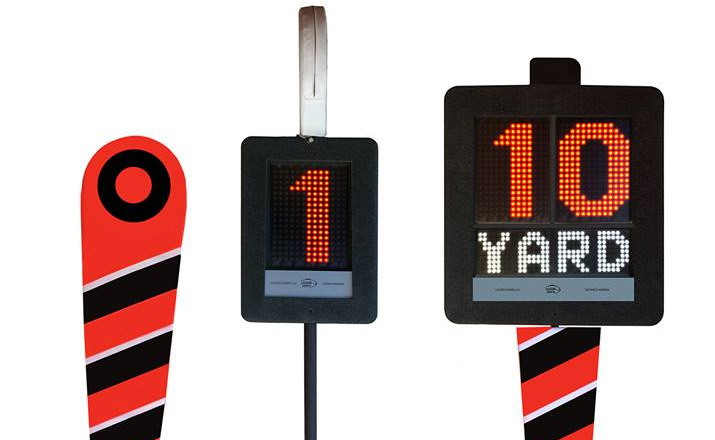
When two out-of-state foes face off Saturday at Children’s Mercy Park, the NCAA Division II Championship game will still host a hometown team.
The title game — between West Florida University and Texas A&M University-Commerce — features local tech created by Lazser Down, a Kansas City-based startup that created a new down marker system that uses lasers to display the yardage teams need on a bright LED screen.
It’s the biggest validation yet for the football firm, which has a goal to be the go-to solution for leagues from pee-wee to the National Football League, Lazser Down founder Mike Foster said.
“It’ll be awesome — it’s the first time we’ll be in anything of this magnitude,” said Foster, a retired college football coach of more than 30 years. “The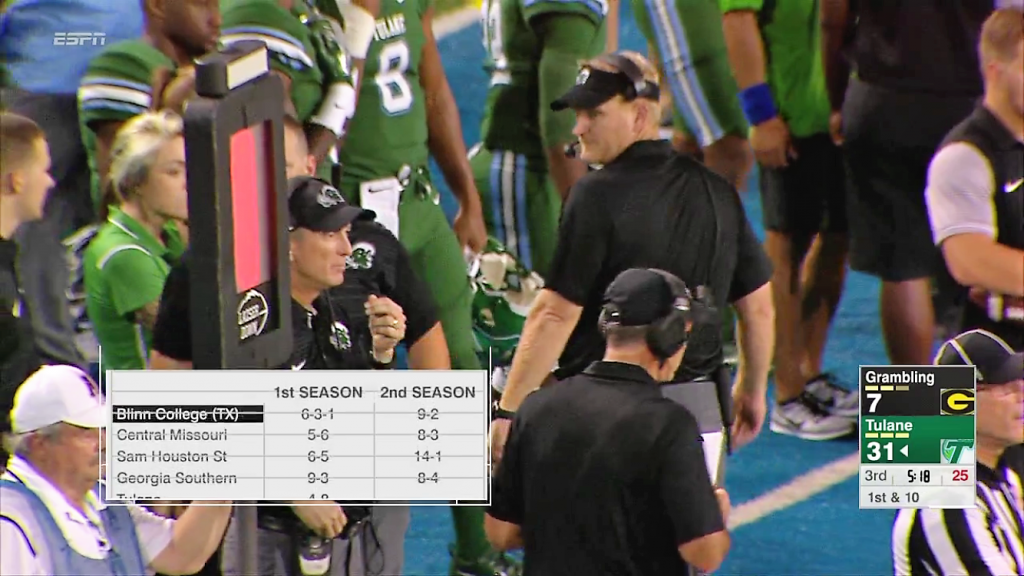 cherry on top is that it’s here in Kansas City. Being in our hometown makes it even better.”
Using an infrared laser similar to what’s in surveying equipment, Lazser Down provides instant information on the distance needed to gain a first down via a large LED screen, helping coaches and players with strategy, Foster said. An operator need only push a button to change the down, Foster said. The technology does not yet sync with scoreboards, but that is in the works, he added.
The bright LED screen also improves the experience for fans, who’ve come to expect yellow lines on TV broadcasts indicating how far a team must travel to nab the first down, Foster said.
“The NFL wants people to be able to experience the same things in the stadium that they do at home,” Foster said. “They’re losing butts in the seats because of the technology available on television. We help bridge that gap.”
The technology represents the next step in down and distance technology for football teams, officials and leagues — a shift that hasn’t occurred for about 30 years, Foster said.
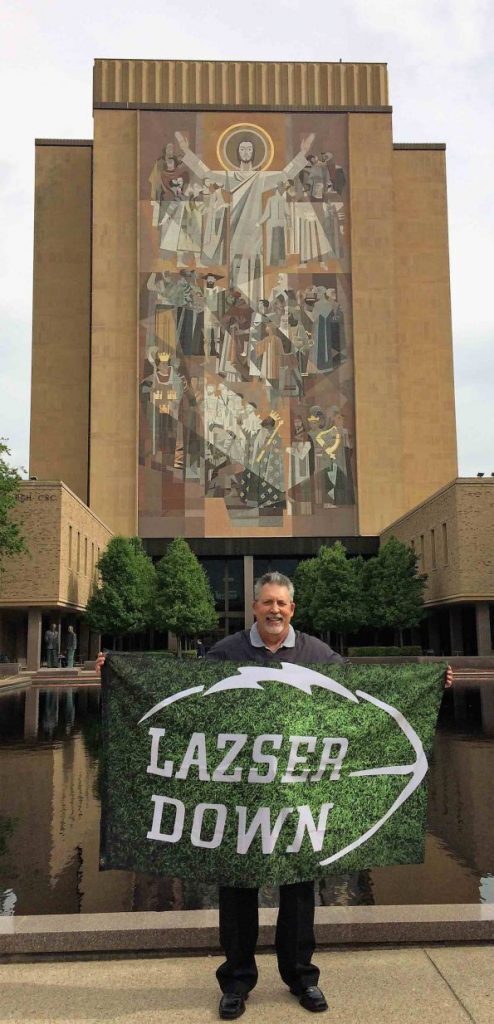
Foster at Notre Dame
Football began with a cube that rotated to show the down, then to a flipboard and in 1987 transitioned to what’s still ubiquitously used across leagues and in the NFL: the Dial-a-Down. Kansas Citian Jim Egender invented the Dial-a-Down device and now sits on Lazser Down’s advisory board, Foster said.
Notre Dame and Tulane universities have both used Lazser Down during practices, Foster said, adding that Tulane has also tapped it during some games. The Kansas City Chiefs and Dallas Cowboys also have observed the tech in use to offer valuable feedback, he added.
Born from an idea he had decades ago as a coach, Foster said he and fellow staff would spend film days lamenting decisions based on poor information. Had officials and teams used Laszer Down, Foster’s teams would have made better-informed play calls, he said.
“When we’d do our post-mortem on Sunday of what we could’ve done differently, without fail, we’d talk about the communication from the press box down to the field on down and distance plays,” he said. “We’d say ‘I didn’t get it soon enough. You told me it was a long yard and it was a short yard. I would’ve called this or that.’ … We’d have these conversations and just waste time. From a coaching standpoint, it improves the communication.”
Check out NCAA Division II Championship game and Lazser Down in action at 5 p.m. Saturday on ESPN2.


2017 Startups to Watch
stats here
Related Posts on Startland News

Help from above: Why protecting satellites from cyber attacks could hold key to adapting to climate change
Humans must responsibly rise to the occasion as Earth’s climate changes, Charles Beames said, detailing the role well-protected satellites and space systems can play in putting life-preserving solutions into orbit. “Space systems are one of the keys to the future, our future, of dealing with the changing climate and our adaptation,” said Beames, aerospace expert and…

In the field: Industry-specific, hands-free voice tech helps ‘hero up’ data collecting workers
After years of research, Bruce Rasa and his team identified a consistent pain point for field workers: capturing data on-the-go and looping it back to their headquarters. They need a co-pilot, he said, noting the role played by KC-based Dexer (formerly AgVoice), agriculture’s first handsfree data capture service to help cross-industry specialists create records —…
New city flag designed for KC’s now (and tomorrow): Here’s where you’ll see it flying first
Kansas City is ushering in an era of growth and development, Jared Horman said, and the unveiling of a new municipal flag is just the way to recognize this new chapter. “The timing feels particularly exciting with the Chiefs headed to the Super Bowl, the opening of the new terminal at the airport and the…

Pushing without force: Founder credits accelerator’s collaborative ‘in the trenches’ guidance for overseas scaling success
Editor’s note: This article is sponsored by the NMotion startup accelerator, but was independently produced by Startland News. The powerhouse mix of global and localized support David Biga received from the NMotion Growth Accelerator was well worth the program’s required exchange of equity, the proptech startup founder detailed. Particle Space — one of Startland News’…