

FAQ: Is it all hype? Tunneling into Missouri’s chances for Hyperloop
November 1, 2017 | Meghan LeVota
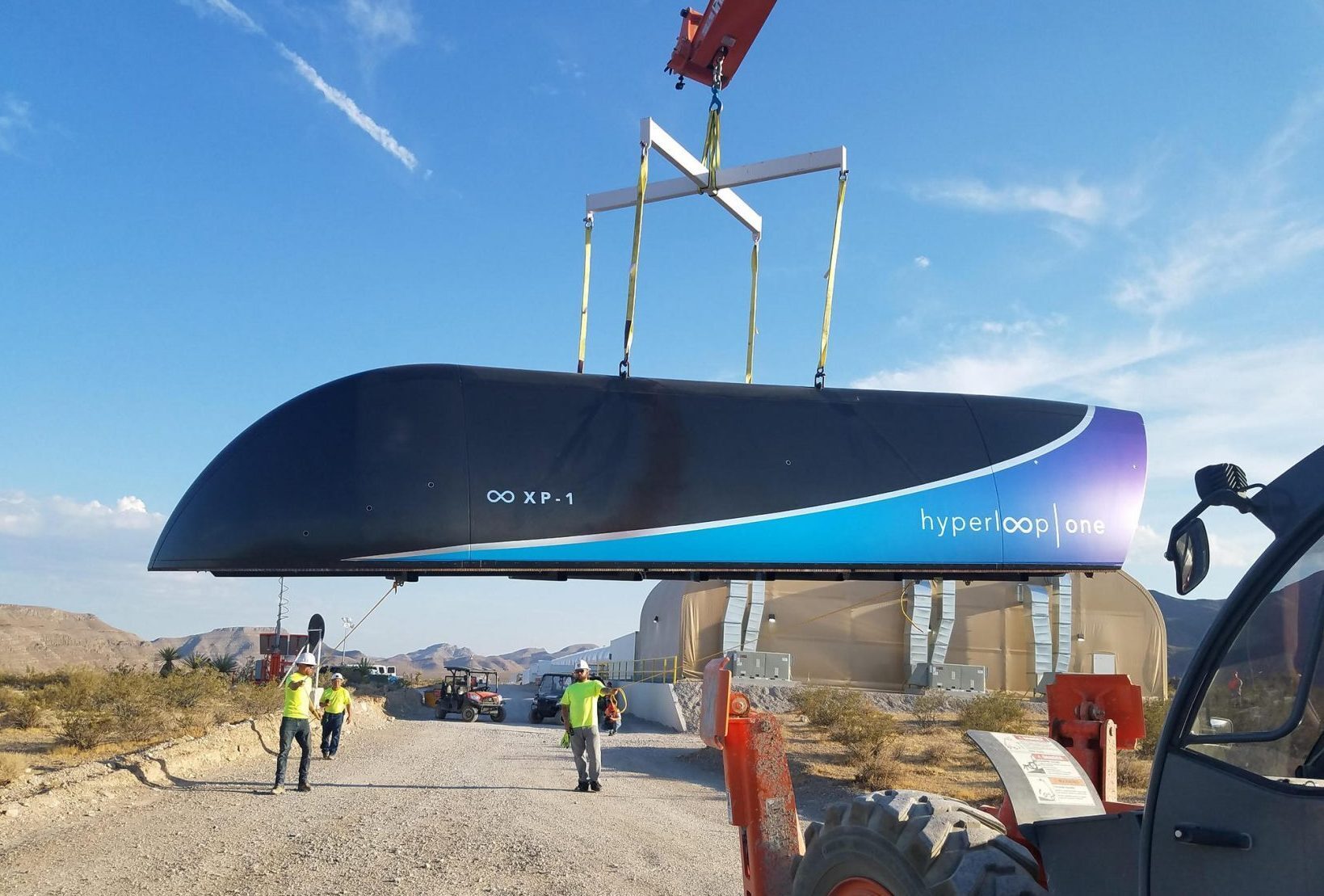
Virgin Hyperloop One might seem like a pipe dream.
But the prospect of Kansas Citians reaching St. Louis in only 23 minutes is more realistic than many think.
In fact, according to recent reports, Missouri has at least a 20 percent chance at landing Hyperloop, a yet-to-be-realized transportation system that moves people and freight at subsonic speeds.
Hyperloop is a 760 miles-per-hour transit system described as high-speed rail travel in a vacuum. A series of interconnected tubes create a low-pressure environment in which levitated pods are propelled by electric motors, gliding with limited friction at speeds that surpass air travel.
Sounds cool, right? Or is it just hype?
Startland News has been fielding a lot of questions from readers about the proposed Hyperloop system that would connect Kansas City to St. Louis. Hyperloop has left some of its details ambiguous — including what it means to be a winner of its global competition.
So, to clear up what we can, here’s a download of what we know.
Wait … Missouri is still in the running for a Hyperloop Route? I thought it lost out?
In May 2016, Hyperloop launched a global competition that garnered more than 2,600 interested applicants from across the globe. In April 2017, the company named 11 semifinalist routes in the United States that could receive its transportation system — Kansas City to St. Louis being one of them.
Later in April, Hyperloop launched an online poll asking residents to weigh in on which route they would most like to see. The poll from Hyperloop was not an official contest, the company said. Startland News cannot confirm the poll had any effect on the company’s decision-making process and results were never shared.
In September, the firm announced four winners of the Hyperloop One Global Challenge. Although the company did not explicitly say that the Kansas City-to-St. Louis route was out of the running, it was not mentioned nor selected as a winner.
The firm said in the release that it planned to work closely with the winning teams to determine each route’s commercial viability. Additionally, Hyperloop and the Colorado Department of Transportation entered a public-private partnership to begin a feasibility study in Colorado.
Omitted from the winners list, it appeared that Missouri was out of luck. But to observers’ surprise, Hyperloop announced in October that it also entered a public-private partnership with the Missouri Department of Transportation, along with several other partners, to study the I-70 route’s feasibility.
A few weeks later, Hyperloop’s global head of policy, Dan Katz, told the Associated Press that the Kansas City-to-St. Louis route was not only among the top five, but potentially among the top three.
Who else is in the running?
Colorado and Missouri are the only two states that announced public-private partnerships with the firm, despite there being other “winning” routes. The Associated Press reported Oct. 19 that Texas is also conducting a feasibility study for its Dallas-Laredo-Houston route.
Other winning U.S. routes in the Hyperloop Global Challenge are Chicago-Columbus-Pittsburgh and Miami-Orlando.
In other parts of the world, Hyperloop announced winning routes in India, the United Kingdom, Mexico and Canada.
What did MoDOT’s original proposal to Hyperloop highlight?
Missouri heavily highlighted its logistics and transportation strengths as part of its Hyperloop proposal.
Dubbing itself the “transportation crossroads” of the U.S., Missouri’s pitch says it is located within 500 miles of 43 percent of the U.S. population, 44 percent of all U.S. manufacturing plants and seven of the top 25 international cargo hubs in the U.S. Trucks, planes, barges and trains move “1.1 billion tons of freight each year valued at $1.3 trillion,” the proposal reads.
In addition, the state’s transportation network includes 4,800 miles of railroad tracks, 123 public-use airports and 15 public ports, the proposal reads. Kansas City and St. Louis are also the nation’s second and third largest freight rail hubs, respectively.
“Bounded and bisected by the nation’s two mightiest rivers, our location provided the jumping off point for America’s westward expansion,” MoDOT said in the proposal. “That movement of settlers and their provisions touched off the need for a national transportation system. Pioneers came forward and answered the call with innovations that have played an important part in Missouri’s history, its character, its pride and its success.”
What does Missouri’s proposed route look like?
The exact connection points are not certain, however, the MoDOT proposal suggested a route from Independence to Columbia to Lake St. Louis. In the Kansas City metro, “feeder spurs” from Kansas City International Airport, Edgerton, Kansas, and Grandview could link to the “mainline.” In St. Louis, the proposal highlighted feeder spurs from St. Louis-Lambert International Airport and Weldon Spring.
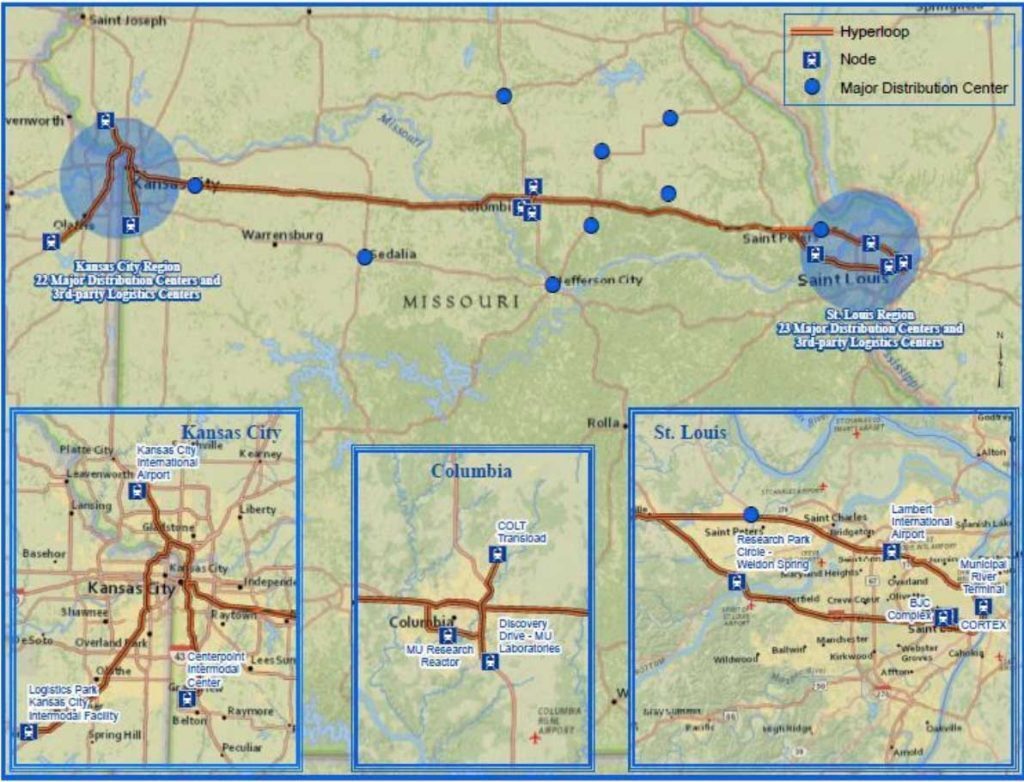
MoDOT’s proposed Hyperloop route
How could a Hyperloop affect Missouri’s economy?
A Hyperloop route would significantly boost any region’s economy. There are many ways such a route would help Missouri, but we’ll focus on job opportunities and freight.
Aside from the jobs created to build the route, Missouri would be able to quickly connect its two largest metros, effectively merging the areas’ workforces. Forty-nine percent of Missouri’s employers, 63 percent of Missouri jobs and 61 percent of the state’s population is within 30 miles of I-70, according to MoDOT.
A St. Louis programmer could theoretically commute to his or her Kansas City tech job before returning home. For rural Missourians, a Hyperloop route would connect them up to more job opportunities and access to cities’ offerings in education, healthcare and recreation.
The MoDOT report offers an example.
“Bob, a resident in mid-Missouri, will have quick access to the top-rated healthcare facilities located in St. Louis and Kansas City,” the proposal reads. “Or, to job opportunities that don’t exist today because of unreasonable commute times or the inability to relocate.”
It also would allow Missouri to significantly beef up its freight operations. The Missouri I-70 corridor carries more than 31,500,000 tons of freight annually, with a value of more than $59 billion.
Small town Missouri could get a boost as well, with Hyperloop allowing freight distribution centers to be placed in rural areas, creating more job opportunities and spurring more development. Rural portions of I-70 carry about 10,000 to 15,000 trucks daily. The volume rises to more than 23,000 trucks within the very urbanized areas of Kansas City and St. Louis, the report said.
Did KC’s Amazon HQ2 proposal mention Hyperloop?
Yes. You can view Missouri’s Amazon HQ2 website by clicking here. The main video specifically mentions Hyperloop. If you scroll lower, the website also includes a video from Rob Lloyd, CEO of Hyperloop.
What does the national press have to say?
The regained traction of the Missouri Hyperloop proposal has piqued the interest of national media.
TechCrunch, the Verge and Inc. are among the national news outlets to have covered the Show Me State’s commitment to building the speedy route.
The Verge reports that even though Missouri was not a winner in the global challenge, Hyperloop sees Missouri’s coalition as validation of its product.
Hyperloop’s Katz told the Verge that the Kansas City-St.Louis route is “incredibly straight,” which is important for the hyperloop pods to achieve optimal speeds. The company is also interested in the prospect of looping in the city of Columbia, home of the University of Missouri.
“Looking at the proposed routes in Missouri, it’s really one of the best we’ve ever seen,” Katz, told the Verge. “It’s about as attractive a route as we’ve seen.”
When do we find out more information?
The National recently reported that Hyperloop CEO Rob Lloyd hopes to roll out its tech in 2019. So while we are not sure when more information will be revealed on Missouri’s route, Startland News will update you as soon as possible. Sign up for our email digest at startlandnews.com/subscribe for email updates.
For more information about Hyperloop, check out the company’s explainer viedo below.

Featured Business

2017 Startups to Watch
stats here
Related Posts on Startland News

Schukman: 5 reasons why KC is the capital of social entrepreneurship
Take a walk in Kansas City’s startup scene and you’ll quickly hear something about KC’s devotion to becoming America’s most entrepreneurial city. This mantra is on everyone’s lips, from city leaders to corporate tycoons to scrappy startup founders. It’s amazing that in five years our city has created such clarity of purpose that millenials populating…

KC Digital Drive creates lab to test drive gigabit apps
Ever since Google Fiber announced Kansas City as its first fiber project, techies across the nation have wondered how gigabit Internet will shape a new wave of innovation and how the city would tap its new infrastructure. And thanks to a new KC Digital Drive initiative, Kansas Citians may have an up-close look at the…
New UMKC center to engage entrepreneurs, community
The University of Missouri-Kansas City recently solidified funds to build an innovation center to serve a broader set of students and the Kansas City community. The $14.8-million Robert W. Plaster Free Enterprise Center will feature a variety of resources for students and the larger business community, including a lab, rapid prototyping equipment, 3D printers and…

Claimkit snags ‘aspirational entrepreneur’ award
Overland Park-based tech startup ClaimKit recently was dubbed 2015’s most “aspirational entrepreneur” by the Greater Kansas City Chamber of Commerce. Founded in 2011, Claimkit created a contract management platform for insurance companies, law firms and consulting groups to help them more efficiently collect and analyze documents. Now with five full time staff, the company in…