

Smart city leader: Can technology predict deadly shooters before it’s too late?
October 4, 2017 | Tommy Felts

A smart city is a safe city, Herb Sih said. And technology can help.
“If you don’t have safety, you don’t have anything,” said Sih, managing partner at Think Big Partners, one of the key collaborators in Kansas City’s $15.7 million public-private Smart City initiative.
Having grown up in St. Louis, Sih said he has been disturbed by recent violence and unrest on the other side of Missouri. Sunday’s mass shooting in Las Vegas, which left at least 58 dead and more than 500 wounded, however, took that feeling to a whole new level, he said.
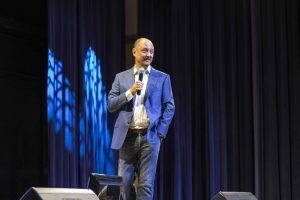
Herb Sih
“You start to get sick of seeing these headlines. And it makes you sad, disgusted, shocked, horrified and frustrated,” Sih said, noting other high-profile mass killings in Orlando, San Bernardino, Paris and Brussels. “What happened at the Mandalay Bay (Resort and Casino in Las Vegas) … I’m not sure anyone could’ve handled it much differently. Talk about a random event. How do you predict every random event?”
Technology — the same technology that powers apps using location services or running complex analytics — could perhaps be the key, he said. Specifically, data already culled from users’ phones and other devices might provide enough information for forecasting or predicting based on activity, he said.
“There’s a lot of data available … data that maybe could’ve identified this guy,” Sih said, referencing the Las Vegas gunman, a 64-year-old retired accountant with no immediately apparent criminal record.
Part of the trick is determining which technologies can make a difference, and which are nothing more than marketing hype, he said.
An Oct. 18-19 Smart City Tech Summit on public safety seeks to help answer such questions during the two-day conference at Plexpod Westport Commons.
Responding to a call to action from former New York Mayor Michael Bloomberg, Sih said Think Big Partners is taking a stand with the event, and putting its money where its mouth is.
“In light of recent public safety incidents, Think Big Partners is waiving the ticket costs to government officials, city leaders, smart city project leaders, university security, public venue technology officers and other public sector non-profits in hopes of getting the right people from every community to be able to attend,” a statement posted by the company read.
Think Big wanted to remove financial barriers for those who could not afford to attend the conference, which is set to feature some of the country’s foremost authorities on public safety issues, Sih said. The program is expected to delve into how technology can be a bridge to safer communities — in part, by looking at the dangers themselves, he said.
“Here’s the world that we live in. Here’s the reality of what you’re facing. There are so many ways that people can be unsafe,” Sih said. “We’ve got to be smarter than these guys, and some of them are pretty darn smart.”
Those interested in attending the public safety event, and who fit the criteria of people working in the public’s interest, may use the promo code “SMARTCITYSAFECITY” for access, Sih said. Representatives of for-profit ventures are asked to purchase tickets, he added.
Kansas City’s Smart City initiative is a collaboration between Think Big, the City of Kansas City, Sprint and Cisco.

Featured Business

2017 Startups to Watch
stats here
Related Posts on Startland News

Kauffman Foundation rolls out $1.2M microlending program to help underserved entrepreneurs
Amid a swarm of 160 events as part of Global Entrepreneurship Week, the Ewing Marion Kauffman Foundation announced a new microlending program to spur investment in underserved entrepreneurs. In partnership with four microfinance lenders, the foundation issued a series of grants totaling $1.2 million that a will change the way the nonprofit microlenders capitalize their…
Scared away from networking events? Anti-social introverts can turn to tech
Networking strength comes in numbers — even for anti-social introverts, Jeremy A. Smith told a crowd Tuesday at Global Entrepreneurship Week. “Anti-social people, myself included, hate events,” he said. But like all other entrepreneurs, such introverts still must build and maintain actionable professional networks from which they can request and receive value, Smith said. In-person networking…

Longfellow Farm coworking the soil amid KC’s urban food desert
In a city ripe with coworking office spaces, there’s a hunger for similar environments outdoors, Ami Freeberg said. As with maintaining individual workplaces, traditional urban farming also can be isolating and expensive, the Longfellow Farm manager said. By working together, however, the collaborative process allows for shared resources, greater human expertise and, of course, more…
Procrastinating? Eat the frog, don’t chase the squirrels
On the metal wall in front of my desk, I’ve magnetically fastened a famous recommendation from Mark Twain. “Eat a live frog first thing in the morning and nothing worse will happen to you the rest of the day,” the humorist from Missouri wrote. Though it can become an aspiration rather than a rule,…