

KCK police capture $842K safety tech grants for body cams, street network
October 10, 2017 | Meghan LeVota
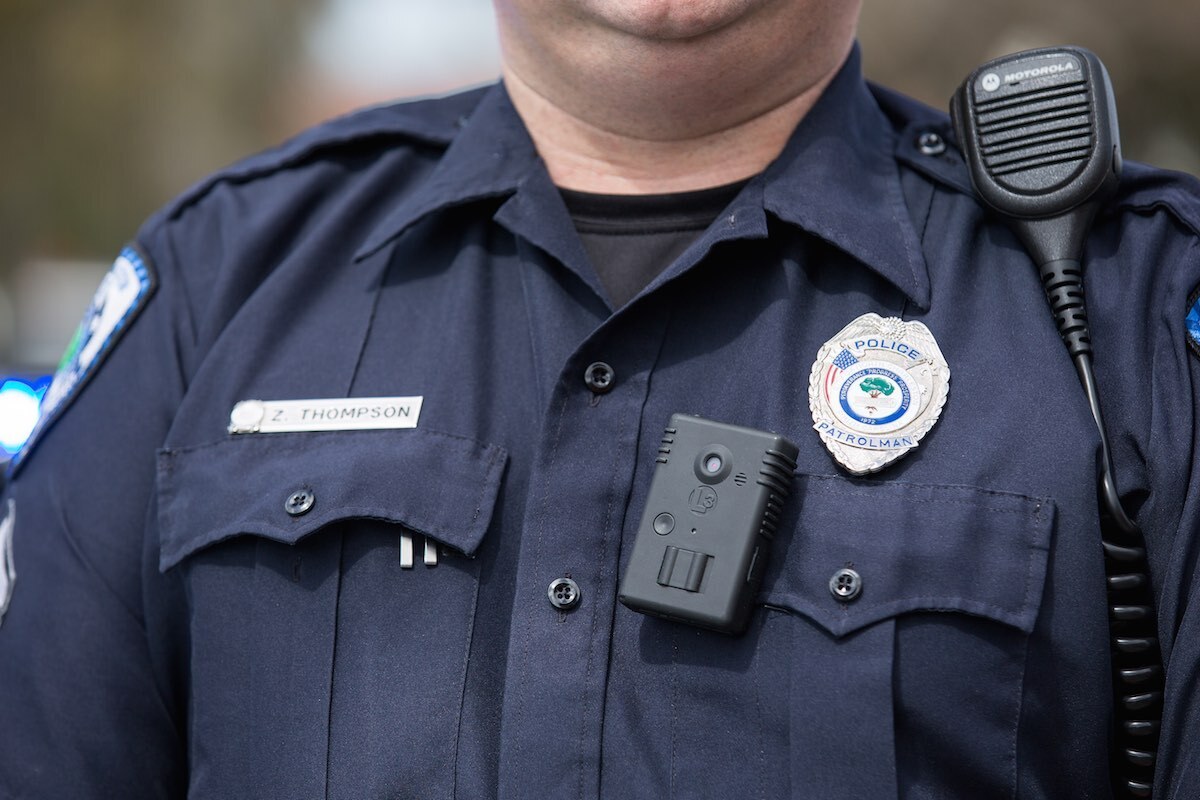
It’s a 21st-century approach to fighting crime, Mayor Mark Holland said.
About $842,000 in federal public safety technology grants are expected to help equip Kansas City, Kansas, police officers with body cameras and build out a network of real-time, street cameras.
“These grants advance one of my top priorities as mayor: to give our police officers the tools they need to protect the public and themselves,” said Holland, noting that being selected was a great honor for the Unified Government of Wyandotte County and Kansas City, Kansas. “This federal investment takes our community to a new level.”
A $342,000 grant is expected to equip 228 KCK officers with body cameras, continuing the Unified Government’s earlier effort, which began in 2016 with the allocation of $500,000 to build the fiber network needed to download and transmit body camera video.
“Body cameras are a great law enforcement tool that will aid us in capturing valuable evidence,” said Police Chief Terry Zeigler in a release. “And they will help us to continue building trust and transparency with the community.”
In addition, $499,402 in grant money is expected to help expand the video camera network with software that integrates video. The street camera network aims to help officers respond to incidents by giving them real-time feedback. The Unified Government also announced it will pilot a Community Connections program, giving businesses the option to connect security footage to the larger police camera network.
The project fits with the city’s larger smart city initiatives, said Alan Howze, chief knowledge officer for the Unified Government.
“We’re excited about what the future of what a more connected Unified Government can provide,” Howze said. “Technology is a force multiplier. That’s true for public safety and transactional interactions with local governments. We want to make it as easy as possible for residents to do business with the government and use technology to foster 24/7 access to information and expand the quality of life in Wyandotte County.”
Although the project primarily would benefit public safety, Howze said the initiative will secondarily benefit the city’s fiber network.
“This will expand fiber connectivity significantly, bringing literally dozens of dark fiber strands in places that haven’t had that kind of connectivity before,” Howze said. “It will create the capability for any integrated traffic network and smart traffic signaling and will allow for connected traffic cameras.”
Although the technological advancements are exciting, Howze said, he is most encouraged by the collaboration within government.
“The reward of the grant – as well as a broader technology push — is a reflection of a spirit of cooperation that exists across the Unified Government,” he said. “My office (the IT department) has been working closely with the police department and a number of different departments to collectively look at how to use technology to address the community’s challenges, creating stronger neighborhoods.”

Featured Business

2017 Startups to Watch
stats here
Related Posts on Startland News

Metactive announces nearly $3M combined in funding round, government grant
Fairway-based Metactive has raised a $1.2 million round to accelerate the development of its products for the treatment of neurovascular, peripheral vascular and structural heart diseases. The round included Kansas City-based Mid-America Angels, as well as Serra Ventures. Founded by CEO Nick Franano, Metactive has raised more than $10 million to date. In addition to…

KC Rising red flag: Educated talent leaving KC, metro tech jobs unfilled
More college-educated workers are leaving Kansas City than being drawn to the region, according to a new KC Rising report. That means local companies are forced to look outward for qualified talent, said Ryan Weber. “Most of those tech firms are hiring; it’s just for skill sets that few people have,” said Weber, president of…
Students struck by KC gun violence search for solutions at MECA Challenge
Editor’s note: MECA Challenge and Startland News are both programs of the Kansas City Startup Foundation, though the content below was produced independently by Startland. For more information on the relationship, click here. Escaping the cycle of gun violence can seem impossible, said Lea Thompson, still wearing a cast on her hand after being shot…
STEAM Studio team coding best fit for boy’s 3-D-printed prosthetic arm
Four-year-old Hudson Borton extended his arm Wednesday, as his father fitted a 3-D-printed prosthetic to the boy’s upper arm and elbow. The light blue plastic piece mimicked the size and length of Hudson’s right arm, though his father and Mandi Sonnenberg, co-founder and director of STEAM Studio, agreed the new device wasn’t yet a perfect…