

KC entrepreneurial educator: ‘Zip code shouldn’t determine success’
October 17, 2017 | Meghan LeVota
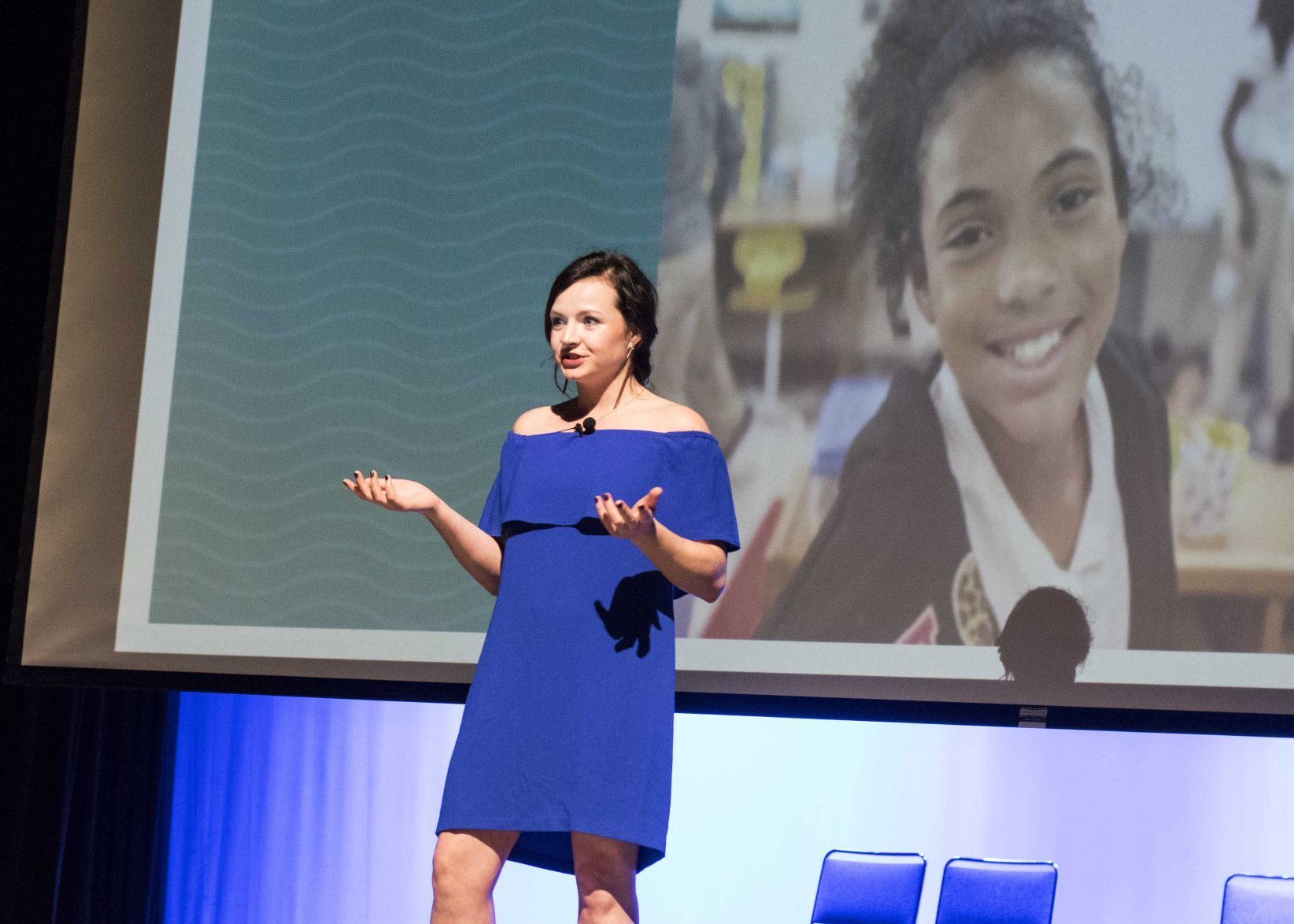
Entrepreneurship education should begin as early as kindergarten, said Rachel Foster.
“The younger my students are, the more creative they are, and the less the world has had time to tell them that it’s ‘not possible’ or ‘you can’t do that,’” said Foster, entrepreneurship teacher at Lee A. Tolbert Community Academy. “If we are able to capture the creativity, brilliance and creative thoughts of a 5-year-old, they will hold onto it when they grow up.”
In her third year with the Teach for America program, Foster has developed entrepreneurship curriculum and activities for students K–8, touching the hearts of as many as 500 children per year. She teaches students financial literacy, critical thinking, collaboration and how to solve 21st-century problems, she said.
Equal access to innovative thinking is one of the best ways to disrupt systems of inequality, Foster said. With faith in the power of entrepreneurship and her students, Foster wants to make Lee A. Tolbert the most “innovative elementary and middle school in Kansas City,” she said.
Foster won a $6,000 grant to build a makerspace for her students Monday at Teach for America Kansas City’s Shark Tank: Teacher Edition pitch event at the Gem Theater. The competition featured such “sharks” as Charlie Hustle CEO Chase McAnulty, award-winning author Angela Cervantes, Hot 103 Jamz radio host Julee Jonez and executive vice chancellor at the University of Kansas Neeli Bendapudi. Five other Teach for America teachers also walked away with funding.
“I am honored and still in shock,” Foster said Tuesday. “I feel as if last night was the show and now I am just invigorated and ready to put in the work and make it happen.”
During her pitch, Foster noted the rise in entrepreneurial educational models being implemented at the schools in Kansas City’s suburbs, including the Blue Valley CAPS program and Park Hill’s LEAD Innovation Studio. These opportunities aren’t available to all students in the metro, she said.
“Darius is an eighth-grader of mine,” she said at the Gem Theater stage Monday. “He is brilliant innovative creative and quite frankly going to be a successful entrepreneur. However, Darius isn’t promised an innovation high school to attend due to his zip code. This has got to change and the change starts here.”
Lee A. Tolbert Community Academy is a majority-minority school with 100 percent of its students qualifying for free or reduced lunch, she said. Her students deserve the same opportunity as the students at Blue Valley School District. Her school’s new makerspace will help even the playing field, Foster said.
“It’s important for all of our children to have access to these things that disrupt poverty and the institutionalized inequities happening in Kansas City,” she said. “They need access to entrepreneurship to break the mold and to break the systematic issues that students of color are living in.”
The $6,000 grant will go toward tools and supplies for the makerspace, as well as new furniture to inspire creativity and flexibility in students of all ages, she said.
“We can’t continue teaching in silos,” Foster said. “We have to combine content and make it real. The skills that don’t always come in a textbook are often the deciding factor for our students’ success.”
Foster has partnered with the Kansas City Startup Foundation in building her curriculum. She continues to lean on Kansas City’s startup community for support as she moves forward with the project.
The Kansas City startup community has impacted my work more than any other community,” Foster said. “Now, I’m just excited to give my students access to a space that feels like an office that they could be working someday.”

Featured Business

2017 Startups to Watch
stats here
Related Posts on Startland News

Three fathers bring Whizz Bang potty-training game to market through Make48, Handy Camel
The Whizz Bang gamifies potty training and saves the bathroom floors of all parents, said Amy Gray. The device, which hooks on the underside of a toilet seat lid, emits a LED light target at the bottom the bowl. Once hit, the device plays musical praise, said Gray, the head of sales for Handy Camel,…

Reconciliation Services hopes to heal trauma in the heart of stigmatized Troost corridor
Commanded by Scripture, David Altschul journeyed into parts unknown, said his successor, Father Justin Mathews. In the mid-1980s, a philanthropic pull tugged at the heart of Altschul — a white, insurance salesman from Johnson County — and eventually led him into the distressed, history-rich neighborhoods that lined Troost Avenue on the east side of…
Thelma’s Kitchen cooks up pay-what-you-can cafe concept to preserve community
Twenty people once filled the kitchen of Thelma Gardner’s apartment in search of their next meal. Their hunger for food fueled her hunger for humanity, recounted Father Justin Mathews as he sat sipping coffee in the newly opened Thelma’s Kitchen. The pay-what-you-can restaurant — located inside of the Reconciliation Services building at 3101 Troost Ave.…
Operation Breakthrough bridge over Troost symbolizes ‘real community’ at an intersection
With reflection in his voice, Alvin Brooks paused. “The city has to be a partner,” the Civil Rights activist and veteran Kansas City Police Commissioner said as he spoke of the redevelopment of Troost Avenue — the well known racial dividing line, that has long isolated the east side of the Kansas City metro from the…