

After shootings, ‘It’s most important to keep the public safe,’ Smart City leaders say
October 19, 2017 | Meghan LeVota
Citizens expect public safety from their city government to encompass such basics as sidewalks and water, Bob Bennett said.
And for that reason, improving public safety must be a top concern for smart city projects around the nation, the chief innovation officer at the City of Kansas City, Missouri, added.
“We have to provide the public safety. … In many ways, we are the ultimate nonprofit,” Bennett said of the government’s role to go beyond the basics to provide advanced security solutions.
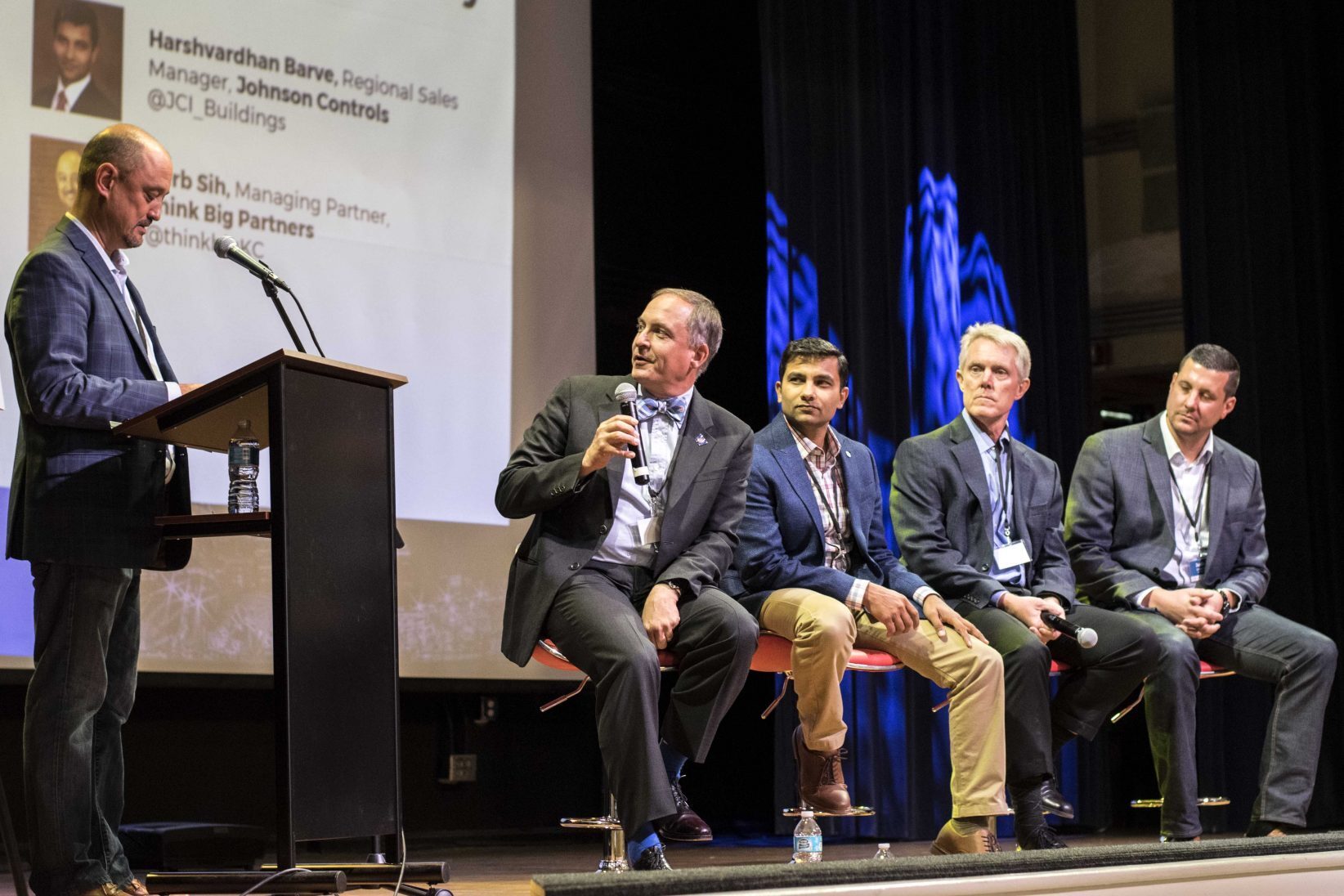
Bennett joined three other smart city technology experts — Black & Veatch smart city director Justin Dickstein, Ruckus Wireless senior director Steve Wimsatt and Johnson Controls regional sales manager Harshvardhan Barve — for a panel Wednesday to discuss public safety and its importance regarding smart city planning. The conversation, part of the second-annual Smart City Tech Summit, was facilitated by Think Big Partners co-founder Herb Sih. It focused on how to create a master plan for a smart city.
After recent mass shootings, cities across the nation have mulled more options and technological solutions to improve public safety. And smart city infrastructure, which pulls torrents of data from passersby and on city activity, could help.
Often times, smart cities are perceived to be more focused on economic growth, Black & Veatch’s Dickstein said. His company is a global provider of smart city infrastructure, including tech focused on energy management, transportation systems and analytics.
But to implement a truly successful project, public safety and smart city projects must go hand in hand, Dickstein said.
“With the recent events, you can’t call yourself a smart city in my mind without being a
safe city,” Dickstein said. “At Black & Veatch, we believe that the heartbeat of any city is just people. As a husband and a father myself, it’s imperative that when we’re looking at smart cities that it’s more than just springing economic development. It’s most important to keep the public safe.”
A safe city can mean different things to different people, but a safe city is always a smart city, said Wimsatt of Ruckus Wireless, which is the third largest WiFi vendor worldwide.
“A safe city means something different all the time,” he said. “A variety of devices and applications that can help provide safety. I think, from an infrastructure perspective, it’s about enabling the wide range of potential solutions that could make a city safe.”
It’s the second time Smart City Tech Summit has delved into the topic of public safety.
In 2016, the summit and Kansas City Police Department played host to a live, remote viewing of a mock shooting and law enforcement’s response that was supplemented by a live-video feed from a drone, social media posts and gunfire tracking technology. On a giant screen featuring 13 live-video feeds, attendees saw how police could respond to such a shooting incident with smart city infrastructure in place.
Smart cities gaining popularity
Black & Veatch has released a smart city industry projections report annually for the past few years that shows such projects are gaining in popularity. The most recent report showed a 26-percent increase in smart city projects since 2015, Dickstein said.
The panel agreed that smart city as a concept is gaining traction. The day is coming soon where integrating data and analytics into decision making will become a no-brainer, said Johnson Controls’ Barve.
“Defining what a smart city is has been hard to capture,” he said, noting his firm creates intelligent building and efficient energy tech. “There’s going to be a lot more products, a lot more solutions and a lot more providers — which means a lot more options. Smart city is definitely going in the right direction, I just hoping there is a common theme or platform that will take place over the evolution.”
Bennett defines smart city as more than just using data to improve a decision-making process. It also means data allowing organizations to reach a predictive state. As an example, he mentioned the City of Kansas City project that is currently using technology, powered by Xaqt, to predict potholes before they occur.
The city hopes to eventually expand from thinking like a “smart city” to behaving like a “smart region,” Bennett said.
“Over the next five years, we’re going to see a regional impact,” he said. “We’ve dedicated a significant amount of research and capital into helping the city collaborate more effectively with some of the 126 communities in our metro area on both sides of the state line.”
Since the initiative’s launch in 2016, the $15.7 million public-private Smart City project has transformed downtown into a hotbed of sensor networks and Wi-Fi connectivity on and around the 2.2-mile streetcar line, thanks to collaboration between Kansas City, Sprint, Cisco and Think Big Partners. In September, the Smart City advisory board meeting announced its next steps toward Phase 2.


2017 Startups to Watch
stats here
Related Posts on Startland News

Study: Lack of funding curbs early-stage biz growth in Kansas City
The Kansas City metro area is losing out on millions of dollars in investment funding that could be helping to add jobs and grow businesses in the region, according to a new study. In recent years, area early-stage businesses’ progress has been stymied thanks to Kansas City’s lacking of microloans, seed capital and locally-based venture…
Sprint Accelerator Demo Day preview (part I)
The second class of the Sprint Mobile Health Accelerator is gearing up for its much-anticipated Demo Day, which serves as a culminating event and is expected to draw a crowd of nearly 2,000 people. Led by Boulder-based Techstars, the Kansas City-based accelerator is now hosting 10 mobile health tech startups from around the world for…
Mayor Sly James helps startup 1 Minute Candidate build, win competition
Kansas City Mayor Sly James stepped up this Sunday to help a team of entrepreneurs win a competition in which they built a business in 54 hours. James, a well-known cheerleader of Kansas City’s startup community, helped political-tech startup 1 Minute Candidate launch its platform at Startup Weekend Kansas City, a event in which entrepreneurial-hopefuls…
Local weight lifting tech firm Rack Performance lands $250K
A Lenexa-based tech company is racking up investment capital to further develop its weight room management software. Rack Performance recently raised $250,000 from local, private investors that will help the company advance the second version of its software. Rack Performance built a web-based, weight room and group fitness platform to help coaches and trainers efficiently…