

Tips for overcoming experience gap, building a diverse workforce
September 13, 2017 | Meghan LeVota
When Ariel Banks graduated from the University of Missouri at Rolla in 2014 with a chemical engineering degree, she felt qualified and eager to jump into her career.
Unfortunately, Banks spent nearly two years without any luck in finding a job. She found herself being asked time and time again, the dreaded question: “What is your experience?”
“I couldn’t tell you how many applications I did online and the different types of job fairs I attended,” Banks said during Tuesday’s Techweek KC panel, Building Inclusive Tech Communities. “But as a fresh graduate with very little experience, I’d get so close to the door and then hear, ‘No, we found someone else.’”
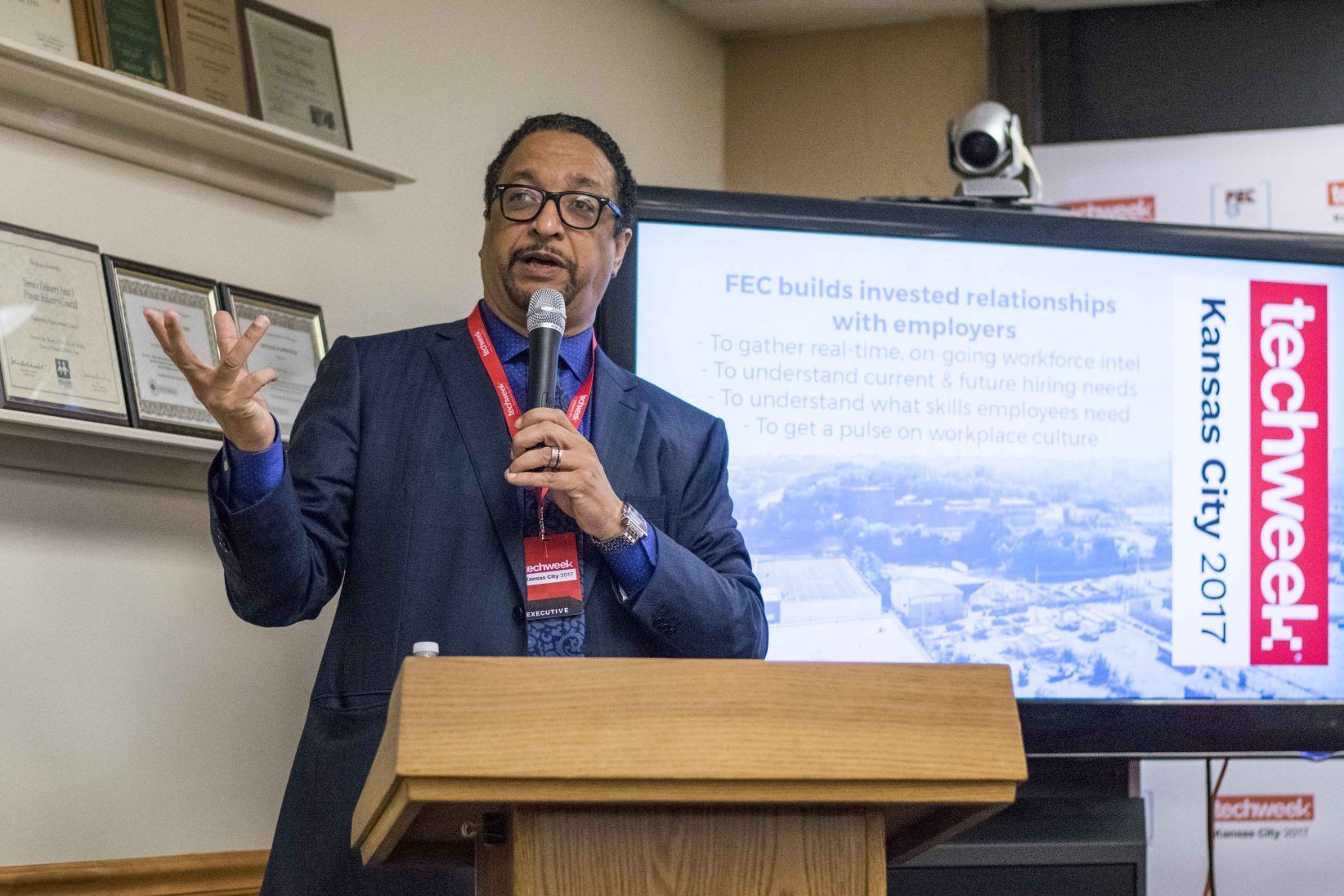
It’s a disheartening story, but not an unfamiliar one, said Clyde McQueen, president and CEO of the Full Employment Council.
“Everyone said to me, ‘Are you kidding me? (Ariel) couldn’t get a gig?’” McQueen said. “I gotta tell you, when you go to an interview, the first thing people want to know is your experience and what you have already done.”
Building an inclusive, innovative and vibrant technology workforce requires collaboration, McQueen said. It takes teamwork between educational systems, employers and the workers — which is not an easy feat, he said.
“How do you train somebody in the 21st century economy to make money?” McQueen said. “Quite frankly, there are many people who have done everything they needed to do — went to work, went to school, got a four-year degree — and they are still sitting at home with mom because they have no other option. Not because they don’t want to, but because the labor market is not aligned with their educational pursuits.”
To illustrate this problem, McQueen — and the Full Employment Council — gathered 11 panelists for a discussion as part of Techweek KC.
“It’s always about the people,” McQueen said. “You can have all the algorithms and apps in the world, and it’s still about the people. … At the end of the day, it’s the foundation of a team that you have around you. And that’s what we are trying to communicate here.”
Here are some takeaways, tips and tricks from the conversation:
Educators: Offer additional credentials for skills
Scott Boyce, director of Workforce Central at the University of Central Missouri, said a bachelor’s degree shouldn’t be seen as an end-all, be-all for young people because it’s not for everyone.
To give the best of both worlds, Boyce said UCM offers several certificates and credentials outside of its traditional degree programs.
“Industries recognize a lot of credentials outside of four-year degree programs,” Boyce said. “We try and offer as many as possible. In most cases, our students graduate with multiple credentials.”
Educators: Collaborate with industry professionals
Boyce added that UCM aims to work with the employer community and the citizenry to make sure the curriculum is informed by the marketplace.
“We are constantly updating curriculum as often as the market demands it,” Boyce said. “We beta test programs before we roll them out full scale to make sure that it’s being informed by as many concerned parties as possible.”
Joe Macklin, a Kansas City-based Grammy-nominated music producer, is an adjunct professor at UCM and also operates an audio engineer training program through the Full Employment Council.
“It’s good for students to be interactive with industry people,” Macklin said. “I want to bring in as many producers as I’ve worked with. I want them to see people in the business and be like, ‘Hey, this is cool. We actually are in with these people and working with them.”
McQueen applauded Macklin, adding that introducing industry professionals to students motivates them to pay attention in class and think outside the box.
Employers: Get creative in your hiring strategy
Neelima Parasker, founder of tech startup SnapIT solutions, figured out a way to tap into impressive talent while on a budget.
“As a startup, we don’t have the funds lying around to afford an $80,000- or $100,000-per-year developer,” Parasker said. “I knew we had to get creative about our hiring strategy.”
Parasker took advantage of TechHire, a program of the Full Employment Council, which connected her with motivated young people looking for work. The resource provides employers with up to three months of payroll while they train the new hire with the skills they need.
“Within a month and a half, I was able to could get them trained, then I could get them a project where I’m already seeing improvement,” Parasker said. “Now for an entrepreneur and a startup company, those three months can make a huge difference. I think it’s a wonderful partnership.”
It’s important to be inclusive when making hiring decisions, Parasker said.
“If we can include our kids here, in this city, who have the passion to learn and improve their technical skills, we can make a huge difference,” she said. “They don’t have to go to the West Coast to find their dream job. You can find it here.”
Employers: Understand the untapped potential of the city
Robert Manigold, COO of Code Koalas, said some areas of Kansas City unfortunately have more opportunities than others. Employers ought to be aware of that gap, he said.
“An organization should meaningfully address community needs, specifically with economic development,” Manigold said. “Because if you want to rebuild a city, we’ve got to give people meaningful jobs and high paying jobs.”
Populace: Don’t be afraid to learn a new skill
Both Bruce Ives and Lowell Toombs joined the panel to share their experience learning a new skill via the ReBootU program.
To cultivate skills that are desired by the marketplace, ReBootU pays for people to take an accelerated format class or earn a certificate, as well as offering work experience.
Dubbing himself “the world’s oldest intern,” Baby Boomer Ives entered the program to learn technological skills during a career change. He now is employed at the University of Kansas Health System.
Programs like these, and others offered by the Full Employment Council, are integral in creating tomorrow’s economy, McQueen said.
“The world is not getting further apart. It is getting closer together,” he said. “How do we deal with a local economy that is increasingly connected? We work together.”

Featured Business

2017 Startups to Watch
stats here
Related Posts on Startland News

MoCannaHub lights up information prohibition; launches cannabis resource-finding app
Rolled in entrepreneurial opportunity, tech companies shouldn’t be afraid to take a hit of the growing marketplace that is cannabis, said Andrew Ellis, explaining the methodology behind MoCannaHub — the app that connects curious consumers with experts and information of various strains. “Some of the platforms out there are banning cannabis-related content,” explained Ellis, president…

InnovateHER KC founder leaving KCSF as womxn’s community-building startup scales
It’s time to set InnovateHER KC on the path to long-term growth, said Lauren Conaway, announcing her plans to leave the Kansas City Startup Foundation in early July to lead the womxn-focused startup full-time. “InnovateHER KC’s No. 1 priority right now is building out our community with intention,” said Conaway, founder of InnovateHER KC and…
Photos: Sprint Accelerator leaders salute former managing director at demo day
Gratitude powered down the sixth cohort of the Sprint and Dairy Farmers of America-backed Corporate Accelerator Thursday. “I do have one more person that I need to acknowledge and that person is Doug Dresslear,” Tina Peterson, manager of the Sprint Accelerator, told a packed crowd at the National World War 1 museum’s J.C. Nichols Auditorium. …

LaunchKC, Nueterra Capital announce health accelerator with $50K, plus resources for each startup in cohort
Adding its third vertical in less than a year, LaunchKC will expand its grant opportunities deployment with the new LaunchKC Health Accelerator aimed at improving patient outcomes, the program announced Thursday. “LaunchKC continues to see momentum, headed into its fifth year, having invested over $2 million in cash grants to attract or retain 38 tech…