

Techstars Spotlight: Somatic Labs’ sees freedom from distraction in touch tech
September 20, 2017 | Meghan LeVota
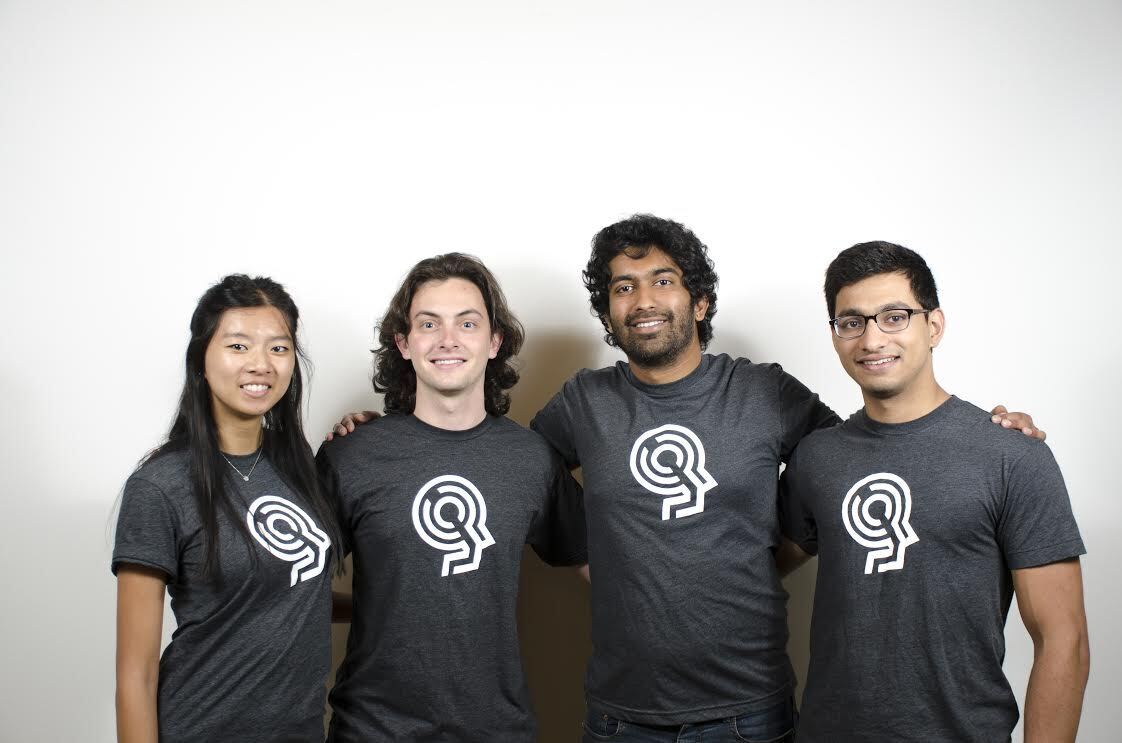
Somatic Labs is designing a technology for a future without screens, founder Shantanu Bala said.
Imagine this: You’re driving in an unfamiliar neighborhood and instead of needing to look at your phone for directions, your wearable device uses physical sensations to direct you to your destination, keeping your eyes on the road.
Or maybe you’re a productive worker, mindful of time, so you set a timer via your wearable device, which then sends customizable, unintrusive vibrations keeping you on track.
“You’re not necessarily paying attention to your surroundings when you’re looking to your phone, your tablet or your laptop,” Bala said. “So, we’re trying to think of other ways of communicating information without requiring you to look at something.”
Technology has made tremendous strides in the last decade, he said, yet it’s still difficult to imagine electronic solutions that do not glue the user to a screen.
That focus on visual interaction has fostered a population distracted from reality, a concern Bala said can be addressed by advancements from Somatic Labs — which was selected for Techstars KC’s 2017 cohort.
“The No. 1 problem caused by people paying attention to screens would be safety and situational awareness, he said. “Simply, the screen is distracting them from something else that should be demanding their attention. The goal isn’t to necessarily make screens obsolete, but more so that the trends of technology aren’t dependent on screens in our day to day lives and interactions.”
In 2015, Bala co-founded the haptic technology firm Somatic Labs with an ambitious goal – he wanted to make the technology of touch ubiquitous, embedding physical feedback into each and every device.
“We can create patterns of sensation that are much more interesting than an ordinary tap or a buzz,” Bala said. “Our technology communicates entirely through your sense of touch by taking a vibration and moving it in different directions across your skin.”
A former undergraduate researcher at the University of Arizona, Bala had more than eight years of experience in haptic technology before forming Somatic Labs. Hailing from Phoenix, Arizona, his experience includes working with individuals with visual disabilities or motor impairments.
“I was really interested in physical therapy and injury rehab and seeing if a device could replicate the touch of a physical therapist while performing an exercise,” he said. “I also researched whether touch could convey a specific emotion, such as a facial expression or a gesture, like a handshake.”
As Bala continued to brainstorm target markets that could benefit from haptic technology advancement, one potential user base became obvious: individuals who are visually impaired.
“If someone is blind, they can’t use a screen. They need information through a different channel,” Bala said. “Part of the motivation of working with people who are blind is that we see this as a group that we can not only provide a lot of value to, but a group that is largely ignored by big companies.”
Before Somatic Labs’ tech is embedded everywhere, the firm wants to focus on making a small number of people “very happy,” Bala said.
“There is a lot of directions this technology can go. But now, we want to be delivering the most value to the most people,” Bala said. “The reason why we find the use cases for individuals who are blind very interesting is because they have problems that we can address that have a pretty significant improvement to their experience.”
In 2016, the technology startup launched Moment, a wearable device using haptic feedback to improve a user’s sense of direction, inform perception of time and assist in staying present.
After downloading the Moment mobile app, the user can then pair the device via Bluetooth.
“You use the screen on your phone to set things up, and once it’s set up, you don’t have to look at it anymore,” Bala said. “Once connected, you can control simple things like setting up a timer, an alarm and track productivity.”
The device was intentionally built as a proof-of-concept, yet more than 200 units have been sold since the first shipment in June. For the coming year, Somatic Labs’ No. 1 focus is to conduct market research, interview focus group participants and garner specific, consumer feedback, Bala said.
“For now, we aren’t focused on necessarily ramping up sales — we’re interested in product-market fit,” he said. “The Moment device is something that we are using as a platform for understanding the value this technology provides.”
Bala hopes that by the end of the Techstars program, the firm will have established partnerships with organizations that are interested in testing Somatic Labs’ technology.
He is optimistic about Somatic Labs’ future, and the credibility Techstars has given the company thus far.
“Techstars has a lot of recognition with investors as well as anyone else you talk to about setting up a pilot program,” Bala said. “When they know you’re a Techstars company, there is understanding. … Rather than them having to take the time to vet your credibility themselves, that is kind of handled by Techstars and we can dive right into thinking about whether a partnership would be a good fit.”
In August, Bala was selected to speak at TEDxKC. To watch the video of his talk and hear more about the technology, see below.


2017 Startups to Watch
stats here
Related Posts on Startland News
Former ECJC exec Melissa Roberts joins Kauffman Foundation grant making team
Everyone has potential if given the right resources, said Melissa Roberts. “Everybody has great ideas if given the right education. Everybody has the potential to be an economic contributor in our society if given the right motivation and support,” she continued. These aren’t her words and values alone, Roberts said. They’re the legacy of Ewing…
Health scare forced KC’s colorful wax guru to get serious: ‘This is Crumble growing up with me’
Brandon Love is keeping his iconic, brightly-colored hair, but melting away distractions that could be holding back his already wildly successful, but evolving lifestyle brand, Crumble Co., he said. The first to go: Some of the eye-catching candle and wax product names that first caught customers’ attention because of their tongue-in-cheek innuendos and four-letter words,…
Insecure phones, devices creating largest-ever sensor grid (for China) in US homes, says Pepper cyber security report
As an industry, the state of cyber security is a “hot mess,” Scott Ford said candidly. “Frankly, its at a point where it ought to be concerning to everybody,” Ford, CEO of Pepper IoT, said in response to a new report that examines the state of the IoT space and released as part of a…
Missouri Hyperloop talk turns to motion sickness, comfort at high-speeds
But how will it feel? With the feasibility of a high-speed Missouri Hyperloop route connecting Kansas City to St. Louis in about 30 minutes now established, the conversation has shifted tracks to ergonomics, said Diana Zhou. Curious members of the public want to know more about the safety of the proposed transportation mode’s 600-plus-mph speeds,…