

With 42 KC evictions per day, civic hackers pinpoint action with data
September 5, 2017 | Tommy Felts
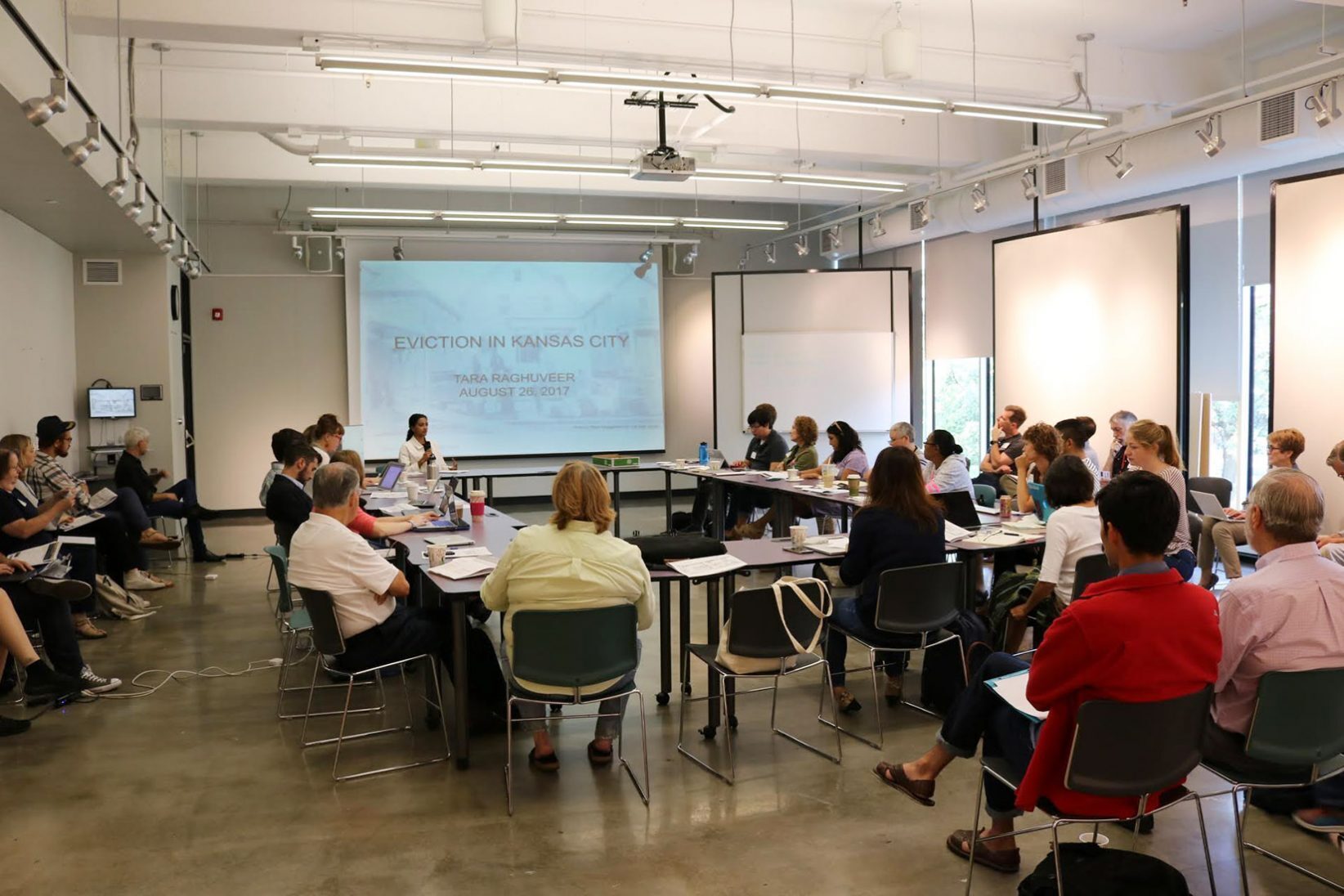
Kansas City can be a leader on housing justice, Tara Raghuveer said. The details are in the data.
Examining a Jackson County data set that included 173,720 eviction records spanning 17 years, Raghuveer, a Harvard-educated researcher and Shawnee Mission East High School graduate, confirmed a leading predictor of eviction in Kansas City: race.
“It disproportionately impacts the black community, even with all other variables — like income — held equal,” she said.
But it wasn’t a conclusion Raghuveer came to alone — nor is it the whole story of evictions in the metro, she said.
Raghuveer partnered with Dataiku, an international data collaborative science firm, and the University of Missouri Kansas City, for a recent workshop and hackathon to explore the impact of evictions on local neighborhoods and the city as a whole. The event drew a diverse crowd of civic hackers, government and neighborhood leaders, educators, artists and others interested in the research and coding, organizers said.
“It was a significant way to rethink how we talk about housing policy with a lot of data, but also with a lot of local expertise,” said Jacob Wagner, associate professor and director of urban studies at UMKC.
Digging into the data
Understanding Kansas City’s eviction problem begins with those 173,720 records from Jackson County, Raghuveer said. The data set included valuable court filings from 1999 to 2016, which were used to build a model for the research.
“All of those records are at the address level,” she said. “So as opposed to zip codes, we can understand the trends in terms of who’s being evicted where, at the block or the neighborhood level.”
Using a tool from New York-based Dataiku, Raghuveer and Jed Dougherty, Dataiku data scientist, blended the Jackson County information with U.S. Census, education and neighborhood data — all based on the geo-coded location of each eviction — to create a map on which to overlay even more information, Dougherty said.
And with the assistance of experts from Code for Kansas City and the resources of Eric Roche and the City of Kansas City’s Open Data KC site, the team was even able to build a model that predicts whether a residence will have an eviction in the next year, Dougherty said.
“Kansas City has this open data initiative that is one of the best in the country, and it gives us access to a lot of other data sets that we can layer onto the evictions data that can help us understand it in a deeper way,” Raghuveer said.
In addition to neighborhoods, the hackathon and accompanying research also focused on how evictions impact education via student mobility, UMKC’s Wagner said.
“If kids are moving around a lot, and their families are getting evicted out of substandard housing, that can totally disrupt their school year,” he said.
The data breaks down to 8,000 to 9,000 evictions annually, Raghuveer said, with about 42 evictions per business day. Since the affected subset of the population — renters — is limited, that impact can be magnified, Wagner said.
“If you do the math, turnover can be as high as people having to move every 14 to 15 months,” he said. “Which means people are getting evicted and having to move almost once every year. And that’s just crazy. That’s really disruptive.”
Both Raghuveer and Wagner are quick to note the numbers reflected in their research only include the records of those who went through the formal, court-based eviction process — not informal evictions where, for example, a landlord changes the locks, or simply tells tenants to move out by the end of the month.
“There are so many more evictions that are happening informally, outside of the court, with no data to represent them,” Raghuveer said. “Forty-two evictions filed per day is a big number that should give us pause. But even that does not represent nearly the footprint eviction is leaving on the city.”
What’s next?
The recent workshop and hackathon were just the start, organizers said.
“We generated some short-term action ideas, but also some questions we want to spend more time understanding,” Wagner said. ““The big question is, ‘OK. … So, what do you do?’
“How do you reduce the impact of eviction on the families involved, on the neighborhoods? How do you get to the underlying affordability issues?”
Education for tenants, eviction prevention measures and a legal clinic are among options being explored, he said.
Kansas City isn’t an extreme example of evictions impacting its communities, Raghuveer said, noting that the city has similarities to many other metro areas: rapidly gentrified neighborhoods, unregulated development, historic racial segregation, and a working-poor class being priced out of the city.
“A lot of these trends across American cities right now just open up even more potential for Kansas City — now armed with this knowledge about what eviction looks like — to take more leadership,” she said.
The Kansas City Public Library is playing host to a forum Nov. 29 for the public to learn more about the data and research findings, Wagner said, and KCPT is planning a series on housing issues in Kansas City.
A key to combatting problems like eviction is awareness — not only among members of the general public, but also policymakers, he said, especially with mayoral and city council races slated for 2018.
“We need to try to figure out how we can make sure the issues of housing affordability and neighborhood stability are addressed by the city council and political candidates,” Wagner said.
It’s important for elected officials to see how evictions and other such concerns impact their districts, Raghuveer said.
“Kansas City, like so many American cities, is designed for people who are not living in unstable housing conditions,” she said. “That’s one of the challenges about housing: When people don’t have to see or contend with a problem in their personal lives, then it’s not going to be the issue on which they vote.”
Dataiku’s Dougherty was impressed by the beauty of Kansas City, in no small part, he said, because of how much people care — as evidenced by the community collaboration that made the hackathon possible.
“It’s one of those issues that shouldn’t be partisan, and should be something that a local community takes on,” Dougherty said. “And I think Kansas City is taking a real big step in that direction.”

Featured Business

2017 Startups to Watch
stats here
Related Posts on Startland News

Their diagnoses were just the beginning: How tech app, community tap into co-founders’ own chronic illnesses
Startland News’ Startup Road Trip series explores innovative and uncommon ideas finding success in rural America and Midwestern startup hubs outside the Kansas City metro. This series is possible thanks to the Ewing Marion Kauffman Foundation, which leads a collaborative, nationwide effort to identify and remove large and small barriers to new business creation. WICHITA…

Just funded: Digital Sandbox KC starts new year with six new startups on its roster
Digital Sandbox KC’s latest round of startup funding reflects the emergence of more Kansas City-built, scalable tech in the new year, said Jill Meyer, announcing the fourth-quarter roster of companies bringing innovative ideas to life in the region. “These six companies demonstrate the creativity and diversity of our region’s technology founders and problem solvers,” said…

Merger alert: ‘Shark Tank’ star teams with Gary Fish, Fishtech to form new cybersecurity powerhouse
A merger announced today between award-winning cybersecurity solutions providers Fishtech Group and Herjavec Group will unite the companies as a single entity under a new brand to be announced in early 2022. The deal — backed by funds advised by Apax Partners LLP (The Apax Funds), which will hold a majority stake in the new…

Vegan spell falls over West Bottoms restaurant as this trio’s plant-based potions ring in a new year
Every witch needs a coven, said Olive Cooke, Sylvia Metta and Kim Conyers; so they conjured a community in the West Bottoms to serve their vegan bites. Cauldron Collective — a plant-based, comfort food venture co-founded by self-proclaimed “cooking witches” Cooke, Metta and Conyers in January 2021 — made its mark in Kansas City through…