

Entrepreneurial inspiration: How a wheelchair freed Wesley Hamilton
September 18, 2017 | Tommy Felts
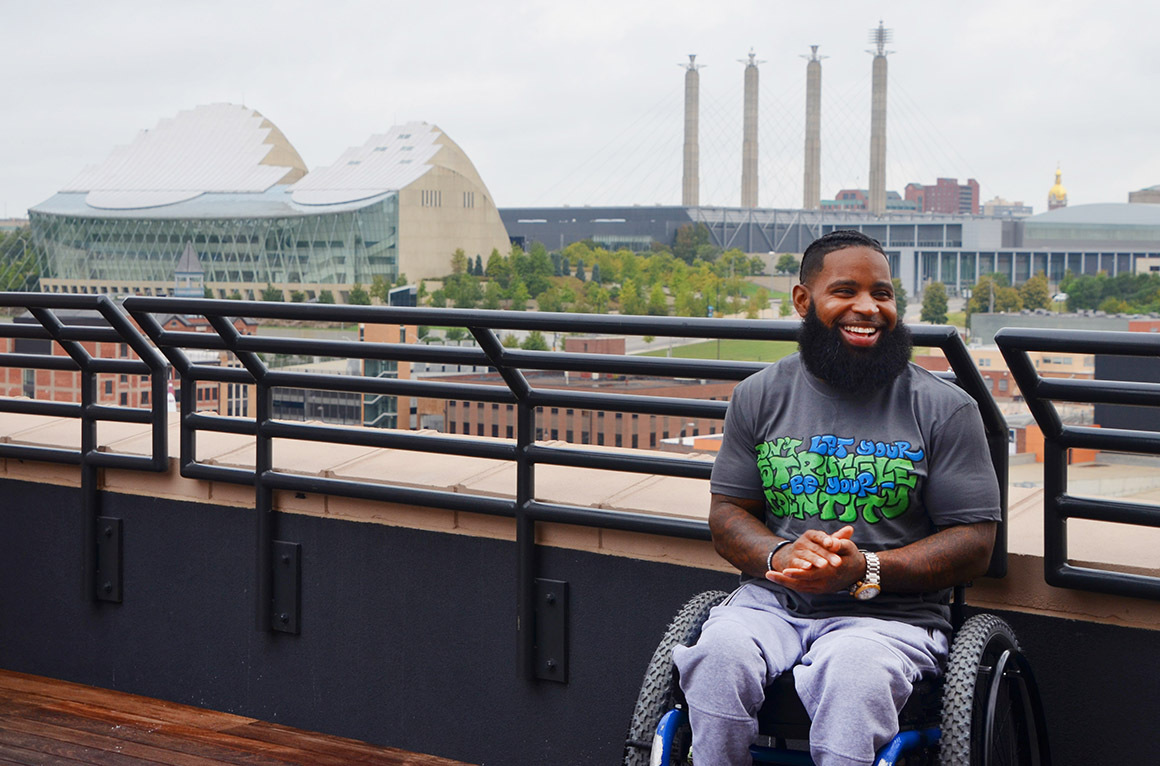
Editor’s note: Kansas City fitness and community advocate Wesley Hamilton offered four inspirational tips for entrepreneurs, illustrated by his own remarkable experiences overcoming adversity.
Two bullets pierced Wesley Hamilton’s back, confining him to a wheelchair, but freeing his mind, the Kansas City adaptive athlete said.
“I found that being shot by someone I never knew was actually just a plan set in place for me. I don’t regret what happened,” said Hamilton, executive director of the Disabled But Not Really Foundation. “To this day, I love being in a wheelchair. I love who I have become. I couldn’t ever call myself someone who was self aware until I was in this chair. Now I know who I am and I know what I love doing. And I’m doing it.”
An irrepressible grin spreads across his face as he speaks outside his office at WeWork Corrigan Station. It’s as contagious as his story is compelling.
“To see someone like me smiling every day shocks some people, but I love what I went through,” Hamilton said. “The struggle made me what I am, but it doesn’t define me.”
“Don’t let your struggle be your identity. Whatever your struggle, you should look at it as a lesson being taught to you. Learn from it. Experience comes from struggle. Become more.”
January 2012 was full of highs and the start of one big low for Hamilton.
He had just turned 24 and about three months earlier gained full custody of his toddler daughter, Nevaeh. Leaving the Grandview, Missouri, home of an ex-girlfriend after what he described as an “everyday situation” that turned into a brief dispute, he was shot in the back by an acquaintance of his ex, he said.
“At that point, I thought life was over,” Hamilton said. “I was laying on the ground, bleeding out. I was like ‘This is my reward for being a single father now?’”
After waking up in the ICU, he eventually learned he wouldn’t walk again. Hamilton didn’t know how to adapt to the news, he said.
“I just kind of sunk in my sorrow every day,” Hamilton said.
At 230 pounds on a 5-foot-4 frame, his inactivity and poor nutrition caught up to him. He became depressed and developed a pressure ulcer on his tailbone. Two years of bed rest and six surgeries followed.
“I asked the doctors, ‘What can I do to help myself heal?’ I couldn’t let my daughter constantly see me in defeat,” he said. “I didn’t know how to make it out. Everyday, she’s in the other room and I’m laying on the bed, on my stomach, with nurses and caretakers coming in, an IV hooked up to me.”
His health workers told him about the benefits of proper protein, he said.
“At that point, I didn’t have knowledge of protein. I didn’t have knowledge of nutrition, period,” Hamilton, now eating a vegan diet, said, noting he was advised to take in at least 100 grams of protein a day. “I was like, ‘I don’t already consume that? These Big Macs aren’t giving me the protein I need?’”
His subsequent research into nutrition led him to Johnson County Community College, where he studied to become a dietician, he said. Ultimately, he also lost 100 pounds in about a year.
“I had never lost weight before I was in a wheelchair,” he said. “I’d try to run down the block and be like, ‘Forget it. This is not for me.’ To make that transformation was amazing.”
“If you can’t control it, you jump over that obstacle. If you can’t jump over it, then you roll over that obstacle. There’s always a way around. There’s always a way through.”
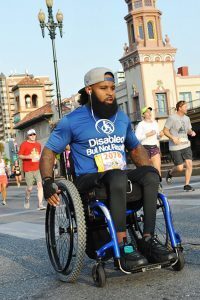
Photo courtesy of Wesley Hamilton
A final surgery put Hamilton on bed rest for six weeks, during which time he began building the idea and structure behind what would become his Disabled But Not Really organization.
“How many people deal with defeat because of a label? Regardless of exactly what it is that has hurt you, ‘disabled’ just hits you right down below. It’s terror,” he said.
Creating the foundation was a breakout moment. With a fresh mindset, Hamilton began exploring gyms for the first time — “I didn’t know what I was doing, but I loved it.” — and eventually found himself entering wheelchair bodybuilding and Crossfit competitions, he said.
“I started to witness people who, in my eyes, were in worse positions than me — double-leg amputees, someone without an arm — and they were pushing themselves. It was amazing. It was powerful. I knew at that point, I couldn’t make excuses for my ability any more,” he said.
Hamilton competed in the Sept. 10 Plaza 10K Run, finishing in an hour, he said. He’s planning a half marathon next.
“Everyday is a challenge, but it’s a challenge I’ve accepted,” Hamilton said.
“Find your passion. Find your purpose. You don’t need something tragic to happen to you to look. Do what you love, and figure out what that love will do for you.”
One of his foundation’s most visible outreach programs, Hydrate the Homeless, debuted this summer with four events targeting individuals facing summer heat on the streets.
Hamilton wanted to shock people out of their preconceived notions about what a person with a disability can do, he said.
“To be able to help someone who’s homeless when even they think you’re the one in need … we proved that a person in a wheelchair is just like someone else and can help others too,” he said.
Volunteers met at the reStart shelter downtown, with Hamilton teaming up with Heartshaped Clothing, the Heart of Kansas City Foundation, Abundant Thinkers and others to distribute water, protein bars, granola bars and hygiene packs, he said.
“For me, it was also to show strength in the urban community,” Hamilton said. “You don’t see a lot of news about black men doing something positive for their community. We wanted to show people all around that our culture is not just a give me-give me type of culture, but we can give back too.”
The hygiene packs — with such essentials as soap, deodorant, lotion, toothbrushes and toothpaste — proved popular, but one item stood out in a telling way, he said.
“When someone sees you putting these hygiene packs together and they say, ‘Oh! You got socks?’ Your mind changes,” he said. “You become more appreciative of things you have and the things you can give.”
Hamilton hopes people who saw him in action during the program look inside themselves — not just to be more charitable, but to challenge the excuses they make related to their own abilities.
“If able-bodied people are thinking, ‘Ugh! It’s so hot!’ and then they see a guy rolling around in a wheelchair, dragging a cooler full of water, they’re going to question their own limits; the limits they set for themselves,” he said.
“Who I am today is not the person I was three years ago. Don’t look at who you are today, if it’s bad. Look at who you can be tomorrow.”
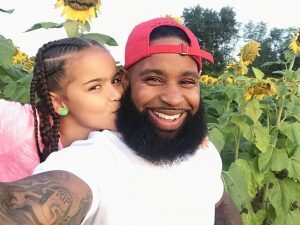
Photo courtesy of Wesley Hamilton
Hamilton became a better man — and a better father — when he stopped feeling sorry for himself and embraced a positive attitude, he said.
With a past rooted in a rough childhood growing up in east Kansas City, where he said people have difficulty seeing the possibilities that lie ahead of them, being shot could have been the end. At times, he wasn’t even sure if he wanted to live, he said.
“I was negative my whole life because I didn’t know what opportunity really meant. I was negative when I got in a wheelchair because I thought that I was defeated,” Hamilton said. “Now, with a different mentality and a positive attitude, I am free and I am happy every day.”
His daughter kept him going, he said.
“Through the process of finding myself, I realized that getting custody of my daughter before the incident empowered me to become who I am,” Hamilton said. “The bond we have is powerful.”
She motivated him without saying a word, he said. And through Disabled But Not Really, Hamilton wants to inspire those struggling without a Nevaeh in their lives.
“I’m that motivation for people who don’t have a little girl watching,” he said.

Featured Business

2017 Startups to Watch
stats here
Related Posts on Startland News
If you build it, they will come: KC leaders pitch downtown baseball to expats eying a return to home plate
Downtown baseball remains a winning prospect for Kansas City — and the Royals — civic and business leaders told a crowd of former residents who are considering a move back to KC, encouraging them to imagine a homecoming of big league proportions. “I think everyone agrees that Major League Baseball is a downtown sport,” Jon Stephens,…

Historic Troost space getting restocked; long-vacant Safeway next on Screenland’s grocery list
A one-story, long-empty, red brick building on Troost is now on the National Register of Historic Places — and set for new uses that reflect the modern-first vision behind its original construction. Redevelopers from Screenland Real Estate Services said the space at 3740 Troost Ave. was one of the first — if not the first…

This beloved family chicken chain is dropping its first new location in decades; Go for its G-Sauce in 2025
Kansas City’s longtime favorite Go Chicken Go is expanding to the Northland — its first new location in nearly 25 years. The hometown staple — a family-owned, third generation business based in Overland Park — is taking over the former Taco Bueno freestanding building at 380 N.E. Vivion Road, for an early 2025 opening. The new…
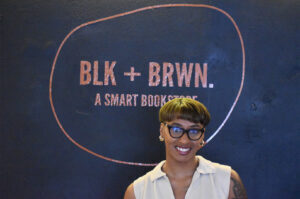
BLK + BRWN owner calls on funders to co-author bookstore’s story of activism for silenced narratives
A recently launched crowdfunding campaign to help BLK + BRWN make rent could mean the difference between access and censorship for the community served by the indie bookstore, said Cori Smith. “This is my flavor of activism,” Smith said of BLK + BRWN, the 39th Street business she describes as both a passion project and…