

Survey: KC small businesses lack action on diversity, inclusion efforts
August 10, 2017 | Meghan LeVota

For many small business people and entrepreneurs, working outside the corporate world has its perks.
Some like the nimble nature of a small team, as well as the death of the cubicle. Others appreciate the adrenaline that comes with taking risks.
Aside from the benefits, a recent study suggests that smaller businesses in Kansas City might fare worse than corporations when it comes to diversity and inclusion.
It’s partly because smaller businesses often have fewer resources, said Michael Gonzales, chair of Kansas City Chamber of Commerce diversity and inclusion and director of diversity and inclusion at Hallmark Cards.
“What I think happens a lot of times with companies is they focus on the bottom line,” Gonzales said. “When diversity and inclusion is perceived as merely an altruistic initiative, and not a business enhancement, it can fall by the wayside. For small companies, they have to prioritize things that will keep them in business tomorrow. Typically, that is revenue generation.”

Michael Gonzales
Conducted by the KC Chamber of Commerce, the first annual Regional Diversity and Inclusion Best Practices Survey for Kansas City was released this month. Sponsored by Hallmark Cards, KCP&L and others, the report surveyed hundreds of Kansas City businesses, both large and small.
The survey concluded that 38 percent of small businesses have a formal commitment to diversity and inclusion or have implemented a strategic plan, compared to 83 percent of large companies. Small businesses are defined as companies with fewer than 100 employees.
Among the report’s findings: Smaller businesses fared worse in almost every category. Only 57 percent of small businesses surveyed support diversity and inclusion activities, compared to 78 percent at large organizations.
The survey also outlines the ways businesses promote diversity and inclusion: recruitment, hiring, professional development, promotion, retention and celebrations. For each activity, small businesses surveyed were less likely to take part.
Entrepreneur Quest Taylor said although these survey results are concerning, it is important to differentiate “talk” and “action” when it comes to diversity and inclusion.

Quest Taylor
“It’s one thing to put it on paper,” Taylor, founder of minority incubator Project United Knowledge, said. “Having a commitment to diversity and inclusion is much different than action.”
Although officials at Kansas City corporations might say they have a higher commitment to diversity and inclusion, Taylor said, formal policies are “meaningless” unless they are reflected in the makeup of C-Suite and senior leadership teams.
For about 40 percent of companies, just 1 to 25 percent of senior management teams and boards consist of diverse individuals, according to the chamber report. Another 25 percent of companies said that less than 50 percent of their leadership is diverse.
“This is how you distinguish between talk and action — the numbers,” Taylor said. “The numbers don’t lie. If you take a look at their board and see someone who isn’t white, or if you visit their firm and see a black person who isn’t a janitor, that’s how you know the company actually cares.”
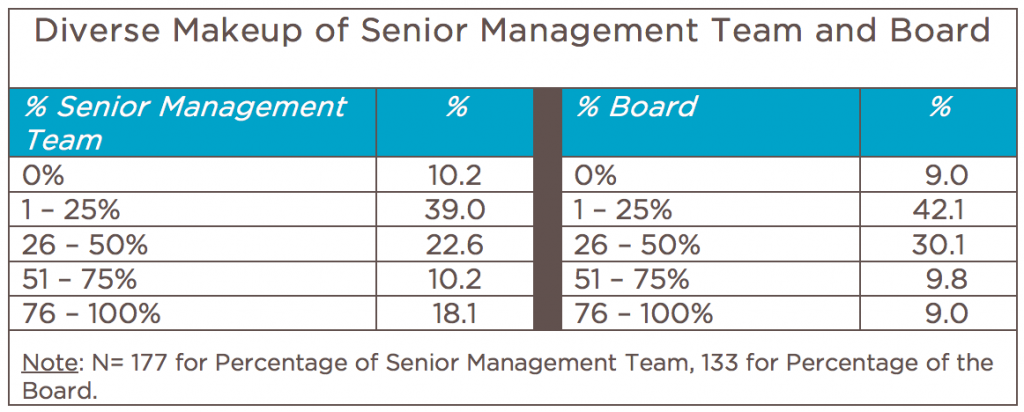
Source: Greater Kansas City Chamber of Commerce
The report defines diverse individuals as those who are a minority in regard to race, ethnicity, gender, sexual orientation, age or veteran status. Taylor hopes future reports include a deeper look at the intersectionality of diverse groups in Kansas City, he said.
“It would be interesting to see what that number would be if you were to remove white women,” Taylor said. “Because diversity is more than just a few white women.”
Gonzales agreed that a breakdown of diversity by race, gender and sexual orientation might be a good idea. As a member of the committee that put together the chamber report, he said the results will serve as a benchmark in future years, as the chamber plans to ramp up its diversity and inclusion activity.
“We thought the report was a great idea,” Gonzales said. “Rather than us assuming or having our own agenda on what would be good for the community, a survey will help us better understand how well our organizations and businesses are doing here in Kansas City.”
Gonzales wishes more businesses had participated in the survey, he said, making an assumption that some did not complete it because they did not know if they would fare well. Malicious behavior is not equality’s main obstacle, it’s ignorance, he said.
“I don’t think the apprehension comes from a lack of value of diversity and inclusion,” Gonzales said. “There is no malice, they just don’t understand it, so it is hard for them to appreciate the value. To me, diversity and inclusion is the sole of a corporation or organization, and it is hard to qualify that. It is hard for people to appreciate an intangible thing.”
Kansas City business leaders ought to be curious about minority communities and willing to have uncomfortable conversations, without being disingenuous, Gonzales said.
Taylor agreed, adding that one-way small business owners and leadership teams can be more proactive about diversity and inclusion is by exposing themselves to different communities.
“We have to have uncomfortable conversations in order to move forward,” Taylor said. “You’ll have to be very humble about it, but I would recommend to anyone who really wants to understand minority business owners to actually strike up a conversation.
Thanks to their innovative mindset, Taylor said he believes the startup community has the potential to move the diversity and inclusion needle.
“Remember, startups are a completely different beast compared to small businesses,” Taylor said. “It would be nice to see those numbers go up once we get the Kansas City startup community on board.”
Gonzales added that although businesses have no problem touting diversity and inclusion during good times, firms ought to remember to stick to their values when times are tough.
“If you are starting a company, the only thing that will get you through the lean times is your culture,” Gonzales said. “Diversity isn’t the future. Diversity is now. Startups serve a diverse clientele. Diversity of thought and ideas is the cultural foundation that will get businesses through those lean times.”
To read the full survey, click here.
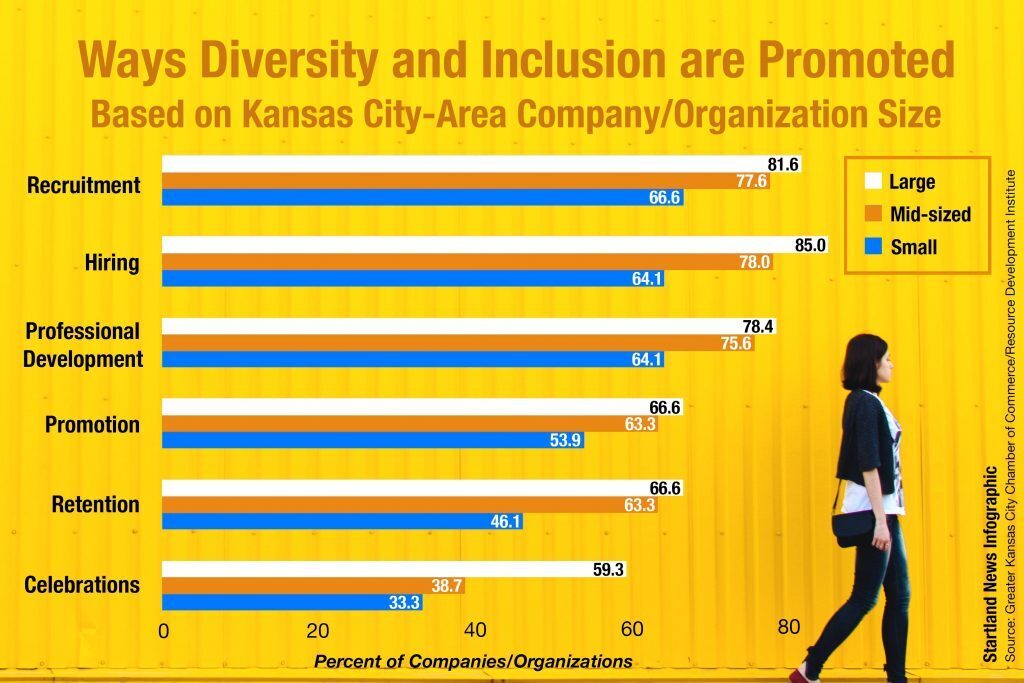
graphic by Tommy Felts

Featured Business

2017 Startups to Watch
stats here
Related Posts on Startland News

KC Daiquiri Shop closing Dec. 1; iconic duo behind the party vibes plans to ‘regroup, reflect, and rebuild’
The good times roll through the weekend at KC Daiquiri Shop as the well-known Mardi Gras-themed getaway on Grand Boulevard shuts down its years-long revelry. “This decision has not come lightly,” Kinley Strickland and Calvin Vick, owners of KC Daiquiri Shop, said Monday in a social media post announcing the business’ plans to close Dec.…

Side hustle to help autistic adults belong in the workplace earns young founder Student Entrepreneur of the Year honor
Grace Kertz is redefining what workplace inclusivity can look like with Sensory Sync, an AI-powered platform designed to support neurodivergent employees. Her work on the innovative venture on Thursday earned her the title of UMKC Student Entrepreneur of the Year. “Sensory sync is an enterprise grade DEI and wellness platform sold to companies. It utilizes…

UMKC Entrepreneur of the Year: How Populous designed a legacy, built to go global
Kansas City-built design firm Populous brought to reality more than just great venues, Tom Bloch shared; it developed great experiences for a worldwide audience. “From its start here in Kansas City as HOK Sport in 1983 until now, Populous has set an unmatched standard for stadiums, convention centers, and event spaces,” Bloch told the crowd…
Black Ambition fund’s $50K gives KC healthech startup the ‘jet fuel we need to propel into 2025’
An initiative led by musician-turned-philanthropist Pharrell Williams to help close the opportunity and wealth gap for Black and Hispanic entrepreneurs has selected Kansas City-based AskSAMIE for its latest cohort of funding, training and mentorship. Through the just-announced Black Ambition cohort, 30 founders are receiving awards between $25,000 and $1 million, totalling $2.7 million. AskSAMIE earned…